Moret
CertiK reviewed Moret on 22 Sep 2022: 19 findings, 0 critical; 9 marked fixed, 10 open.
Report hosted on skynet.certik.com.
Trustblock does not review code.
Findings19
Statuses are the security firm’s own, from its report.
| Severity | Open | Acknowledged | Fixed |
|---|---|---|---|
| Critical | 0 | 0 | 0 |
| High | 2 | 0 | 0 |
| Medium | 0 | 0 | 1 |
| Low | 8 | 0 | 8 |
HighCentralization RisksOpen
In the contract `Moret` the role `_owner` has authority over the functions shown in the diagram below. Any compromise to the `_owner` account may allow the hacker to take advantage of this authority and withdraw pool tokens, set the protocol fee, modify protocol recipient, etc. 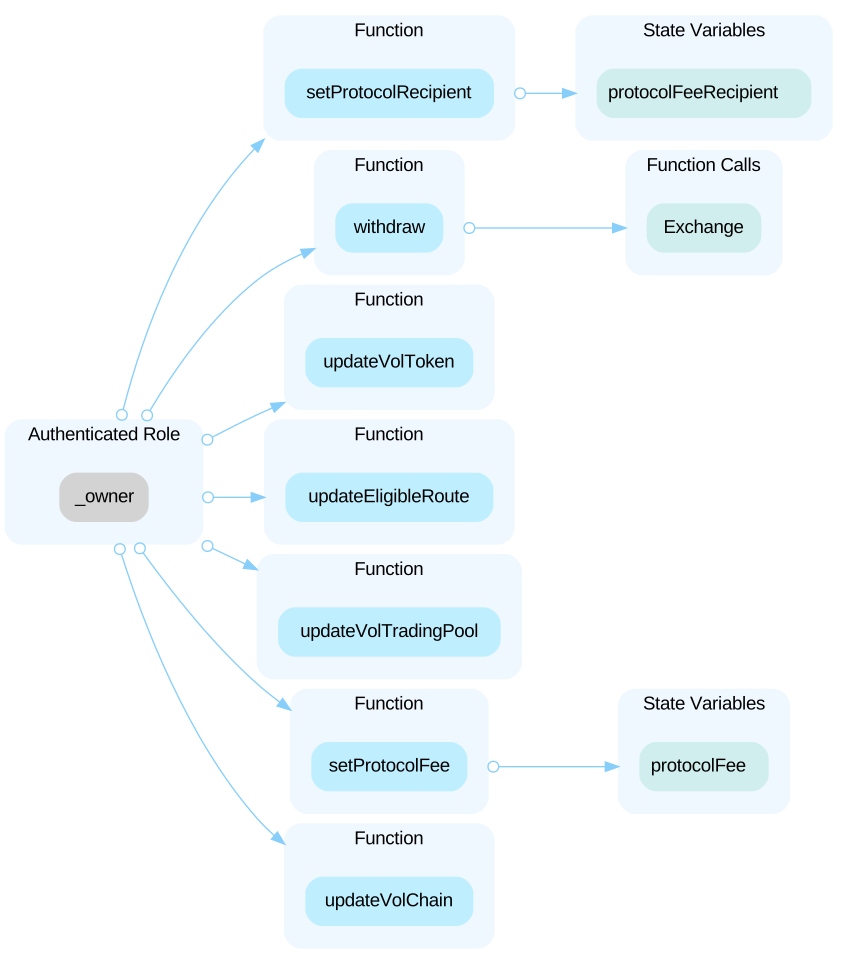 Furthermore, the role `broker` has authority over the `mint()` function. Any compromise to the `broker` address may allow the hacker to take advantage of this authority and mint any amount of tokens. In the contract `MarketMaker` the role `hedgingBot` has authority over the functions shown in the diagram below. Any compromise to the `hedgingBot` account may allow the hacker to take advantage of this authority and trade swaps/loans and modify loan interest. 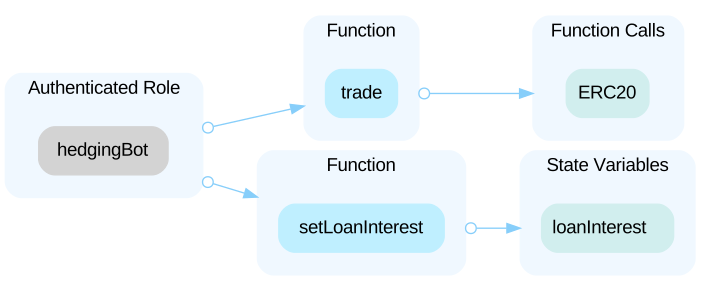 Furthermore, the role `exchange` has authority over the `settlePayment()` function. Any compromise to the `exchange` address may allow the hacker to take advantage of this authority and send option payouts. In the contract `Pool` the role `exchange` has authority over the functions shown in the diagram below. Any compromise to the `exchange` account may allow the hacker to take advantage of this authority and mint and burn Pool tokens. 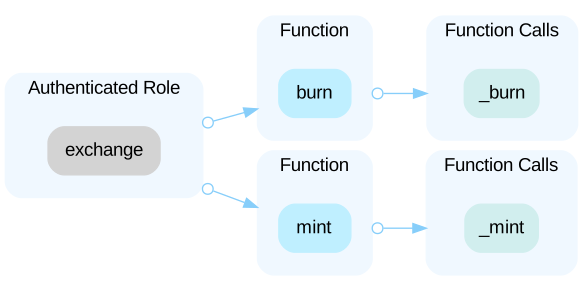 Furthermore, the role `_owner` has authority over the function `setPoolParameters()`. Any compromise to the `_owner` account may allow the hacker to take advantage of this authority and update some of the parameters of the contract. In the contract `Migrations` the role `owner` has authority over the function `setCompleted()`. Any compromise to the `owner` account may allow the hacker to take advantage of this authority and change the value of the last completed migration. In the contract `OptionVault` the role `EXCHANGE` has authority over the functions `addOption()`, `stampActiveOption()` and `stampExpiredOption()`. Any compromise to the `EXCHANGE` account may allow the hacker to take advantage of this authority and add new option contracts, stamp option as an active contract and stamp option as an expired contract. In the contract `VolatilityChain` the role `_owner` has authority over the functions shown in the diagram below. Any compromise to the `_owner` account may allow the hacker to take advantage of this authority and reset volatility parameters and remove tenors. 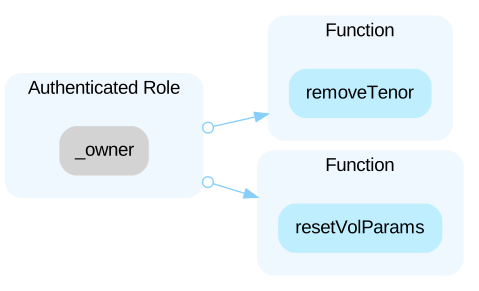 Furthermore, the role `UPDATE_ROLE` has authority over the function `update()`. Any compromise to the `UPDATE_ROLE` account may allow the hacker to take advantage of this authority and update volatility. In the contract `VolatilityToken` the role `EXCHANGE` has authority over the functions `mint()`, `burn()` and `pay()`. Any compromise to the `EXCHANGE` account may allow the hacker to take advantage of this authority and mint and burn as much tokens as they wanted.
HighInitial Token DistributionOpen
Tokens are sent to deployer when deploying the contract. This could be a centralization risk as the deployer can distribute tokens without obtaining the consensus of the community.
LowAmbiguous Error Messages and EventsOpen
The highlighted error messages do not describe the error correctly.
LowCommented Out CodeOpen
Commented out code is redundant.
LowMissing Error MessagesOpen
The **require** can be used to check for conditions and throw an exception if the condition is not met. It is better to provide a string message containing details about the error that will be passed back to the caller.
LowThird Party DependencyOpen
The contract is serving as the underlying entity to interact with one or more third party protocols. The scope of the audit treats third party entities as black boxes and assume their functional correctness. However, in the real world, third parties can be compromised and this may lead to lost or stolen assets. In addition, upgrades of third parties can possibly create severe impacts, such as increasing fees of third parties, migrating to new LP pools, etc. - The contract `VolatilityChain` interacts with third party contract with `AggregatorV3Interface` interface via `priceInterface`. ```solidity=21 AggregatorV3Interface internal priceInterface; ```
LowUnchecked Value of ERC-20 `transfer()`/`transferFOpen
The linked `transfer()`/`transferFrom()` invocations do not check the return value of the function call which should yield a `true` result in case of a proper ERC-20 implementation.
LowUninitialized State VariableOpen
One or more state variables are used without being initialized in the constructor. ```solidity=27 mapping(uint256=>EnumerableSet.UintSet) internal latestBookTimeSet; ``` - `latestBookTimeSet` is never initialized, but used in `VolatilityChain.update()`.
LowUnlocked Compiler VersionOpen
The contract has unlocked compiler version. An unlocked compiler version in the source code of the contract permits the user to compile it at or above a particular version. This, in turn, leads to differences in the generated bytecode between compilations due to differing compiler version numbers. This can lead to an ambiguity when debugging as compiler specific bugs may occur in the codebase that would be hard to identify over a span of multiple compiler versions rather than a specific one.
LowVariables That Could Be Declared as `constant`Open
The linked variables could be declared as `constant` since these state variables are never modified.
Contracts in scope
No deployed address is recorded for this audit.
The report names a repository or files. Open the report to see its scope.
Repository and files the report names (16)
- contracts/libraries/MarketLib.sol
- contracts/libraries/OptionLib.sol
- contracts/VolatilityChain.sol
- contracts/pools/PoolFactory.sol
- contracts/governance/Moret.sol
- contracts/governance/Govern.sol
- contracts/OptionVault.sol
- contracts/VolatilityToken.sol
- contracts/pools/Pool.sol
- contracts/libraries/MathLib.sol
- contracts/pools/MarketMaker.sol
- contracts/pools/PoolGovernorFactory.sol
- contracts/Exchange.sol
- contracts/governance/MoretBroker.sol
- contracts/pools/MarketMakerFactory.sol
- contracts/Migrations.sol
Part of Moret’s security record
 Moret
Security firm
 CertiK
1,045 projects reviewed · 1,376 reports · latest May 2025
See CertiK’s auditsSomething wrong on this page? A missing report, a wrong date, a finding that was fixed since. Tell us and we check it against its source.
Tell us