0x1591e923e0836a3949b59637fbe8959f000894b9
As of 21 Nov 2026, Trustblock’s record holds 0x1591e923e0836a3949b59637fbe8959f000894b9 on BNB Chain as a contract of Multi AI. 1 audit report on Trustblock lists this address: CertiK, 25 Aug 2023. 9 findings in it are recorded as open or acknowledged.
Each report’s scope as stored on Trustblock names this address on BNB Chain.
3 High, 6 Low. In the firm’s own words; statuses are the firm’s, from each report.
In the contract `MAI` the role `_owner` has authority over the functions shown in the diagram below. 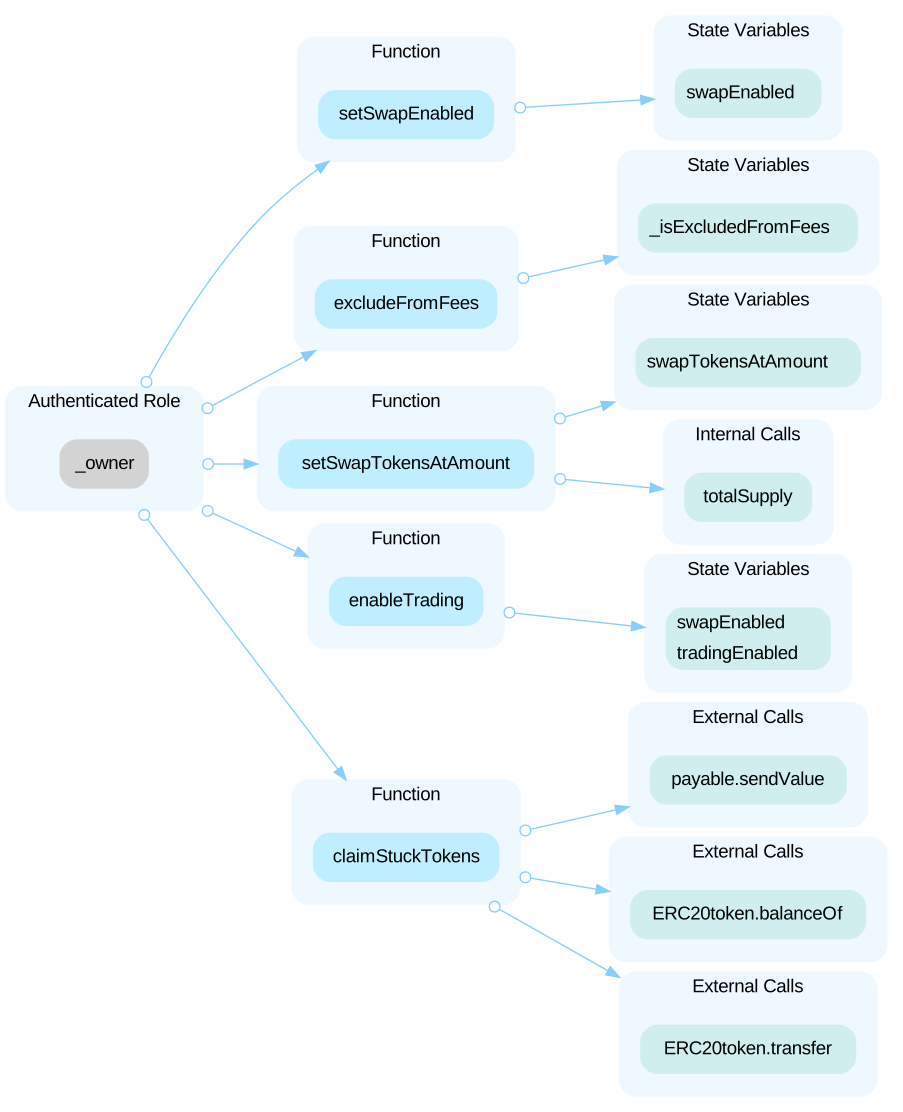 - `claimStuckTokens(address token)`: Enables the owner to claim tokens that get stuck in the contract. Only the owner can call this function. - `excludeFromFees(address account, bool excluded)`: Lets the owner exclude or include an account from fees. Only the owner can call this function. - `enableTrading()`: Allows the owner to enable trading. Only the owner can call this function. - `setSwapEnabled(bool _enabled)`: Lets the owner set the state of the swap. Only the owner can call this function. - `setSwapTokensAtAmount(uint256 newAmount)`: Enables the owner to set the amount of tokens at which the swap occurs. Only the owner can call this function. In the contract `Ownable` the role `_owner` has authority over the functions shown in the diagram below. 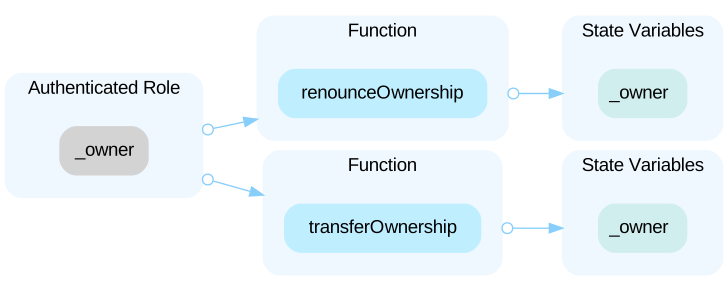 - `renounceOwnership()`: Allows the current owner to renounce ownership of the contract. Only the owner can call this function. - `transferOwnership(address newOwner)`: Allows the current owner to transfer ownership of the contract to a new address. Only the owner can call this function. Any compromise to the `_owner` account may allow the hacker to take advantage of this authority and update the sensitive settings and execute sensitive functionalities of the project
The audit on Trustblock · Open the reportAll `1e8 * (10 ** decimals())` of the `MAI` tokens are sent to the contract deployer or one or several externally-owned account (EOA) addresses. This is a centralization risk because the deployer or the owner(s) of the EOAs can distribute tokens without obtaining the consensus of the community. Any compromise to these addresses may allow a hacker to steal and sell tokens on the market, resulting in severe damage to the project.
The audit on Trustblock · Open the reportThe `swapAndSendMarketing` function calls the `uniswapV2Router.swapExactTokensForETHSupportingFeeOnTransferTokens()` function to swap the MAI tokens to BNB/ETH and send the BNB/ETH to the `address(this)` address. As a result, over time the `marketingWallet`, `developmentWallet` and `teamWallet` addresses will accumulate a significant portion BNB/ETH. For the common deflationary token, the entire tokenomic requires certain liquidity to support. However, in the current implementation, the swapped BNB is transferred to the predefined addresses and is not being used for adding liquidity. Therefore, the entire tokenomic may crash due to lacking enough liquidity in the pool.
The audit on Trustblock · Open the reportThere should be a check to ensure `recipient != msg.sender` to avoid users' transferring to themselves.
The audit on Trustblock · Open the reportIf `value == 0`, the operation will do nothing but waste gas.
The audit on Trustblock · Open the reportA sandwich attack may happen when an attacker observes a transaction swapping tokens or adding liquidity without setting restrictions on slippage or minimum output amount. The attacker can manipulate the exchange rate by frontrunning (executing before the target) a transaction to purchase one of the assets and make profits by backrunning (executing after the target) a transaction to sell the asset. The following function is called without setting restrictions on slippage or minimum output amount, so transactions triggering these functions are vulnerable to sandwich attacks, especially when the input amount is large: - `IUniswapV2Router02.swapExactTokensForETHSupportingFeeOnTransferTokens`
The audit on Trustblock · Open the reportThe return values of the `transfer()` and `transferFrom()` calls in the smart contract are not checked. Some ERC-20 tokens' transfer functions return no values, while others return a bool value, they should be handled with care. If a function returns `false` instead of reverting upon failure, an unchecked failed transfer could be mistakenly considered successful in the contract. ```solidity=639 ERC20token.transfer(msg.sender, balance); ```
The audit on Trustblock · Open the reportThe smart contract does not check or store the return value of an external call in a local or state variable, which may introduce vulnerabilities due to the unhandled outcome. ```solidity=634 payable(msg.sender).sendValue(address(this).balance); ``` --- ```solidity=736 payable(marketingWallet).sendValue(oneThird); ``` --- ```solidity=737 payable(developmentWallet).sendValue(oneThird); ``` --- ```solidity=738 payable(teamWallet).sendValue(address(this).balance - initialBalance); ```
The audit on Trustblock · Open the reportThe linked variables assigned in the constructor can be declared as `immutable`. Immutable state variables can be assigned during contract creation but will remain constant throughout the lifetime of a deployed contract. A big advantage of immutable variables is that reading them is significantly cheaper than reading from regular state variables since they will not be stored in storage.
The audit on Trustblock · Open the reportThe Multi AI security record · Every Multi AI address · This address on the explorer