0x4e2434294a722329b6b64e0c2fca51b2533d7015
As of 21 Nov 2026, Trustblock’s record holds 0x4e2434294a722329b6b64e0c2fca51b2533d7015 on BNB Chain as a contract of PEPE FLOKI. 1 audit report on Trustblock lists this address: CertiK, 12 May 2023. 11 findings in it are recorded as open or acknowledged.
Each report’s scope as stored on Trustblock names this address on BNB Chain.
3 High, 8 Low. In the firm’s own words; statuses are the firm’s, from each report.
In the contract `Ownable` the role `_owner` has authority over the functions shown in the diagram below. 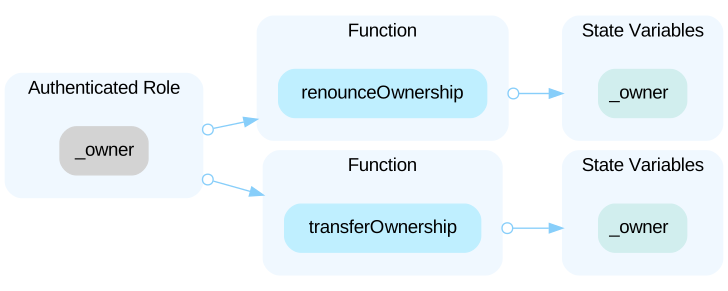 Any compromise to the `_owner` account may allow the hacker to take advantage of this authority and renounce/transfer ownership to the other address. --- In the contract `PEPEFLOKI` the role `_owner` has authority over the functions shown in the diagram below. 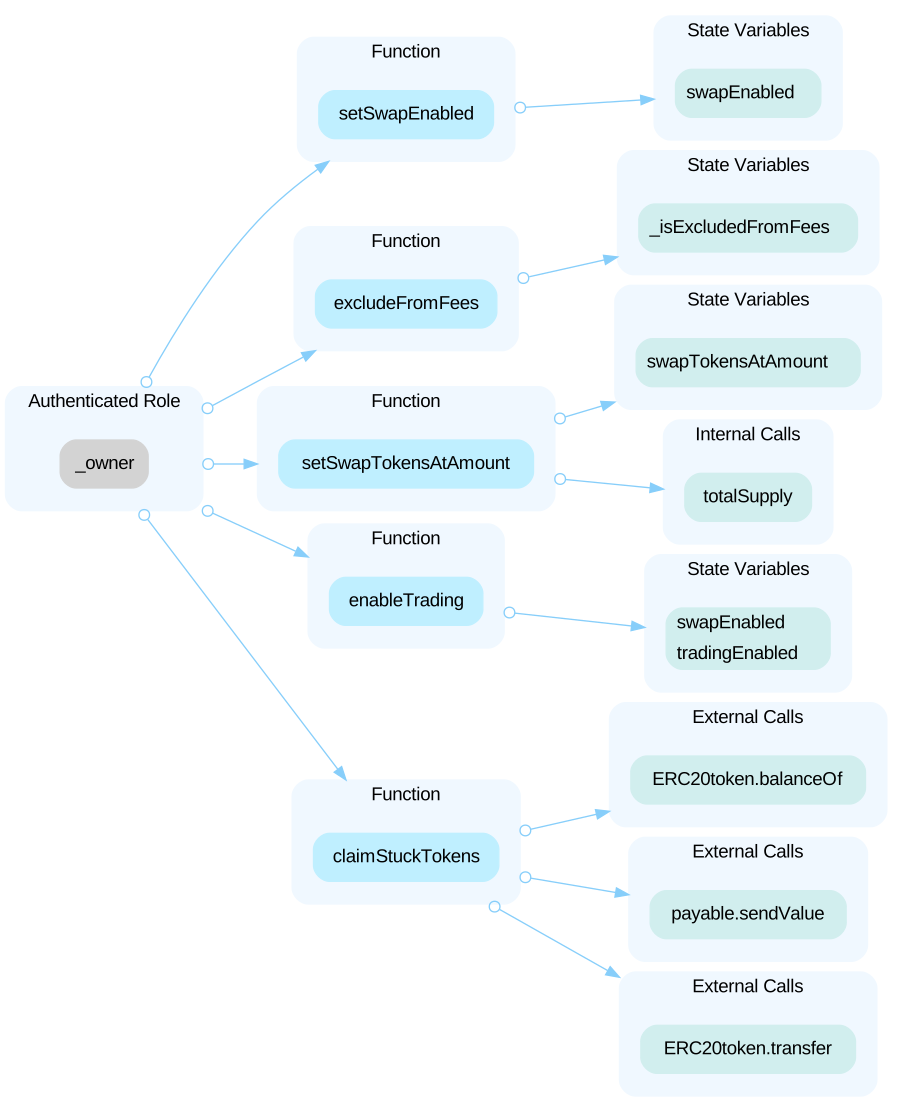 - `claimStuckTokens()`: Claims stuck tokens in the contract, can only be called by the contract owner. - `excludeFromFees()`: Excludes or includes an account from fees, can only be called by the contract owner. - `enableTrading()`: Enables trading for the token, can only be called by the contract owner. - `setSwapEnabled()`: Sets the swapEnabled state, can only be called by the contract owner. - `setSwapTokensAtAmount()`: Sets the number of tokens to be swapped at once, can only be called by the contract owner. Any compromise to the `_owner` account may allow the hacker to take advantage of this authority and update the sensitive settings and execute sensitive functions of the project.
The audit on Trustblock · Open the reportAll **PEPEF** tokens are sent to the contract deployer when deploying the contract. This is a potential centralization risk as the deployer can distribute **PEPEF** tokens without the consensus of the community.
The audit on Trustblock · Open the report```solidity=698 function swapAndSendMarketing(uint256 tokenAmount) private { uint256 initialBalance = address(this).balance; address[] memory path = new address[](2); path[0] = address(this); path[1] = uniswapV2Router.WETH(); uniswapV2Router.swapExactTokensForETHSupportingFeeOnTransferTokens( tokenAmount, 0, path, address(this), block.timestamp); uint256 newBalance = address(this).balance - initialBalance; payable(marketingWallet).sendValue(newBalance); emit SwapAndSendMarketing(tokenAmount, newBalance); } ``` The `swapAndSendMarketing()` function calls the `uniswapV2Router.swapExactTokensForETHSupportingFeeOnTransferTokens()` function to swap the `PEPEF` tokens to BNB and send the BNB to the `marketingWallet` address. As a result, over time the `marketingWallet` address will accumulate a significant portion BNB. If the `marketingWallet` is an EOA (Externally Owned Account), the mishandling of its private key can have devastating consequences for the project as a whole. For the common deflationary token, the entire tokenomic requires certain liquidity to support. However, in the current implementation, the swapped BNB is transferred to `marketingWallet` and is not being used for adding liquidity. Therefore, the entire tokenomic may crash due to lacking enough liquidity in the BNB-PEPEF pool.
The audit on Trustblock · Open the reportThere should always be events emitted in the sensitive functions that are controlled by centralization roles. Specifically: - `enableTrading()` does not emit an event when is executed. - `claimStuckTokens()` emits an event only when `ERC20token.transfer()` is executed. No event is emitted when BNB is withdrawn from the contract.
The audit on Trustblock · Open the reportWhen the contract is deployed the following addresses are exempted from fees: - the current `owner` - the current `marketingWallet` If ownership is transferred or renounced with `transferOwnership()` or `renounceOwnership()`, the exemptions are not granted to the new owner nor are they revoked from the previous owner. Also if `marketingWallet` is updated with `changeMarketingWallet()` the exemptions are not granted to the new marketing wallet nor are they revoked from the previous marketing address.
The audit on Trustblock · Open the reportState variables that never change should be declared as `constant` to save gas. ```solidity=549 string public creator; ``` - `creator` should be declared `constant`.
The audit on Trustblock · Open the reportThe return values of the `transfer()` and `transferFrom()` calls in the smart contract are not checked. Some ERC-20 tokens' transfer functions return no values, while others return a bool value, they should be handled with care. If a function returns `false` instead of reverting upon failure, an unchecked failed transfer could be mistakenly considered successful in the contract. ```solidity=617 ERC20token.transfer(msg.sender, balance); ```
The audit on Trustblock · Open the report```solidity=20 interface IUniswapV2Pair { ``` - `IUniswapV2Pair` is declared but never used.
The audit on Trustblock · Open the reportThe smart contract does not check or store the return value of an external call in a local or state variable, which may introduce vulnerabilities due to the unhandled outcome. ```solidity=612 payable(msg.sender).sendValue(address(this).balance); ``` --- ```solidity=714 payable(marketingWallet).sendValue(newBalance); ```
The audit on Trustblock · Open the report- `address public uniswapV2Pair;` - `uint256 public marketingFeeOnBuy;` - `uint256 public marketingFeeOnSell;` - `address public marketingWallet;` The above variables assigned in the constructor can be declared as `immutable`. Immutable state variables can be assigned during contract creation but will remain constant throughout the lifetime of a deployed contract. A big advantage of immutable variables is that reading them is significantly cheaper than reading from regular state variables since they will not be stored in storage.
The audit on Trustblock · Open the reportThe PEPE FLOKI security record · Every PEPE FLOKI address · This address on the explorer