0x7082ff3a22e707136c80a9efcb215ec4c1fda810
As of 21 Nov 2026, Trustblock’s record holds 0x7082ff3a22e707136c80a9efcb215ec4c1fda810 on BNB Chain as a contract of Metathings. 1 audit report on Trustblock lists this address: CertiK, 27 Jan 2023. 12 findings in it are recorded as open or acknowledged.
Each report’s scope as stored on Trustblock names this address on BNB Chain.
3 High, 9 Low. In the firm’s own words; statuses are the firm’s, from each report.
In the contract `AntiBotLiquidityGeneratorToken` the role `_owner` has authority over the functions shown in the diagram below. Any compromise to the `_owner` account may allow the hacker to take advantage of this authority and update the sensitive settings and execute sensitive functions of the project. 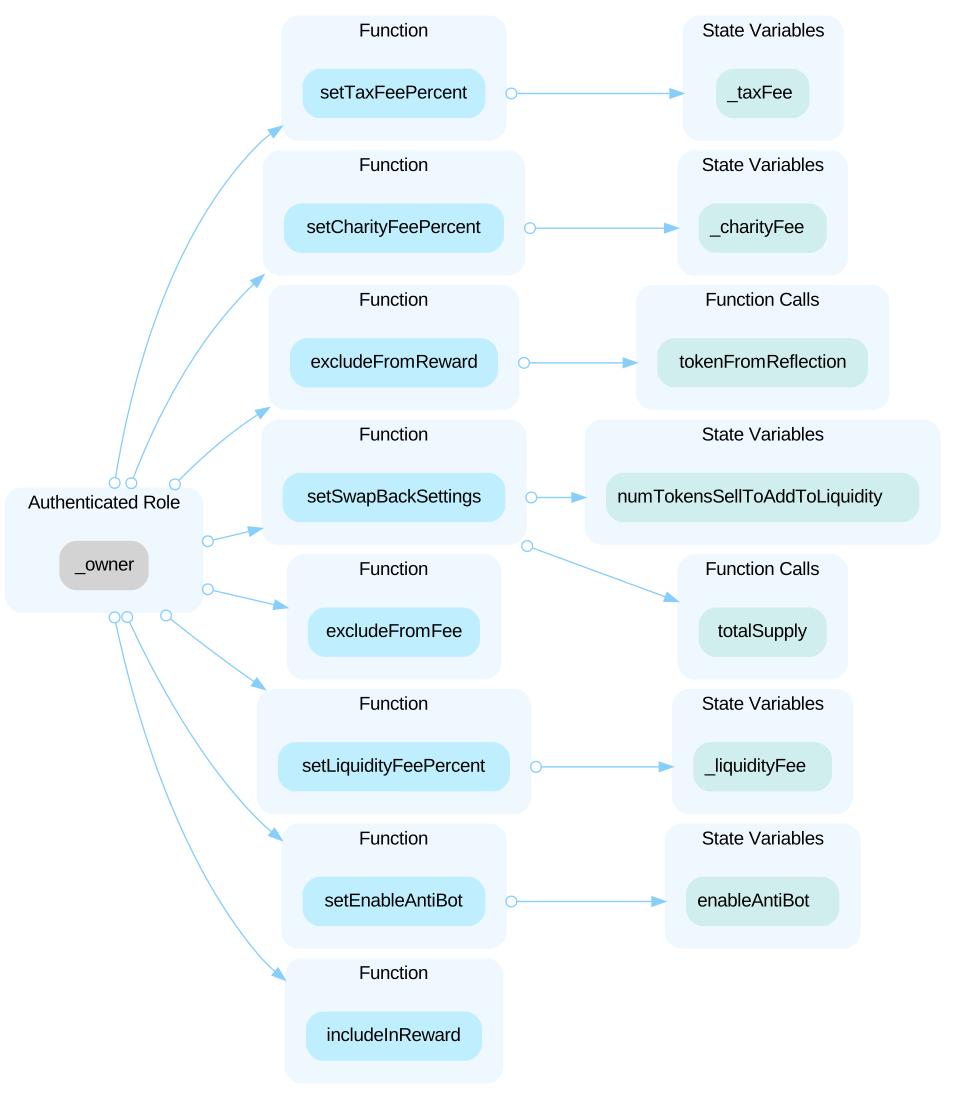
The audit on Trustblock · Open the reportThe `swapAndLiquify` function converts half of the `contractTokenBalance` METT tokens to BNB. The other half of METT tokens and part of the converted BNB are deposited into the METT-BNB pool on uniswap as liquidity. For every `swapAndLiquify` function call, a small amount of BNB leftover in the contract. This is because the price of METT drops after swapping the first half of METT tokens into BNBs, and the other half of METT tokens require less than the converted BNB to be paired with it when adding liquidity. The contract doesn't appear to provide a way to withdraw those BNB, and they will be locked in the contract forever.
The audit on Trustblock · Open the reportAll of the `METT` tokens are sent to the contract deployer when deploying the contract. This could be a centralization risk as the deployer can distribute all tokens without obtaining the consensus of the community.
The audit on Trustblock · Open the reportThe error message in `require(_isExcluded[account], "Account is already excluded")` does not describe the error correctly.
The audit on Trustblock · Open the reportThere should always be events emitted in the sensitive functions that are controlled by centralization roles.
The audit on Trustblock · Open the reportAddresses should be checked before assignment or external call to make sure they are not zero addresses. ```solidity=1065 payable(serviceFeeReceiver_).transfer(serviceFee_); ``` - `serviceFeeReceiver_` is not zero-checked before being used.
The audit on Trustblock · Open the reportTo the best of understanding, the reward of a specific account should stop accumulating while in the range of being excluded from reward after calling `excludeFromReward()`. In L1218, the current `_tOwned` balance of the `account` is recorded and any reward starting from this point should not be accumulated after calling the function `excludeFromReward()`. However, when calling the function `includeInReward()` to include the excluded `account` for reward, `_rOwned` should be calculated with current `_tOwned` value.
The audit on Trustblock · Open the reportThe condition `!_isExcluded[sender] && !_isExcluded[recipient]` can be included in `else` .
The audit on Trustblock · Open the reportThe function `deliver()` can be called by anyone. It accepts an uint256 number parameter `tAmount`. The function reduces the METT token balance of the caller by `rAmount`, which is `tAmount` reduces the transaction fee. Then, the function adds `tAmount` to variable `_tFeeTotal`, which represents the contract's total transaction fee. We wish the team could explain more on the purpose of having such functionality.
The audit on Trustblock · Open the reportThe method `onPreTransferCheck` in `pinkAntiBot` is unknown implementation. ```solidity=1493 if (enableAntiBot) { pinkAntiBot.onPreTransferCheck(from, to, amount); } ``` The scope of the audit treats 3rd party entities as black boxes and assumes their functional correctness. However, in the real world, 3rd parties can be compromised and this may lead to lost or stolen assets. In addition, upgrades of 3rd parties can possibly create severe impacts, such as increasing fees of 3rd parties, migrating to new LP pools, etc.
The audit on Trustblock · Open the reportThe return value of an external call is not stored in a local or state variable. ```solidity=1574 uniswapV2Router.addLiquidityETH{value: ethAmount}( address(this), tokenAmount, 0, // slippage is unavoidable 0, // slippage is unavoidable address(0xdead), block.timestamp ); ```
The audit on Trustblock · Open the reportThe linked variables assigned in the constructor can be declared as `immutable`. Immutable state variables can be assigned during contract creation but will remain constant throughout the lifetime of a deployed contract. A big advantage of immutable variables is that reading them is significantly cheaper than reading from regular state variables since they will not be stored in storage.
The audit on Trustblock · Open the reportThe Metathings security record · Every Metathings address · This address on the explorer