0x85b1c275af0c4e65dc9f5dbfc9ce52bd007722a6
As of 21 Nov 2026, Trustblock’s record holds 0x85b1c275af0c4e65dc9f5dbfc9ce52bd007722a6 on BNB Chain as a contract of Monbase. 1 audit report on Trustblock lists this address: CertiK, 4 Mar 2024. 12 findings in it are recorded as open or acknowledged.
Each report’s scope as stored on Trustblock names this address on BNB Chain.
| Audit | Security firm | Date | Commit named in the report | Report |
|---|---|---|---|---|
| MonbaseCoin | CertiK | Not recorded (see the report) | Open |
3 High, 2 Medium, 7 Low. In the firm’s own words; statuses are the firm’s, from each report.
In the contract `Ownable`, the role `_owner` has the authority over the following functions: - function `renounceOwnership()`: set the `owner` of current contract to `address(0)`, - function `transferOwnership()`: transfer the `owner` role to any arbitrary addresses. Any compromise to the `_owner` account may allow the hacker to take advantage of this and users' assets may suffer loss. In the contract `ERC20`, the role `_owner` has authority over the functions shown in the diagram below. - function `modifyWhiteListSender()`: add/remove the addresses into/from `whiteListSender(s)` list so that they can be exclude/include from/to fee, - function `modifyWhiteListReceiver()`: add/remove the addresses into/from `whiteListReceiver(s)` list so that they can be exclude/include from/to fee, - function `modifyBlackList()`: add/remove the addresses into/from `blackLists(s)` list so that they are allowed/disallowed to transfer/receive the `OPV` token, - function `setAntiBot()`: set the `antiBotEnabled` flag to block/unblock the token transfer to/from the addresses not in the list `whiteListBot`, - function `transferToken()`: transfer all the assets in the current contract to any arbitrary addresses, - function `modifyWhiteListBot()`: add/remove the addresses into/from `whiteListBot(s)` list, - function `changeFeeWallet()`: change the address `_feeWallet` which will receive all the transaction fees, - function `changeFee()`: change the value of the state variable `_feeTransfer` to update the fee amount, - function `modifyDexPool()`: add/remove the addresses into/from `dexPool(s)` list, - function `setNumTokensSell()/setLimitSell()`: change the value of the state variable `_numTokensSellToAddToLiquidity` and `limitSell` to block the token transfer if the amount is larger than `_numTokensSellToAddToLiquidity` and the flag `limitSell` is true, - function `getDexPool()`: view the `dexPools` list, - function `getWhiteListBot()`: view the `whiteListBots` list, - function `getBlacklist()`: view the `blackLists` list, - function `getWhiteListReceiver()`: view the `whiteListReceivers` list, - function `getWhiteListSender()`: view the `whiteListSenders` list, - function `flush()`: withdraw all types of tokens and or bnb to the owner. 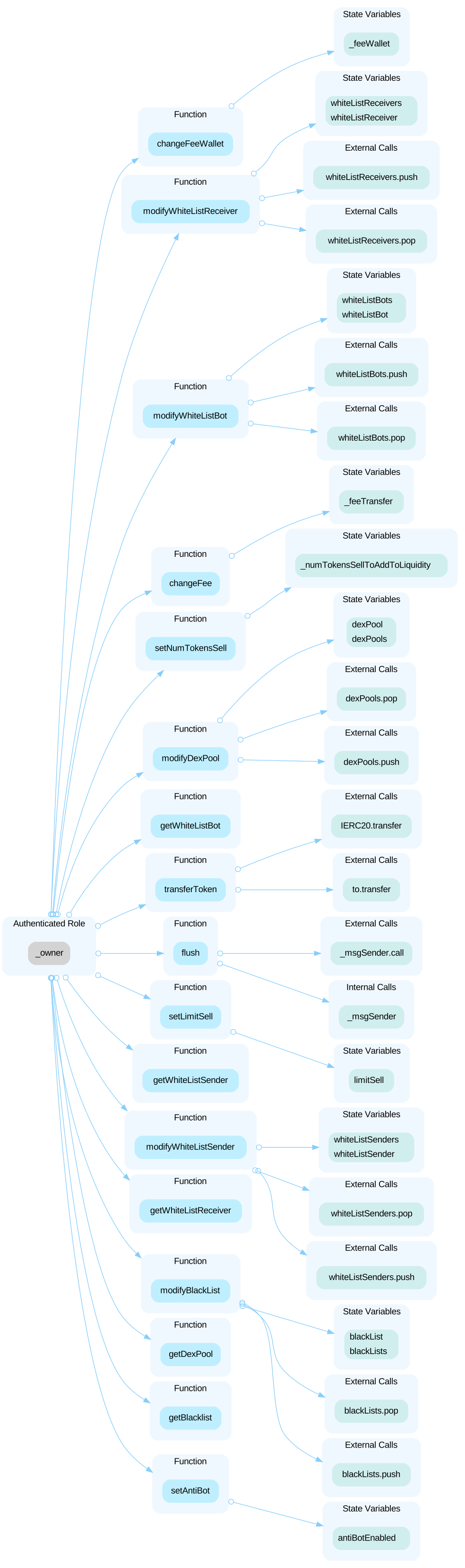 Any compromise to the `_owner` account may allow the hacker to take advantage of this authority.
The audit on Trustblock · Open the reportAll of the `OPV` tokens(`200 * 10**6`) are sent to the contract deployer(owner) when deploying the contract. This could be a centralization risk as the deployer can distribute `OpenLive NFT` tokens without obtaining the consensus of the community.
The audit on Trustblock · Open the reportAccording to the below if statement in the code, if the `_msgSender()` of the function `transferFrom()` is in the list `whiteListSender`, the transaction fee is skipped. Thus, if some users are added to the list `whiteListSender`, they can help other users to transfer tokens and bypass the transaction fee check with the function `transferFrom()`. ```solidity=218 if ( sender != owner() && whiteListSender[_msgSender()] == false && whiteListSender[sender] == false && whiteListReceiver[recipient] == false ) { _transfer(sender, recipient, amountAfterFee); _transfer(sender, _feeWallet, feeTransfer); } ```
The audit on Trustblock · Open the reportThe state variables `_numTokensSellToAddToLiquidity` and `_feeTransfer` do not have reasonable boundaries, so they can be given arbitrary values after deploying. For the variable `_feeTransfer`, if it is changed to 1000, all the transfer amounts will be charged for fees and the receiver will not receive any tokens. If the `_feeTransfer` is larger than 1000, all the transfers will fail because the statement `amount.sub(feeTransfer)` in L155 and L215 will roll back. For the variable `_numTokensSellToAddToLiquidity`, if it is changed to a very small value, the users will be unable to sell OPV tokens to the dex pool because any transfer amount greater than `_numTokensSellToAddToLiquidity` will fail the transaction. Furthermore, the liquidity in the dex pool could be exhausted later and the users will be unable to buy tokens from the dex pool.
The audit on Trustblock · Open the reportThe `if` statement in the function `_transfer()` is a little confusing. The statement from L24 to L28 will only revert the transaction if `antiBotEnabled` is true, and both the `sender` and `recipient` are not in the `whiteListBot` list. This still allows the token transfer from/to addresses not in the `whiteListBot` list as long as the other side of the transaction is in the list. ```solidity=36 if ( !whiteListBot[sender] && !whiteListBot[recipient] && antiBotEnabled ) { revert("Anti Bot"); } ```
The audit on Trustblock · Open the reportThe OPVToken is a deflationary token that charges transaction fees for each transaction between non-whitelisted addresses. Some popular deflationary tokens will automatically add the transaction fees to the liquidity pool or just burn out to be locked forever when selling, e.g., Safemoon. While OPVToken transfers the transaction fees directly to `_feeWallet`, which has no benefits for better liquidity and token price but increases the centralized risks.
The audit on Trustblock · Open the reportOne or more parameters with `memory` data location are never modified in their functions and those functions are never called internally within the contract. Thus, their data location can be changed to `calldata` to avoid the gas consumption copying from calldata to memory. ```solidity=430 function modifyWhiteListSender( ``` `modifyWhiteListSender` has memory location parameters: `newAddr`, `removedAddr`. --- ```solidity=467 function modifyWhiteListReceiver( ``` `modifyWhiteListReceiver` has memory location parameters: `newAddr`, `removedAddr`. --- ```solidity=504 function modifyBlackList( ``` `modifyBlackList` has memory location parameters: `newAddr`, `removedAddr`. --- ```solidity=549 function modifyWhiteListBot( ``` `modifyWhiteListBot` has memory location parameters: `newAddr`, `removedAddr`. --- ```solidity=586 function modifyDexPool( ``` `modifyDexPool` has memory location parameters: `newAddr`, `removedAddr`.
The audit on Trustblock · Open the reportThe `flush()` function in the `ERC20` contract uses `{value:}` structure and is designed to receive native tokens, but the `payable` function is missing in the contract and the `receive` function is also missing, making it impossible to receive native tokens. Although the `receive` function is added to the child contract `OPVToken`, the parent contract will face the above issue if it is deployed standalone.
The audit on Trustblock · Open the reportAddresses are not validated before assignment or external calls, potentially allowing the use of zero addresses and leading to unexpected behavior or vulnerabilities. For example, transferring tokens to a zero address can result in a permanent loss of those tokens. ```solidity=544 return to.transfer(value); ``` - `to` is not zero-checked before being used. --- ```solidity=617 _feeWallet = feeWallet; ``` - `feeWallet` is not zero-checked before being used.
The audit on Trustblock · Open the reportThe change of `owner` by function `transferOwnership()` overrides the previously set `owner` with the new one without guaranteeing the new `owner` has the ability to actuate transactions on-chain.
The audit on Trustblock · Open the reportThe return values of the `transfer()` and `transferFrom()` calls in the smart contract are not checked. Some ERC-20 tokens' transfer functions return no values, while others return a bool value, they should be handled with care. If a function returns `false` instead of reverting upon failure, an unchecked failed transfer could be mistakenly considered successful in the contract. ```solidity=546 IERC20(coinAddress).transfer(to, value); ```
The audit on Trustblock · Open the reportIt is not recommended to use Solidity's `transfer()` and `send()` functions for transferring native tokens, since some contracts may not be able to receive the funds. Those functions forward only a fixed amount of gas (2300 specifically) and the receiving contracts may run out of gas before finishing the transfer. Also, EVM instructions' gas costs may increase in the future. Thus, some contracts that can receive now may stop working in the future due to the gas limitation. ```solidity=544 return to.transfer(value); ``` - `ERC20.transferToken` uses `transfer()`.
The audit on Trustblock · Open the reportThe Monbase security record · Every Monbase address · This address on the explorer