0x92b0e13f1c6bf5696289863ebc49a4f0bce46f3e
As of 21 Nov 2026, Trustblock’s record holds 0x92b0e13f1c6bf5696289863ebc49a4f0bce46f3e on BNB Chain as a contract of Crebit. 1 audit report on Trustblock lists this address: CertiK, 24 May 2024. 7 findings in it are recorded as open or acknowledged.
Each report’s scope as stored on Trustblock names this address on BNB Chain.
2 High, 5 Low. In the firm’s own words; statuses are the firm’s, from each report.
In the contract `Ownable` the role `owner` has authority over the functions shown in the diagram below. 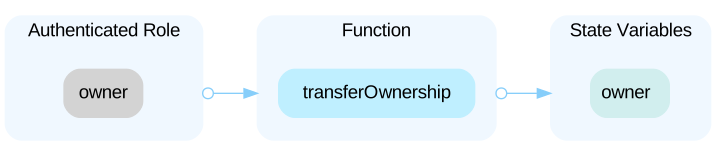 - `transferOwnership(address _newOwner)`: Transfers ownership of the contract to a new owner. Only owner role account can call this function. In the contract `Pausable` the role `owner` has authority over the functions shown in the diagram below. 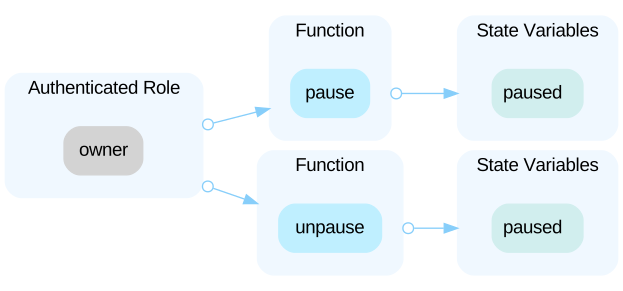 - `pause()`: Pauses all contract functionalities that are restricted by the `whenNotPaused` modifier. Only owner role account can call this function. - `unpause()`: Resumes all contract functionalities that are restricted by the `whenNotPaused` modifier. Only owner role account can call this function. In the contract `TOKEN` the role `owner` has authority over the functions shown in the diagram below. 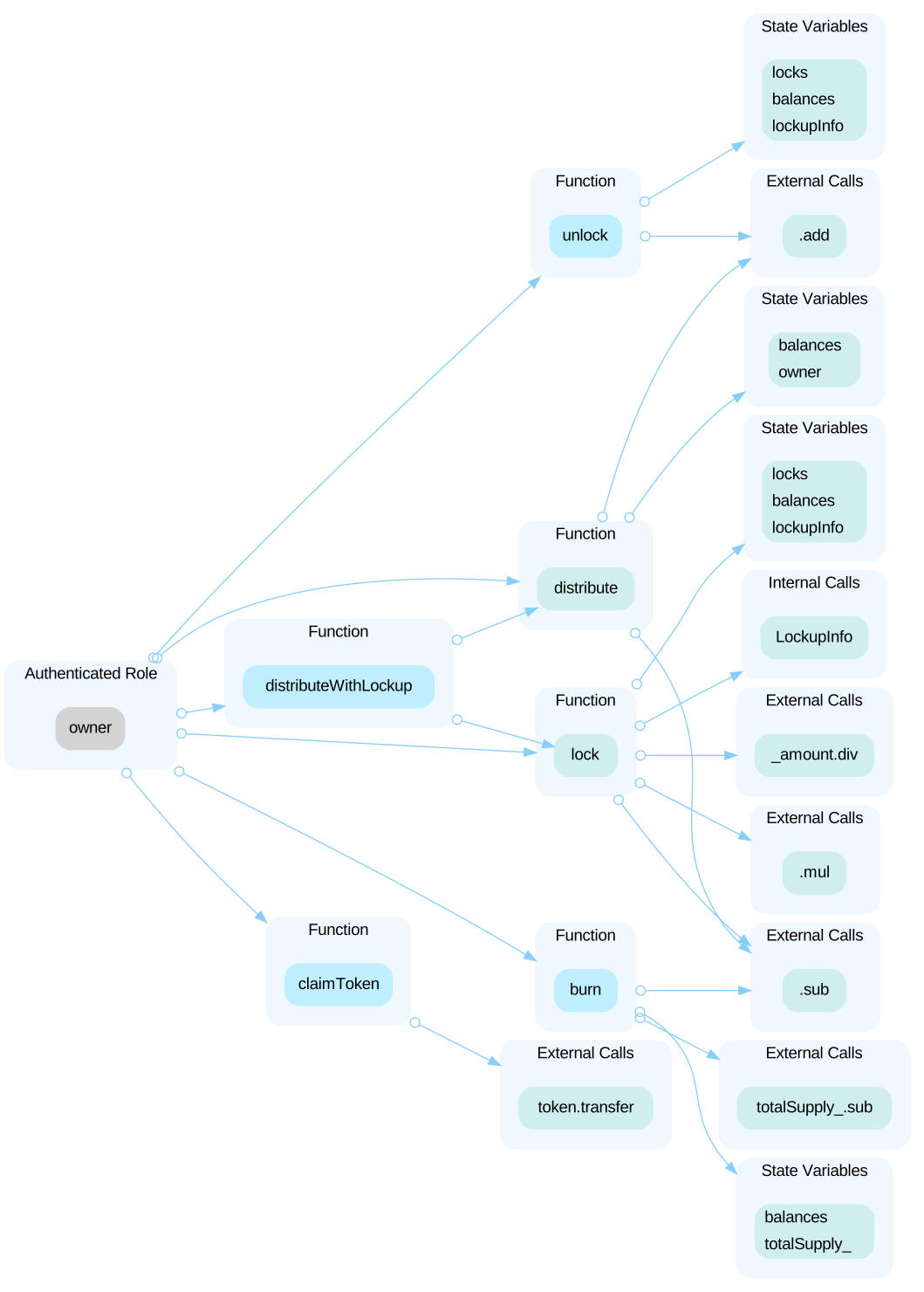 - `lock(address _holder, uint256 _amount, uint256 _releaseStart, uint256 _releaseRate)`: Locks a specified amount of tokens for a holder, setting release start time and release rate. Only owner role account can call this function. - `unlock(address _holder)`: Unlocks tokens for a specified holder. Only owner role account can call this function. - `distribute(address _to, uint256 _value)`: Move tokens to a specified address's balance from the owner’s balance. Only owner role account can call this function. - `distributeWithLockup(address _to, uint256 _value, uint256 _releaseStart, uint256 _releaseRate)`: Move tokens to a specified address's balance from the owner’s balance and lock them with a specified release schedule. Only owner role account can call this function. - `claimToken(ERC20 token, address _to, uint256 _value)`: Transfer tokens from a ERC20 contract to a specified address. Only owner role account can call this function. - `burn(uint256 _value)`: Burns a specified amount of tokens from the owner's balance, reducing the total supply. Only owner role account can call this function. Any compromise to the privileged account may allow the hacker to take advantage of this authority and update the sensitive settings and execute sensitive functions of the project
The audit on Trustblock · Open the reportAll of the `8000000000*10**18` `CBAB` tokens are sent to the contract deployer or one or several externally-owned account (EOA) addresses. This is a centralization risk because the deployer or the owner(s) of the EOAs can distribute tokens without obtaining the consensus of the community. Any compromise to these addresses may allow a hacker to steal and sell tokens on the market, resulting in severe damage to the project.
The audit on Trustblock · Open the reportSolidity integer division might truncate. As a result, performing multiplication before division can sometimes avoid loss of precision. This has minimal impact because that dust of assets will be sent in the last round of release in `releaseTimeLock()` function
The audit on Trustblock · Open the reportOne or more parameters with `memory` data location are never modified in their functions and those functions are never called internally within the contract. Thus, their data location can be changed to `calldata` to avoid the gas consumption copying from calldata to memory. ```solidity=181 function approveAndCall(address _spender, uint256 _value, bytes _extraData) public returns (bool success) { ``` `approveAndCall` has memory location parameters: `_extraData`.
The audit on Trustblock · Open the reportA reentrancy issue can occur when the contract creates a function that makes an external call to another untrusted contract before resolving any effects. If the attacker can control the untrusted contract, i.e. `_spender` in function `approveAndCall()`, they can make a recursive call back to other functions, repeating interactions that would have otherwise not run after the external call resolved the effects.
The audit on Trustblock · Open the reportState variables that never change should be declared as `constant` to save gas. ```solidity=101 uint128 internal MONTH = 30 * 24 * 3600; // 1 month ``` - `MONTH` should be declared `constant`.
The audit on Trustblock · Open the report```solidity=113 uint8 public decimals; uint256 internal initialSupply; ``` The above variables assigned in the constructor can be declared as `immutable`. Immutable state variables can be assigned during contract creation but will remain constant throughout the lifetime of a deployed contract. A big advantage of immutable variables is that reading them is significantly cheaper than reading from regular state variables since they will not be stored in storage.
The audit on Trustblock · Open the reportThe Crebit security record · Every Crebit address · This address on the explorer