0xa39964d6212c3753c3ef8dada0d46311504ea18b
As of 21 Nov 2026, Trustblock’s record holds 0xa39964d6212c3753c3ef8dada0d46311504ea18b on BNB Chain as a contract of UUNSE. 1 audit report on Trustblock lists this address: CertiK, 18 Oct 2022. 9 findings in it are recorded as open or acknowledged.
Each report’s scope as stored on Trustblock names this address on BNB Chain.
| Audit | Security firm | Date | Commit named in the report | Report |
|---|---|---|---|---|
| UUNSE - Audit | CertiK | Not recorded (see the report) | Open |
1 High, 8 Low. In the firm’s own words; statuses are the firm’s, from each report.
In the contract `UNGToken` the role `_owner` has authority over the `mint()` function. Any compromise to the `_owner` account may allow the hacker to take advantage of this authority and mint as many tokens as they wanted. Furthermore, the role `_owner` has authority over the functions shown in the diagram below. Any compromise to the `_owner` account may allow the hacker to take advantage of this authority and transfer or renounce ownership of the contract at any time. 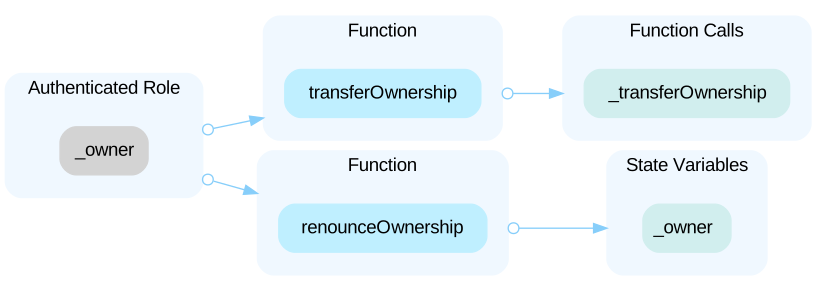
The audit on Trustblock · Open the reportOne or more declarations do not conform to the [Solidity style guide](https://solidity.readthedocs.io/en/v0.7.3/style-guide.html#naming-conventions) with regards to its naming convention. Particularly: - `camelCase`: Should be applied to function names, argument names, local and state variable names, modifiers - `UPPER_CASE`: Should be applied to `constant` variables - `CapWords`: Should be applied to contract names, struct names, event names and enums Constant variable `_maxSupply` is not in `UPPER_CASE`: ```solidity=345 uint256 private constant _maxSupply = 10000000000 * 1e18; ```
The audit on Trustblock · Open the reportThe functions which are never called internally within the contract should have external visibility for gas optimization.
The audit on Trustblock · Open the reportIt is highly recommended NOT to include OpenZeppelin library code directly in source code, but import the original library to minimize risk because even slight changes to the library code may lead to critical/major vulnerabilities/bugs. The latest version of the OpenZeppelin libraries is 4.7.3.
The audit on Trustblock · Open the reportThe `approve` function could be used in an attack that allows a spender to transfer more tokens than the owner of the tokens ever wanted to allow the spender to transfer. Here is a possible attack scenario: Alice allows Bob to transfer N of Alice's tokens (N>0) by calling approve method on token smart contract passing Bob's address and N as method arguments. After some time, Alice decides to change from N to M (M>0) the number of Alice's tokens Bob is allowed to transfer, so she calls `approve()` method again, this time passing Bob's address and M as method arguments. Bob notices Alice's second transaction before it was mined and quickly sends another transaction that calls `transferFrom()` method to transfer N Alice's tokens somewhere. If Bob's transaction will be executed before Alice's transaction, then Bob will successfully transfer N Alice's tokens and will gain the ability to transfer another M tokens. Before Alice noticed that something went wrong, Bob calls `transferFrom()` method again, this time to transfer M Alice's tokens. So, Alice's attempt to change Bob's allowance from N to M (N>0 and M>0) made it possible for Bob to transfer N+M of Alice's tokens, while Alice never wanted to allow so many of her tokens to be transferred by Bob. ERC20 API: An Attack Vector on Approve/TransferFrom Methods: https://docs.google.com/document/d/1YLPtQxZu1UAvO9cZ1O2RPXBbT0mooh4DYKjA_jp-RLM/edit#heading=h.m9fhqynw2xvt
The audit on Trustblock · Open the reportThe linked statements do not affect the functionality of the codebase and appear to be either leftovers from test code or older functionality.
The audit on Trustblock · Open the reportLiterals with many digits are difficult to read and review. ```solidity=345 uint256 private constant _maxSupply = 10000000000 * 1e18; ```
The audit on Trustblock · Open the reportVariables `_name`, `_symbol` and `_decimals` could be declared as `constant` since these state variables are hardcoded in the constructor and never to be changed.
The audit on Trustblock · Open the reportThe linked variables assigned in the constructor can be declared as `immutable`. Immutable state variables can be assigned during contract creation but will remain constant throughout the lifetime of a deployed contract. A big advantage of immutable variables is that reading them is significantly cheaper than reading from regular state variables since they will not be stored in storage.
The audit on Trustblock · Open the reportThe UUNSE security record · Every UUNSE address · This address on the explorer