DecentralizedUnitedAudit
CertiK reviewed Decentralized United (DecentralizedUnitedAudit) on 19 Sep 2022: 19 findings, 0 critical; 2 marked fixed, 17 open.
Report hosted on skynet.certik.com.
Trustblock does not review code.
Findings19
Statuses are the security firm’s own, from its report.
| Severity | Open | Acknowledged | Fixed |
|---|---|---|---|
| Critical | 0 | 0 | 0 |
| High | 2 | 0 | 2 |
| Medium | 0 | 0 | 0 |
| Low | 15 | 0 | 0 |
HighCentralization Risks in DecentralizedUnited.solOpen
In the contract `DecentralizedUnited` the role `_owner` has authority over the functions shown in the diagram below. The `_owner` can also call the centralized functions described in `DUC-04`. 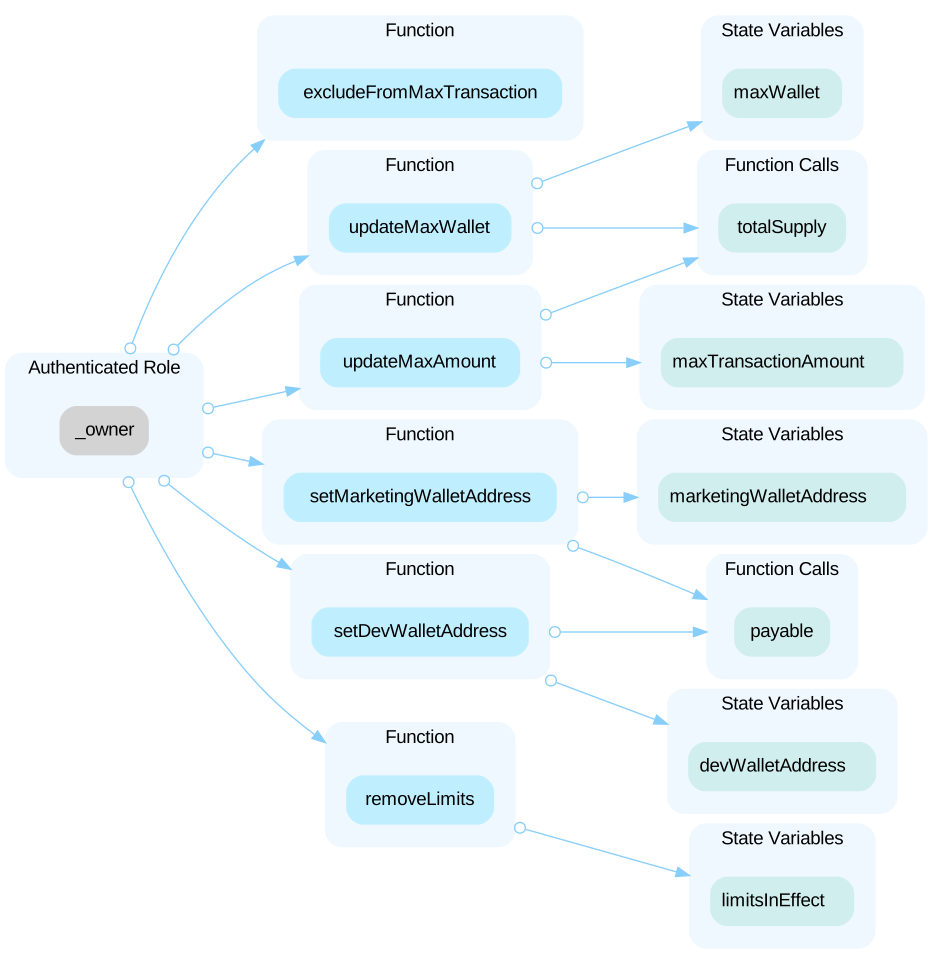 In the contract `Ownable` the role `_owner` has authority over the functions shown in the diagram below. 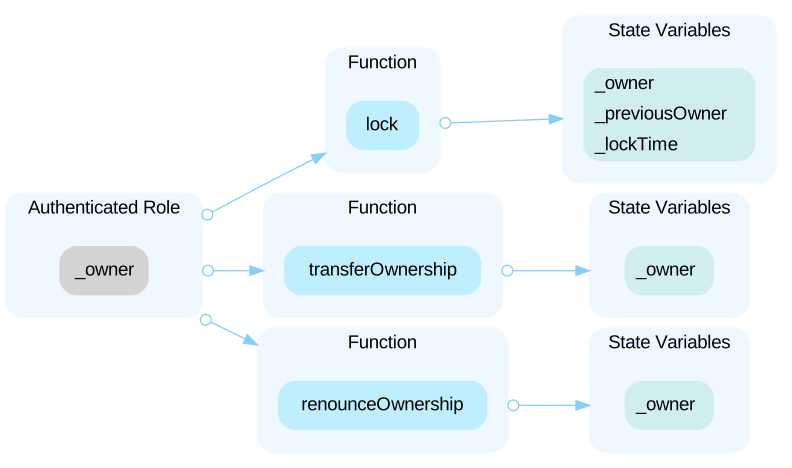 In the contract `Ownable` the role `_previousOwner` has authority over the functions shown in the diagram below. 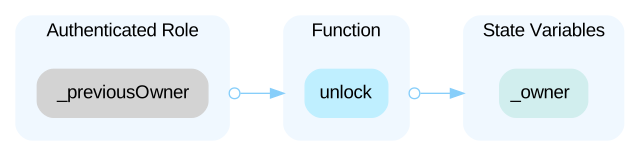 Any compromise to the privileged accounts may allow the hacker to take advantage of this authority and users' assets may suffer loss.
HighVariable `_rOwned` not updatedOpen
To the best of our understanding, the reward of a specific account should stop accumulating while in the range of being excluded from reward after calling `excludeFromReward()`. In L599, the current `_tOwned` balance of the `account` is recorded and any reward starting from this point should not be accumulated after calling the function `excludeFromReward()`. However, when calling the function `includeInReward()` to include the excluded `account` for reward, `_rOwned` should be calculated with current `_tOwned` value. Details of this finding can be seen in this article from Pera Finance: [Link]https://perafinance.medium.com/safemoon-is-it-safe-though-a-detailed-explanation-of-frictionless-yield-bug-338710649846
LowDead CodeOpen
One or more internal functions are not used. ```solidity=1030 function swapETHForTokens(uint256 amount) private ```
LowDiscussion For `_isExcludedFromFees`Open
In the function `_transfer()`, the `maxTransactionAmount/maxWallet` checks and call to the `swapAndLiquify()` function will be skipped when either of the `from` or `to` address is set `_isExcludedFromFee`.
LowERC20 Approval Race ConditionOpen
The approval function of the ERC20 standard possesses a well-known vulnerability whereby two consecutive approvals can be exploited to instead “reset” the approval by consuming the approval that is meant to be replaced with a new one.
LowFunction Could Be Declared ExternalOpen
The functions which are never called internally within the contract should have external visibility for gas optimization. ```solidity=119 function renounceOwnership() public virtual onlyOwner { ``` --- ```solidity=130 function getUnlockTime() public view returns (uint256) { ``` --- ```solidity=134 function getTime() public view returns (uint256) { ``` --- ```solidity=138 function lock(uint256 time) public virtual onlyOwner { ``` --- ```solidity=145 function unlock() public virtual { ``` --- ```solidity=517 function name() public pure returns (string memory) { ``` --- ```solidity=521 function symbol() public pure returns (string memory) { ``` --- ```solidity=525 function decimals() public pure returns (uint8) { ``` --- ```solidity=538 function transfer(address recipient, uint256 amount) public override returns (bool) { ``` --- ```solidity=543 function allowance(address owner, address spender) public view override returns (uint256) { ``` --- ```solidity=547 function approve(address spender, uint256 amount) public override returns (bool) { ``` --- ```solidity=552 function transferFrom(address sender, address recipient, uint256 amount) public override returns (bool) { ``` --- ```solidity=558 function increaseAllowance(address spender, uint256 addedValue) public virtual returns (bool) { ``` --- ```solidity=563 function decreaseAllowance(address spender, uint256 subtractedValue) public virtual returns (bool) { ``` --- ```solidity=568 function isExcludedFromReward(address account) public view returns (bool) { ``` --- ```solidity=573 function minimumTokensBeforeSwapAmount() public view returns (uint256) { ``` --- ```solidity=649 function excludeFromMaxTransaction(address updAds, bool isEx) public onlyOwner { ```
LowIncorrect Error MessageOpen
The first linked error message in `require(_isExcluded[account], "Account is already excluded")` does not describe the error correctly. Also, the second and third linked error messages in `require(newNum >= (totalSupply() * 1 / 100)/1e9, "Cannot set maxTransactionAmount lower than 0.5%")` does not describe the error correctly. The require condition is 1% but the error message is 0.5%. The third error message is `maxTransactionAmount` while the function is changing `maxWallet`.
LowMaximum transaction limit can be skippedOpen
In the function `_transfer()`, when `inSwapAndLiquify` is set to true in the function `swapAndLiquify()`, other transfer transaction will not check the `maxTransactionAmount` maximum transfer limitations. Also `maxWallet` check for the `to` address will be skipped. Thus, malicious users can skip these limitations when observing the `swapTokens()` transaction. ```solidity=675 if (limitsInEffect && !(_isExcludedFromFee[from] || _isExcludedFromFee[to]) && !inSwapAndLiquify){ ```
LowPotential Sandwich AttacksOpen
A sandwich attack might happen when an attacker observes a transaction swapping tokens or adding liquidity without setting restrictions on slippage or minimum output amount. The attacker can manipulate the exchange rate by frontrunning (before the transaction is attacked) a transaction to purchase one of the assets and make profits by back running (after the transaction is attacked) a transaction to sell the asset. The following functions are called without setting restrictions on slippage or minimum output amount, so transactions triggering these functions are vulnerable to sandwich attacks, especially when the input amount is large: - `uniswapV2Router.swapExactTokensForETHSupportingFeeOnTransferTokens()` - `uniswapV2Router.addLiquidityETH()` - `uniswapV2Router.swapExactETHForTokensSupportingFeeOnTransferTokens()`
LowPrivilege not Revoked or TransferredOpen
The owner is exempt from fees by default. Yet when ownership is reset through `renounceOwnership()` or `transferOwnership()`, the exemptions are not granted to the new owner nor are they revoked from the previous owner.
Show 7 more
LowPull-Over-Push Pattern In `transferOwnership()` FOpen
The change of `_owner` by function `transferOwnership()` overrides the previously set `_owner` with the new one without guaranteeing the new `_owner` is able to actuate transactions on-chain.
LowSolidity Version Not RecommendedOpen
Solidity frequently releases new compiler versions. Using an old version prevents access to new Solidity security features. Also, recent versions may be too early to be trusted. Pragma version^0.8.15 (DecentralizedUnited.sol#9) necessitates a version too recent to be trusted. Consider deploying with 0.6.12/0.7.6/0.8.7 ```solidity=9 pragma solidity ^0.8.15; ```
LowThird Party DependencyOpen
The contract is serving as the underlying entity to interact with one or more third-party protocols. The scope of the audit treats third-party entities as black boxes and assumes their functional correctness. However, in the real world, third parties can be compromised and this may lead to lost or stolen assets. In addition, upgrades of third parties can possibly create severe impacts, such as increasing fees of third parties, migrating to new LP pools, etc. ```solidity=438 IUniswapV2Router02 public immutable uniswapV2Router; ``` - The contract `DecentralizedUnited` interacts with third-party contract with `IUniswapV2Router02` interface via `uniswapV2Router`.
LowUnknown Externally Owned Account (EOA)Open
In the contracts `DecentralizedUnited`, the state variable `devWalletAddress` is initialized as `0xCFBfc487f2e22a7E297B48623476F8ae1119C46a` and the ownership of it is uncertain.
LowUnused EventOpen
```solidity=380 event LogTokenApproval(address from, uint256 total); ``` - `LogTokenApproval` is declared in `DecentralizedUnited` but never emitted. --- ```solidity=381 event LogTokenBulkSentETH(address from, uint256 total); ``` - `LogTokenBulkSentETH` is declared in `DecentralizedUnited` but never emitted. --- ```solidity=382 event LogTokenBulkSent(address token, address from, uint256 total); ``` - `LogTokenBulkSent` is declared in `DecentralizedUnited` but never emitted. --- ```solidity=448 event RewardLiquidityProviders(uint256 tokenAmount); ``` - `RewardLiquidityProviders` is declared in `DecentralizedUnited` but never emitted.
LowUnused Return ValueOpen
The return value of an external call is not stored in a local or state variable. ```solidity=769 uniswapV2Router.addLiquidityETH{value: ethAmount}( address(this), tokenAmount, 0, // slippage is unavoidable 0, // slippage is unavoidable deadWallet, block.timestamp ); ```
LowUsage of `transfer`/`send` for sending EtherOpen
It is not recommended to use Solidity's `transfer()` and `send()` functions for transferring Ether, since some contracts may not be able to receive the funds. Those functions forward only a fixed amount of gas (2300 specifically) and the receiving contracts may run out of gas before finishing the transfer. Also, EVM instructions' gas costs may increase in the future. Thus, some contracts that can receive now may stop working in the future due to the gas limitation. ```solidity=1018 recipient.transfer(amount); ``` - `DecentralizedUnited.transferToAddressETH` uses `transfer()`.
Contracts in scope1
| Address | Chain | Source code |
|---|---|---|
| 0xcb1ddc8f705e2737685a9c1e6b84a63d04d200e5 | Chain: BNB Chain | Source code: Verified source |
Part of Decentralized United’s security record
 Decentralized United
Security firm
 CertiK
1,044 projects reviewed · 1,375 reports · latest May 2025
See CertiK’s auditsSomething wrong on this page? A missing report, a wrong date, a finding that was fixed since. Tell us and we check it against its source.
Tell us