Wemix MirM
Part of CertiK’s retainer series
CertiK reviewed WEMIX (Wemix MirM) on 25 Jan 2023: 16 findings, 2 critical; 8 marked fixed, 8 open.
Report hosted on skynet.certik.com.
Trustblock does not review code.
Findings16
Statuses are the security firm’s own, from its report.
| Severity | Open | Acknowledged | Fixed |
|---|---|---|---|
| Critical | 0 | 0 | 2 |
| High | 2 | 0 | 0 |
| Medium | 1 | 0 | 2 |
| Low | 5 | 0 | 4 |
HighCentralization Related RisksOpen
In the contract `DOGMA` the role `_owner` has authority over the functions shown in the diagram below. Any compromise to the `_owner` account may allow the hacker to take advantage of this authority. 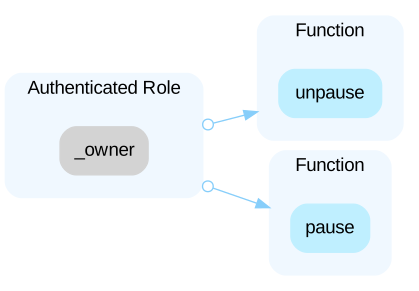 In the contract `Drain` the role `onlyBurner` has authority over the functions. Any compromise to the `onlyBurner` account may allow the hacker to take advantage of this authority. - burn anyone's tokens In the contract `Drain` the role `_owner` has authority over the functions shown in the diagram below. Any compromise to the `_owner` account may allow the hacker to take advantage of this authority. 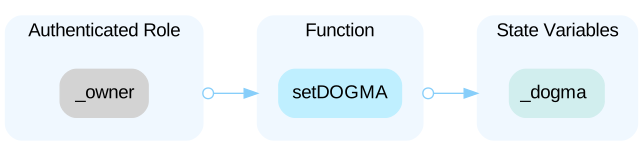 In the contract `Drain` the role `onlyBurner` has authority over the functions. Any compromise to the `onlyBurner` account may allow the hacker to take advantage of this authority. - burn themself's tokens In the contract `DrainAway` the role `_owner` has authority over the functions shown in the diagram below. Any compromise to the `_owner` account may allow the hacker to take advantage of this authority. 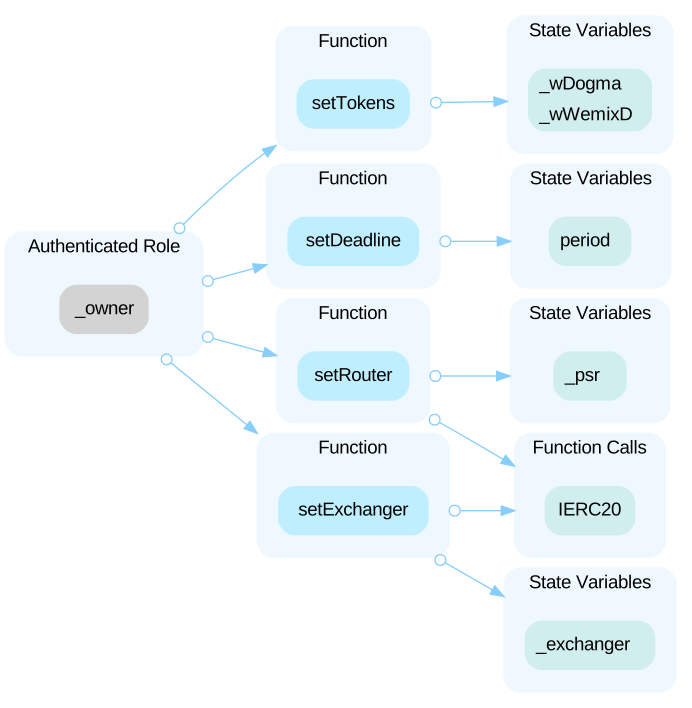 In the contract `DrainAway` the role `onlyBurner` has authority over the functions. Any compromise to the `onlyBurner` account may allow the hacker to take advantage of this authority. - burn tokens of the contract In the contract `GameExchanger` the role `_owner` has authority over the functions shown in the diagram below. Any compromise to the `_owner` account may allow the hacker to take advantage of this authority. 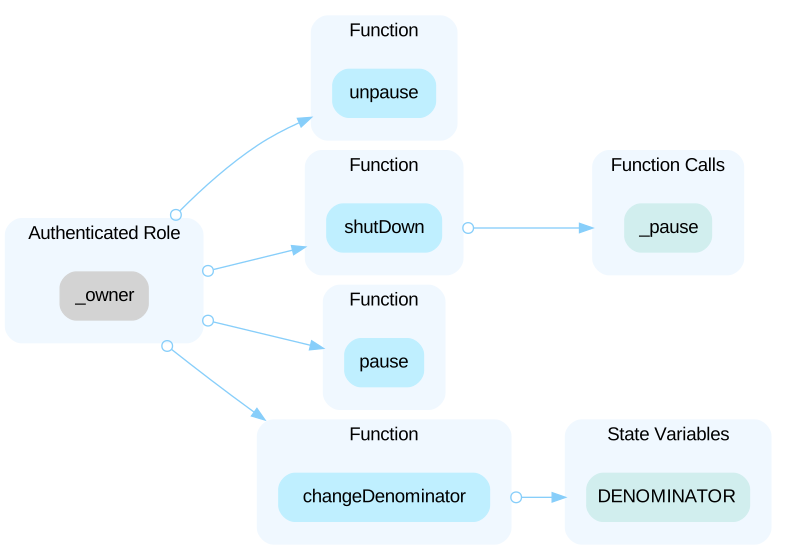 In the contract `GovernanceAccrue` the role `_owner` has authority over the functions shown in the diagram below. Any compromise to the `_owner` account may allow the hacker to take advantage of this authority. 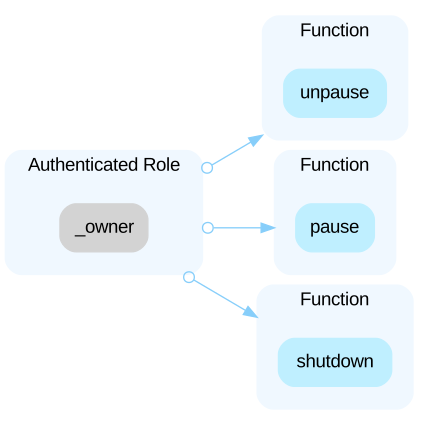 In the contract `GovernanceAccrue` the role `validator` has authority over the functions listed below. Any compromise to the `validator` account may allow the hacker to take advantage of this authority. - create agenda and add sectors - drop agenda and kill sectors - execute sectors In the contract `DRONEStakingPool` the role `_owner` has authority over the functions shown in the diagram below. Any compromise to the `_owner` account may allow the hacker to take advantage of this authority. 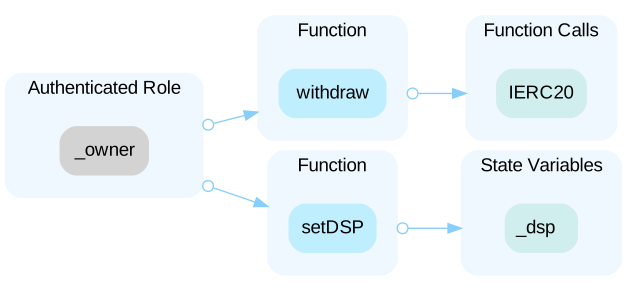 In the contract `DivineStakingPool` the role `_owner` has authority over the functions shown in the diagram below. Any compromise to the `_owner` account may allow the hacker to take advantage of this authority. 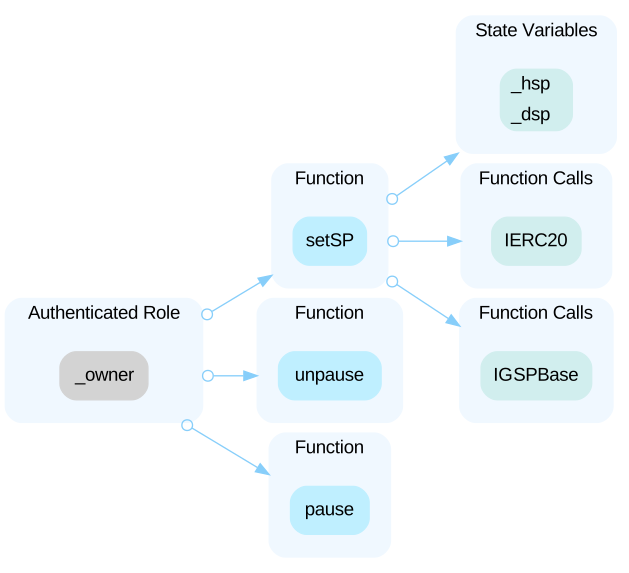 In the contract `HYDRAStakingPool` the role `_owner` has authority over the functions shown in the diagram below. Any compromise to the `_owner` account may allow the hacker to take advantage of this authority. 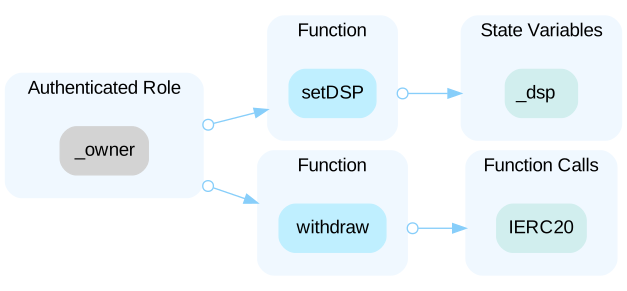 In the contract `GSPBase` the role `_owner` has authority over the functions shown in the diagram below. Any compromise to the `_owner` account may allow the hacker to take advantage of this authority. 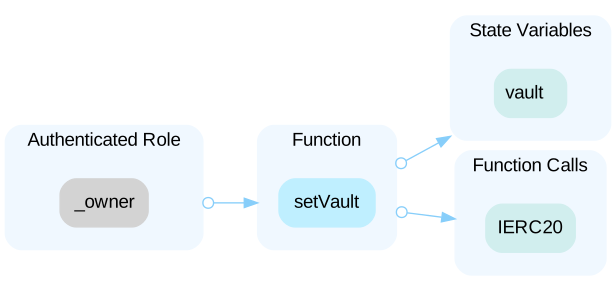 In the contract `GSPCoolTime` the role `_owner` has authority over the functions shown in the diagram below. Any compromise to the `_owner` account may allow the hacker to take advantage of this authority. 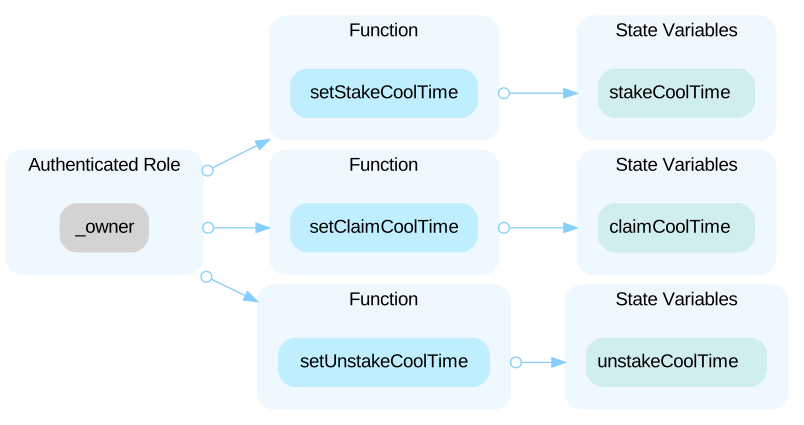 In the contract `WemixFeeVaultV4` the role `_owner` has authority over the functions shown in the diagram below. Any compromise to the `_owner` account may allow the hacker to take advantage of this authority and change the variable `mintFeePercent`.  In the contract `WemixDollarPayment` the role `_owner` has authority over the functions shown in the diag
HighCentralization Risks with MinterOpen
DOGMA is a governance token of the MirM, which is also used as compensation for MirM staking. The DOGMA token is minted in function `mint` and can only be called by `Minter`. The staking reward calculation will use the total amount of minted token Any compromise to the `Minter` account may allow a hacker to take advantage of this authority.
MediumOut of Scope DependenciesOpen
In the contract `WemixFeeVault`: ```solidity=51 function _addIncome(address token, bytes32 column, uint amount, uint percent) internal { _recipientRole._addIncome(token, column, amount, percent); } ``` In the library `RecipientLib`: ```solidity=21 function _addIncome(Recipient storage r, address token, bytes32 column, uint amount, uint percentToOwner) internal { require(r.recipientRoleV2 != address(0), "RecipientLib: RecipientRoleV2 address is not set"); if(IERC20(token).allowance(address(this), r.recipientRoleV2) < amount) { require(IERC20(token).approve(r.recipientRoleV2, uint(-1)),"RecipientLib: approve error"); } require(IRecipientRoleV2(r.recipientRoleV2).addIncome(r.service, token, column, amount, percentToOwner),"RecipientLib: addIncome error"); } ``` When method `_distribution()` is called, the contract `GameExchanger` approves the maximum transfer amount of `recipientRoleV2`, so `recipientRoleV2` can transfer all the tokens from the exchange. The scope of the audit treats contract `_recipientRole` and above-linked parent contracts that are out of scope as black boxes and assumes their functional correctness. However, in the real world, those contracts can be compromised.
LowIncompatibility With Deflationary TokensOpen
When transferring standard ERC20 deflationary tokens, the input amount may not be equal to the received amount due to the charged transaction fee. As a result, an inconsistency in the amount will occur and the transaction may fail due to the validation checks. For example, if a user sends 100 deflationary tokens (with a 10% transaction fee) to the target contract, only 90 tokens actually arrive to the contract.
LowPotential Cross-chain Replay AttackOpen
The signature does not include the identification of the blockchain. So if the signer signed a message on one blockchain and accidentally leaked the signature, the signature would be valid for a similar transaction on another blockchain with the same encryption method. For example, if the signer signed a message using `address(this), nonce` on Ethereum and the same `address(this)` and `nonce` exist on BSC, the attacker can reuse this signature to set the winners via `BYLOSports.settle()` on BSC.
LowRedundant Code ComponentsOpen
The linked statements do not affect the functionality of the codebase and appear to be either leftovers from test code or older functionality.
LowUnknown InterfacesOpen
The linked interfaces used in the protocol are unknown. We understand that this protocol depends on the service of other contracts, however, the unknown imported source file may incur unexpected behaviors. This audit will treat the unknown imported source files as a black box.
LowUsage of `_transfer` instead of `transferFrom`Open
In function `exchangeToItem`, users will transfer tokens to the contract in the following line: `super._transfer(user, address(this), amount);`. This does not requires users to call approve(address(this), amount) prior to calling `exchangeToItem`, which increased the risk of users being phished.
Contracts in scope
No deployed address is recorded for this audit.
The report names a repository or files. Open the report to see its scope.
Repository and files the report names (25)
- governance/interface/IGSPCoolTime.sol
- MirM/Staking/HYDRAStakingPool.sol
- GovernanceAccrue.sol
- governance/interface/IGSPMultiPoint.sol
- MultiPeriodic.sol
- Token/DRONE.sol
- token/ERC20/IERC20MultiPeriodCapable.sol
- governance/base/GSPK.sol
- DrainAway.sol
- Drain.sol
- governance/option/GSPCoolTime.sol
- FTMultiCapable.sol
- governance/interface/IGSPSchedule.sol
- GameExchanger.sol
- governance/base/GSPSchedule.sol
- token/ERC20/ERC20MultiPeriodCapable.sol
- MirM/Staking/DRONEStakingPool.sol
- governance/interface/IGSPBase.sol
- governance/base/GSPBase.sol
- MirM/Staking/interface/IDivineStakingPool.sol
- DOGMA.sol
- MirM/Staking/DivineStakingPool.sol
- governance/option/GSPMultiPoint.sol
- MultiPausable.sol
- Token/DOGMA.sol
Part of WEMIX’s security record
 WEMIX
Security firm
 CertiK
1,045 projects reviewed · 1,376 reports · latest May 2025
See CertiK’s auditsSomething wrong on this page? A missing report, a wrong date, a finding that was fixed since. Tell us and we check it against its source.
Tell us