X314 - Audit
CertiK reviewed X314 (X314 - Audit) on 17 Dec 2024: 17 findings, 0 critical; 1 marked fixed, 16 open.
The original report was removed from its address (seen 15 Oct 2026).
Trustblock does not review code.
Findings17
Statuses are the security firm’s own, from its report.
| Severity | Open | Acknowledged | Fixed |
|---|---|---|---|
| Critical | 0 | 0 | 0 |
| High | 3 | 0 | 0 |
| Medium | 4 | 0 | 1 |
| Low | 9 | 0 | 0 |
HighCentralization Related Risks in Removing LiquiditOpen
**Important Note: Certain identification and KYC procedures were attempted to be applied to the project team in order to better understand the centralization situation and potential risks of the project. Based on the collected information and further conducted investigation, the project failed to pass the criteria with a certain amount of negative signals. Thus the case analysis concluded that there is potential high risk to the project. We strongly advise end users to conduct further research and exercise due diligence before engaging with the project. It is crucial for end users to independently verify and assess all available information to make informed decisions.** In the `X314` protocol, only the owner can add liquidity as a liquidity provider, and it can be done only once. The owner can set an LP unlock time, after which the liquidity provider can withdraw all native tokens ('BNB') from the contract and close swap trading. Once this action is performed, the contract will no longer have any liquidity to support transactions. This results in the `X314` token holders being unable to sell their tokens, effectively rendering the contract non-functional and causing losses to token holders. Additionally, all other `X314` tokens for liquidity will be locked in the contract. ```solidity function removeLiquidity() public onlyLiquidityProvider { require(block.number > blockToUnlockLiquidity, "Liquidity locked"); tradingEnable = false; payable(msg.sender).transfer(address(this).balance); emit RemoveLiquidity(address(this).balance); } ```
HighCentralization Risks in X314.solOpen
**Important Note: Certain identification and KYC procedures were attempted to be applied to the project team in order to better understand the centralization situation and potential risks of the project. Based on the collected information and further conducted investigation, the project failed to pass the criteria with a certain amount of negative signals. Thus the case analysis concluded that there is potential high risk to the project. We strongly advise end users to conduct further research and exercise due diligence before engaging with the project. It is crucial for end users to independently verify and assess all available information to make informed decisions.** In the contract `Ownable`, the role `_owner` has authority over the functions shown in the diagram below. Any compromise to the `_owner` account may allow the hacker to take advantage of this authority and renounce ownership of the contract or transfer the contract ownership. 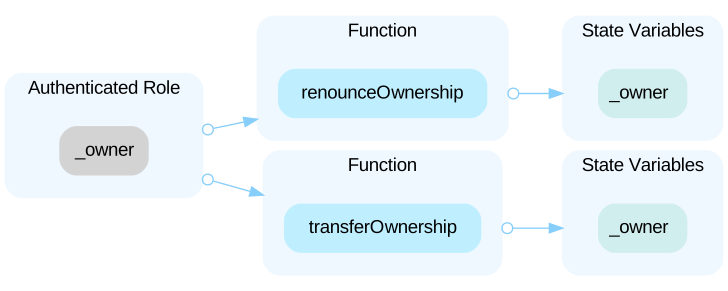 In the contract `X314`, the role `_owner` has authority over the functions shown in the diagram below. Any compromise to the `_owner` account may allow the hacker to take advantage of this authority and enable or disable wallet maximum holding limit, set the buy fee, set trading open time, set maximum wallet amount, send tokens to multiple addresses without cooldown limitation, set the cooldown seconds, set the sell fee, add liquidity and enable trading, initialize the liquidity amount, and set exclude cooling status for accounts. 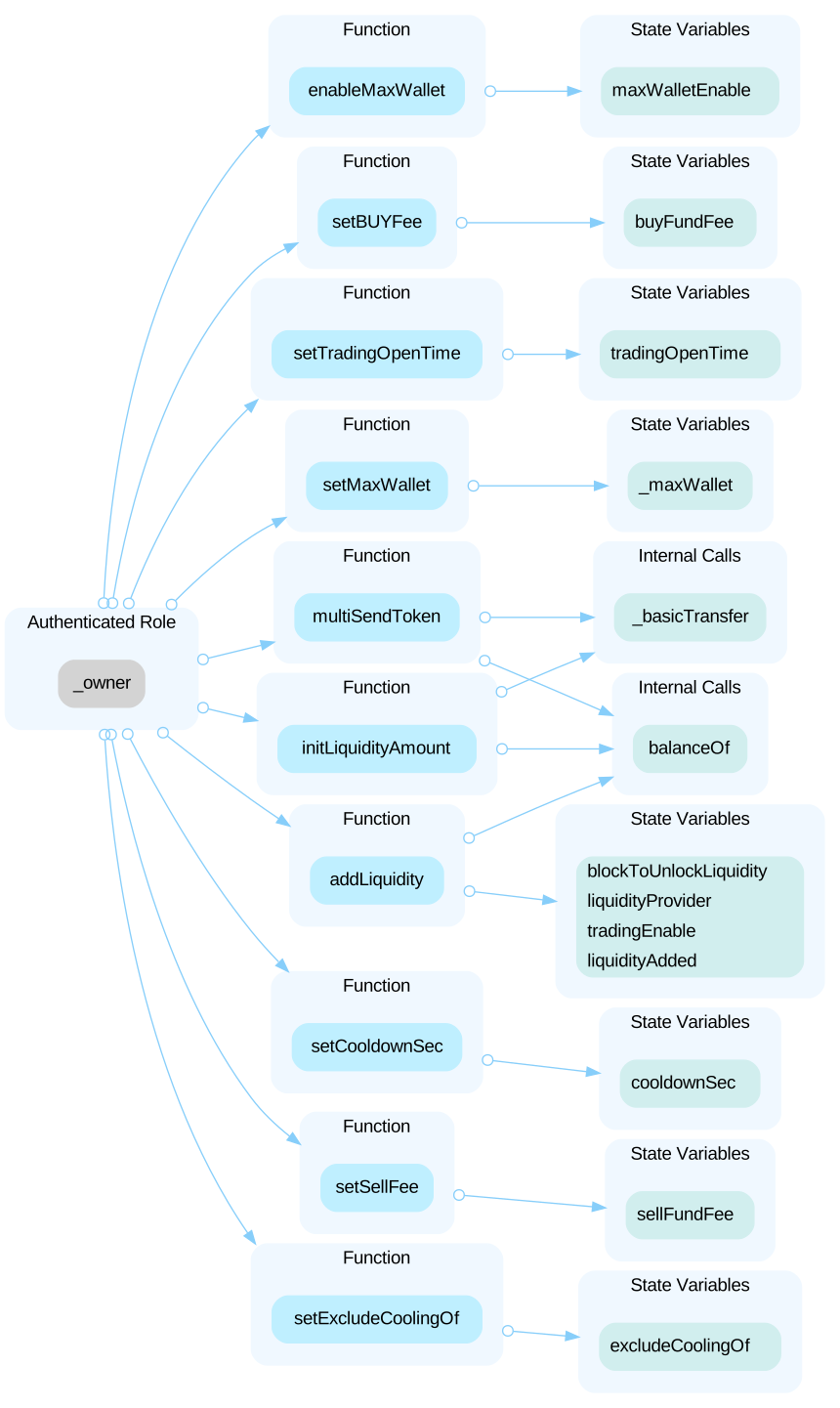 In the contract `X314`, the role `excludeCoolingOf` has authority over the functions shown in the diagram below. Any compromise to the `excludeCoolingOf` account may allow the hacker to take advantage of this authority and execute a buy or sell transaction without fees and conditions when trading is not open. 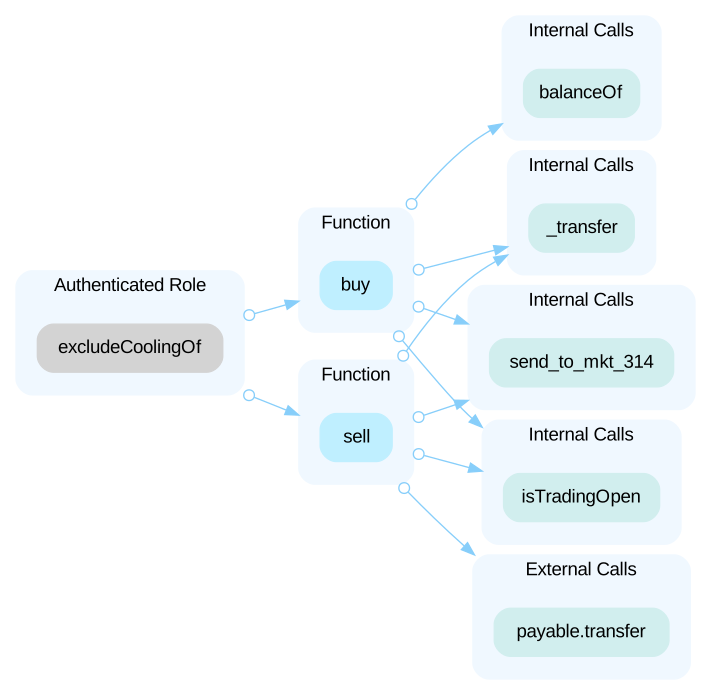 In the contract `X314`, the role `liquidityProvider` has authority over the functions shown in the diagram below. Any compromise to the `liquidityProvider` account may allow the hacker to take advantage of this authority and extend the liquidity lock duration, removing liquidity if unlocked. All native tokens (`BNB`) in the contract will be claimed when removing liquidity, and users cannot buy or sell tokens through the contract. 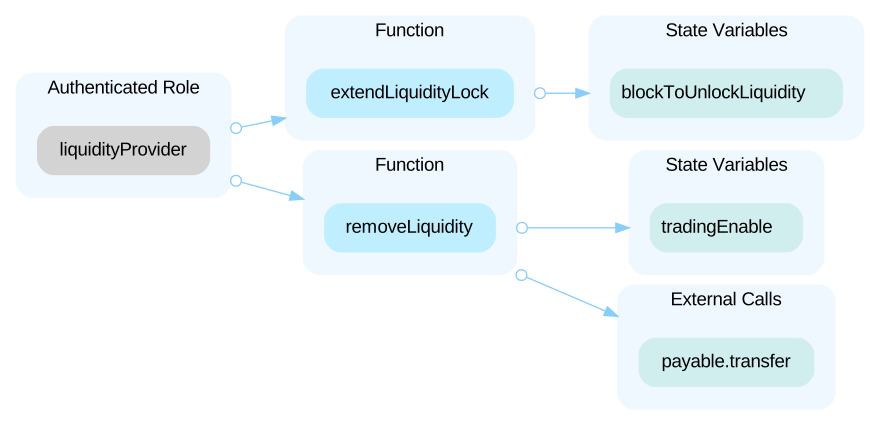 In the contract `X314`, the role `mkt_314` has authority over the functions shown in the diagram below. Any compromise to the `mkt_314` account may allow the hacker to take advantage of this authority and withdraw any ERC20 token from the contract except the `X314` token. 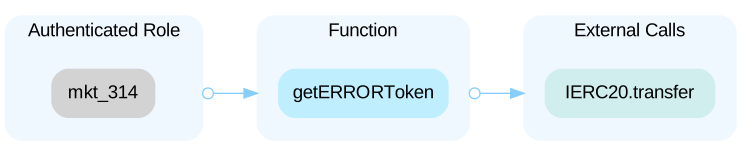
HighInitial Token DistributionOpen
**Important Note: Certain identification and KYC procedures were attempted to be applied to the project team in order to better understand the centralization situation and potential risks of the project. Based on the collected information and further conducted investigation, the project failed to pass the criteria with a certain amount of negative signals. Thus the case analysis concluded that there is potential high risk to the project. We strongly advise end users to conduct further research and exercise due diligence before engaging with the project. It is crucial for end users to independently verify and assess all available information to make informed decisions.** All of the `X314` tokens are sent to the contract and an externally-owned account (EOA) address, and the owner of the EOA address can withdraw `X314` tokens before adding liquidity. This is a centralization risk because the deployer or the owner(s) of the EOAs can distribute tokens without obtaining the consensus of the community. Any compromise to these addresses may allow a hacker to steal and sell tokens on the market, resulting in severe damage to the project.
Medium`getAmountOut` Function Does Not Give Accurate InOpen
The `X314` protocol has designed a transaction fee that is charged to users during actual swap transactions. ```solidity function getAmountOut(uint256 value, bool _buy) public view returns (uint256) { (uint256 reserveETH, uint256 reserveToken) = getReserves(); if (_buy) { return (value * reserveToken) / (reserveETH + value); } else { return (value * reserveETH) / (reserveToken + value); } } ``` However, the `getAmountOut()` function does not incorporate transaction fees in the calculations. The outcomes may not meet users expectations if they rely on the function's return result as a reference.
MediumInconsistent Maximum Holding Limit DesignOpen
When a user purchases `X314` tokens, they are subject to the maximum holding limit if they are not in the `excludeCoolingOf` list. ```solidity function buy() internal { ... if ( maxWalletEnable && _maxWallet != 0 && !excludeCoolingOf[msg.sender] ) { require(balanceOf(msg.sender) <= _maxWallet, "Max wallet exceeded"); } emit Swap(msg.sender, swapValue, 0, 0, user_amount); } ``` However, this limit is only enforced during purchases and not during regular transactions. This means a user could potentially receive X314 tokens from multiple accounts, exceeding the maximum holding limit.
MediumMissing Sanity Check in `_basicTransfer()` FunctiOpen
In the `_basicTransfer()` function, relevant parameters lack sanity checks. If the transaction addresses are zero addresses, it may lead to potential losses. Additionally, a transaction amount of zero is meaningless. For instance, when the transaction amount is calculated as zero during purchase operations due to rounding issues, users will not receive any `X314` tokens and will lose the native tokens they paid.
MediumNo Slippage Protection and Potential Sandwich AttOpen
When users perform token swaps without a minimum output amount or slippage parameter, transactions execute without safeguards. This not only exposes users to the risk of receiving fewer tokens than expected due to price slippage but also makes them susceptible to sandwich attacks. In a sandwich attack, a malicious actor inserts their transactions before and after the user's transaction, manipulating the price for profit, causing the user to complete the trade at an unfavorable price and incur financial losses. Despite the cooldown limitation and same block limitation, accounts listed in `excludeCoolingOf` do not face these restrictions and can easily execute sandwich attacks.
LowInconsistency Between Transfer And TransferFrom LOpen
The `transferFrom()` function contains different restrictions compared to the `transfer` function, resulting in inconsistent behavior between these two core ERC-20 functions. This inconsistency can lead to a situation where a transfer to the `X314` contract (Sell transaction) might fail when using `transferFrom()`, but the same transfer could succeed using `transfer()`. Such discrepancies can create confusion for users and may lead to potential incompatibilities with other contracts. ```solidity function transferFrom( address from, address to, uint256 amount ) public virtual returns (bool) { ... if (to == address(this)) { require(false,"reject self"); // sell(from, amount); } else { _transfer(from, to, amount); } ... } ```
LowLocal Variable ShadowingOpen
A local variable is shadowing another component defined elsewhere. This means that when the contract accesses the variable by its name, it will use the one defined locally, not the one defined in the other place. The use of the variable may lead to unexpected results and unintended behavior. ```solidity=191 address _owner, ``` - Local variable `_owner` in `X314.allowance` shadows the variable `_owner` in `Ownable`. ```solidity=226 address _owner, ``` - Local variable `_owner` in `X314._approve` shadows the variable `_owner` in `Ownable`. ```solidity=201 address _owner = msg.sender; ``` - Local variable `_owner` in `X314.approve` shadows the variable `_owner` in `Ownable`. ```solidity=238 address _owner, ``` - Local variable `_owner` in `X314._spendAllowance` shadows the variable `_owner` in `Ownable`.
LowLow-level Call UsageOpen
The smart contract contains low-level call (`.call()`) to send ether to the account `mkt_314`.If the account `mkt_314` is a contract that manages to receive ether with customized logic, it may introduce vulnerabilities such as reentrancy, unexpected gas consumption, or unexpected revert. ```solidity=469 (bool success,) = address(mkt_314).call{value: fundValue}(""); ```
Show 6 more
LowMeaningless RequirementOpen
The `oldLiquidityAmount` represents the `X314` token balance of the contract; when `oldLiquidityAmount` is greater than `newLiquidityAmount`, `differ` represents their difference and is always less than or equal to the contract's `X314` token balance. ```solidity uint256 oldLiquidityAmount = balanceOf(address(this)); if (oldLiquidityAmount > newLiquidityAmount) { uint256 diff = oldLiquidityAmount - newLiquidityAmount; require(balanceOf(address(this)) >= diff, "lp not enough token"); ... } ```
LowMissing Emit EventsOpen
There should always be events emitted in the sensitive functions that are controlled by centralization roles.
LowMissing Error MessagesOpen
The **require** can be used to check for conditions and throw an exception if the condition is not met. It is better to provide a string message containing details about the error that will be passed back to the caller.
LowRedundant Code ComponentsOpen
The linked statements do not affect the functionality of the codebase and appear to be either leftovers from test code or older functionality. ```solidity function isContract(address _addr) private view returns (bool) { uint32 size; assembly { size := extcodesize(_addr) } return (size > 0); } ```
LowUsage of `transfer()` for sending Native TokensOpen
After [EIP-1884](https://eips.ethereum.org/EIPS/eip-1884) was included in the Istanbul hard fork, it is not recommended to use `.transfer()` or `.send()` for transferring native tokens as these functions have a hard-coded value for gas costs making them obsolete as they are forwarding a fixed amount of gas, specifically `2300`. This can cause issues in case the linked statements are meant to be able to transfer funds to other contracts instead of EOAs.
LowVariables That Could Be Declared as ImmutableOpen
The linked variables assigned in the constructor can be declared as `immutable`. Immutable state variables can be assigned during contract creation but will remain constant throughout the lifetime of a deployed contract. A big advantage of immutable variables is that reading them is significantly cheaper than reading from regular state variables since they will not be stored in storage.
Contracts in scope1
| Address | Chain | Source code |
|---|---|---|
| 0x40ba01da634a189d248fb1ee47141a4e11cd94bd | Chain: BNB Chain | Source code: Verified source |
Part of X314’s security record
 X314
Security firm
 CertiK
1,044 projects reviewed · 1,375 reports · latest May 2025
See CertiK’s auditsSomething wrong on this page? A missing report, a wrong date, a finding that was fixed since. Tell us and we check it against its source.
Tell us