RealFevr - bridge
CertiK reviewed RealFevr (RealFevr - bridge) on 1 Mar 2024: 29 findings, 0 critical; 13 marked fixed, 3 acknowledged, 13 open.
Report hosted on skynet.certik.com.
Trustblock does not review code.
Findings29
Statuses are the security firm’s own, from its report.
| Severity | Open | Acknowledged | Fixed |
|---|---|---|---|
| Critical | 0 | 0 | 0 |
| High | 0 | 3 | 0 |
| Medium | 3 | 0 | 2 |
| Low | 10 | 0 | 11 |
HighCentralization Related RisksAcknowledged
## ERC20BridgeImpl.sol In the contract `ERC20BridgeImpl` the role `DEFAULT_ADMIN_ROLE` has authority over the functions shown in the diagram below. Any compromise to the `DEFAULT_ADMIN_ROLE` account may allow the hacker to take advantage of this authority and - change the implementation logic used by the proxy to malicious code - give any role used within the contract to an address they control - remove the role privilege from a legitimate account - remove all available ERC20 tokens in the contract and send to an account they control - deposit any amount of an ERC20 approved to be bridged in the contract, potentially preventing others from depositing that token if the daily maximum is exceeded - create new ERC20 tokens to be used maliciously with the bridge protocol - burn all ERC20 tokens currently held in the contract - mint any amount of any ERC20 token for which the contract is the owner of 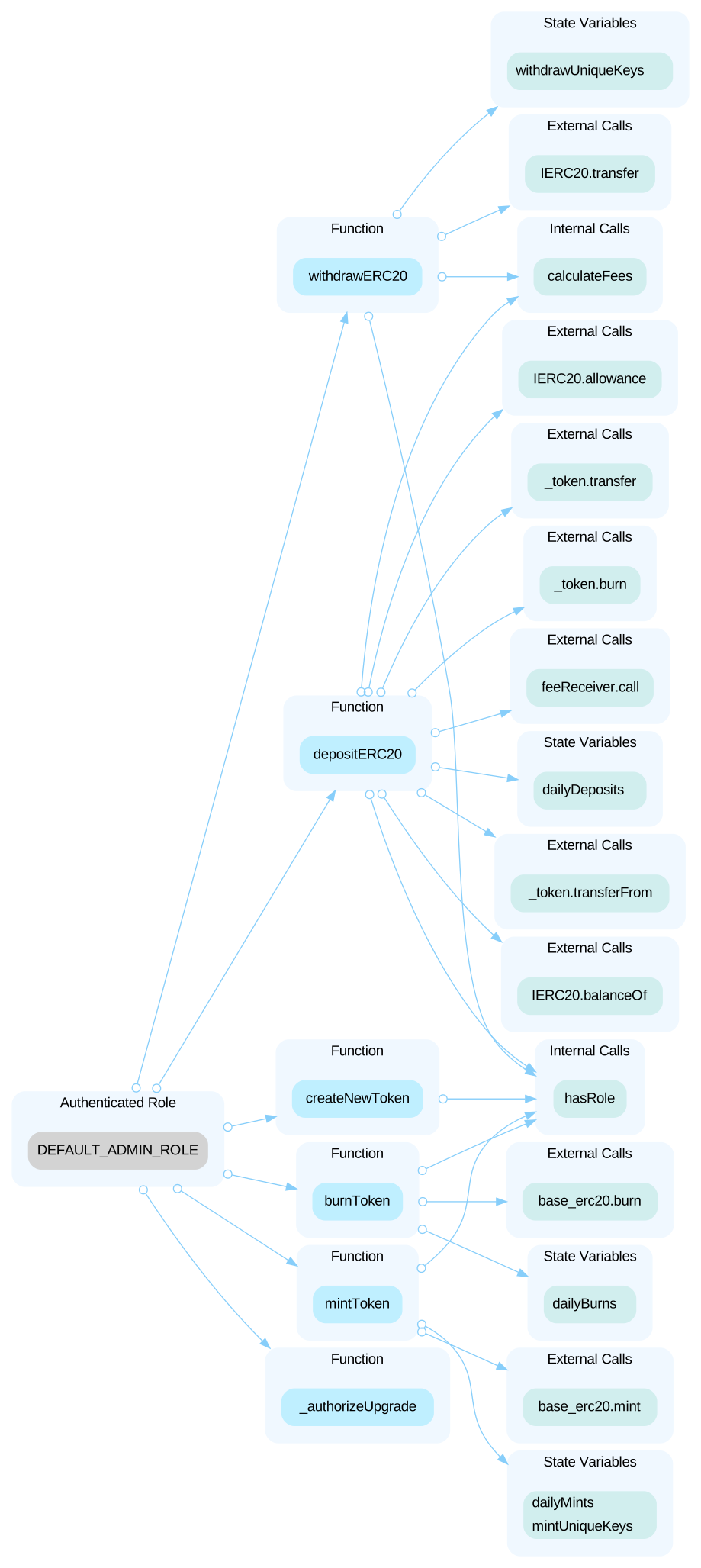 In the contract `ERC20BridgeImpl` the role `BRIDGE` has authority over the functions shown in the diagram below. Any compromise to the `BRIDGE` account may allow the hacker to take advantage of this authority and - withdraw all available ERC20 tokens in the contract and send to an account they control, as long as the amount does not cause the daily maximum to be exceeded for that token - burn all ERC20 tokens currently held in the contract, as long as the amount does not cause the daily maximum to be exceeded for that token - mint any amount of any ERC20 token for which the contract is the owner of, as long as the amount does not cause the daily mint maximum to be exceeded for that token 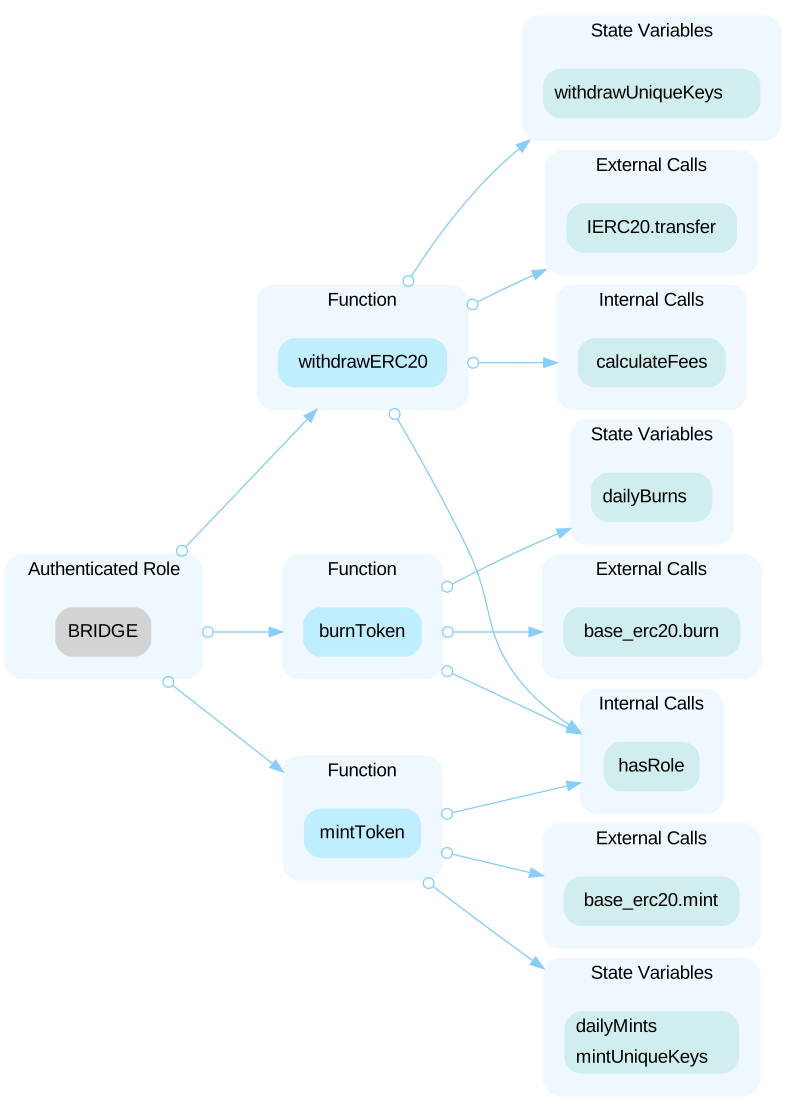 In the contract `ERC20BridgeImpl` the role `OPERATOR` has authority over the functions shown in the diagram below. Any compromise to the `OPERATOR` account may allow the hacker to take advantage of this authority and - update the bridge status in order to use or prevent the use of bridge functionality during a time-sensitive period. - change the `feeReceiver` address to an account they control, and update fees to collect a maximal amount from deposits and withdrawals - update supported chains to allow unintended chains, or to prevent legitimate chains from being used - create new ERC20 tokens to be used maliciously with the bridge protocol - change the 24 hour maximum values for deposit, withdrawal, minting and burning to either prevent these actions or allow an unintended amount to pass for their own gain - set `burnOnDeposit` to false for a token in order to remove the tokens through withdrawal and re-use within the bridge or other protocols for gain. This can be done if the account possesses both the `OPERATOR` role and either the `DEFAULT_ADMIN_ROLE` or the `BRIDGE` role - set up a malicious ERC20 token contract for use with the bridge 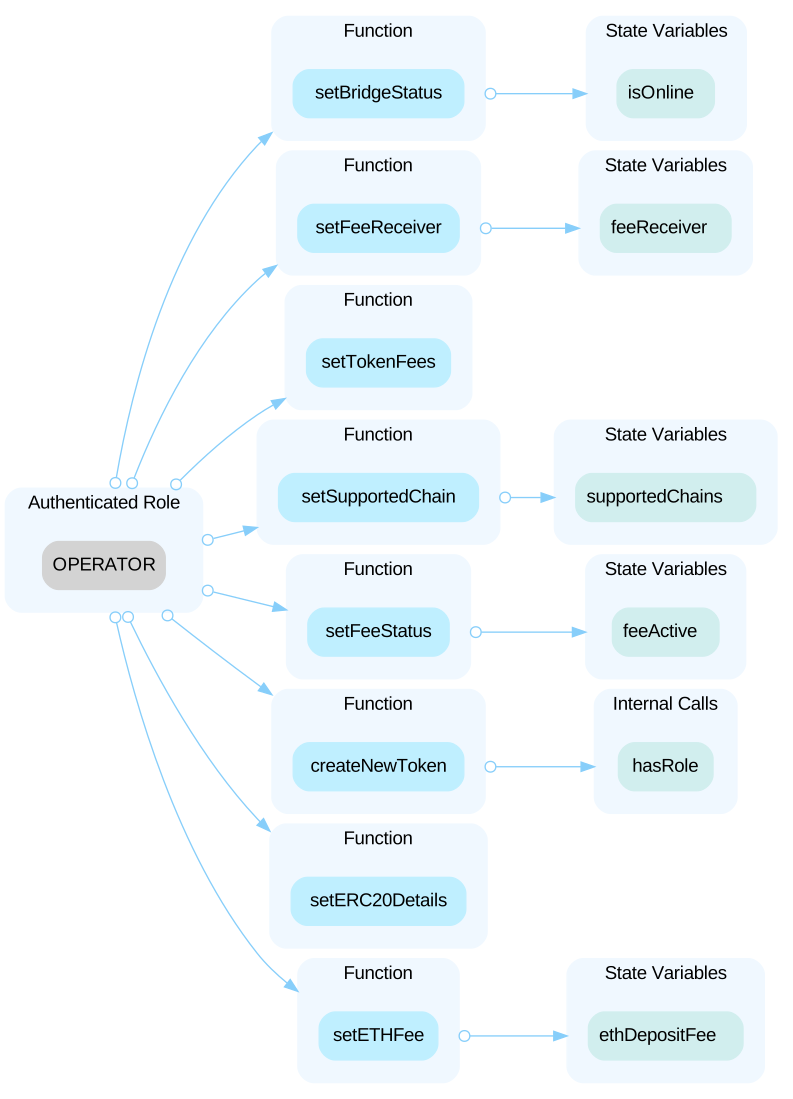 --- ## ERC721BridgeImpl.sol In the contract `ERC721BridgeImpl` the role `DEFAULT_ADMIN_ROLE` has authority over the functions shown in the diagram below. Any compromise to the `DEFAULT_ADMIN_ROLE` account may allow the hacker to take advantage of this authority and - change the implementation logic used by the proxy to malicious code - give any role used within the contract to an address they control - remove the role privilege from a legitimate account 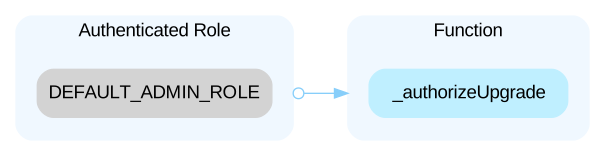 In the contract `ERC721BridgeImpl` the role `BRIDGE` has authority over the functions shown in the diagram below. Any compromise to the `BRIDGE` account may allow the hacker to take advantage of this authority and - withdraw all available ERC721 tokens in the contract and send to an account they control - mint any amount of any ERC721 tokens for which the bridge contract is the owner - update any NFT's market distributions to include any address and any uint rate, as long as the bridge contract is the owner of the ERC721 contract 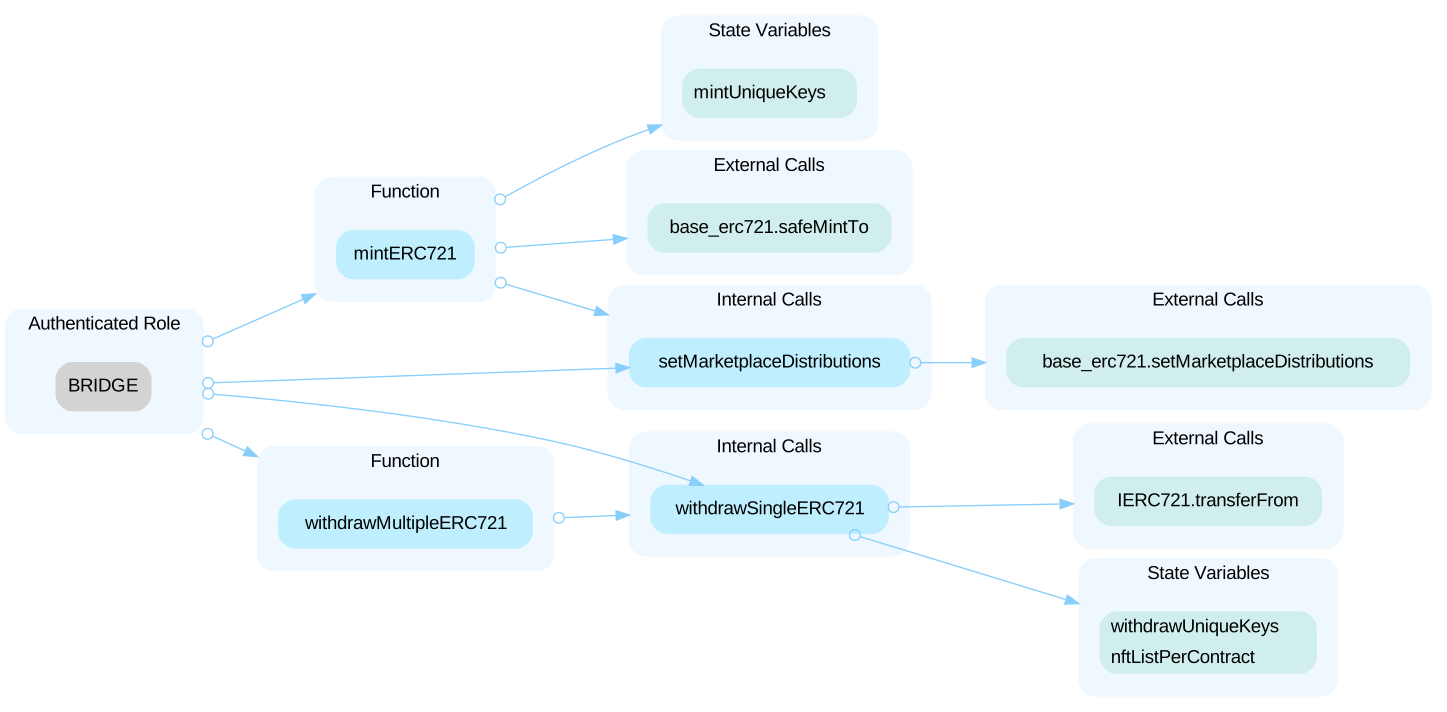 In the contract `ERC721BridgeImpl` the role `OPERATOR` has authority over the functions shown in the diagram below. Any compromise to the `OPERATOR` account may allow the hacker to take advantage of this authority and - update the bridge status in order to use or prevent the use of bridge functionality during a time-sensitive period. - change the `feeReceiver` address to an account t
HighCentralized Control of Contract UpgradeAcknowledged
In contracts `ERC20BridgeImpl` and `ERC721BridgeImpl`, the role `DEFAULT_ADMIN_ROLE` has the authority to update the implementation contract behind each contract. Any compromise to the `DEFAULT_ADMIN_ROLE` account may allow a hacker to take advantage of this authority and change the implementation contract pointed by proxy and execute potential malicious functionality in the implementation contract.
HighMinting Centralization RiskAcknowledged
In contracts `base_erc721` and `base_erc20`, the role `_owner` has the authority to mint tokens to arbitrary addresses. Any compromise to the `_owner` account may allow a hacker to take advantage of this authority and mint tokens to an address they control.
Contracts in scope
No deployed address is recorded for this audit.
The report names a repository or files. Open the report to see its scope.
Repository and files the report names (4)
- src/ERC20BridgeImpl.sol
- src/base_erc721.sol
- src/base_erc20.sol
- src/ERC721BridgeImpl.sol
Part of RealFevr’s security record
 RealFevr
Security firm
 CertiK
1,044 projects reviewed · 1,375 reports · latest May 2025
See CertiK’s auditsSomething wrong on this page? A missing report, a wrong date, a finding that was fixed since. Tell us and we check it against its source.
Tell us