Squidgrow - ILO
Part of CertiK’s series
CertiK reviewed SquidGrow (Squidgrow - ILO) on 22 May 2023: 25 findings, 1 critical; 21 marked fixed, 4 open.
Report hosted on skynet.certik.com.
Trustblock does not review code.
Findings25
Statuses are the security firm’s own, from its report.
| Severity | Open | Acknowledged | Fixed |
|---|---|---|---|
| Critical | 0 | 0 | 1 |
| High | 1 | 0 | 1 |
| Medium | 0 | 0 | 5 |
| Low | 3 | 0 | 14 |
HighCentralization Risks in ILO.solOpen
In the contract `SquidGrowILO` the role `_owner` has authority over the functions shown in the diagram below. Any compromise to the `_owner` account may allow the hacker to take advantage of this authority and - remove all BNB, `squidgrowToken`, or any other token from the contract; - reset the `merkleRoot` to a value which makes all previously whitelisted user's `merkleProof` invalid for either the contributions or airdrop; - update the truth value of `claimable` and `status` to prevent collection of `squidGrowToken` through contributions or airdrop; - update `maxContribution` to a lower value after users have begun purchasing, restricting some users from purchasing more `squidgrowToken`; - update `discount` and `bonusForTradeIn` to values that represent more than 100% of the original value, and use this remove all `squidgrowToken` from the contract via multiple accounts they own; - update the `tokenPrice` to a larger or smaller value, either making it easier or more difficult to exchange BNB for `squidgrowToken`; 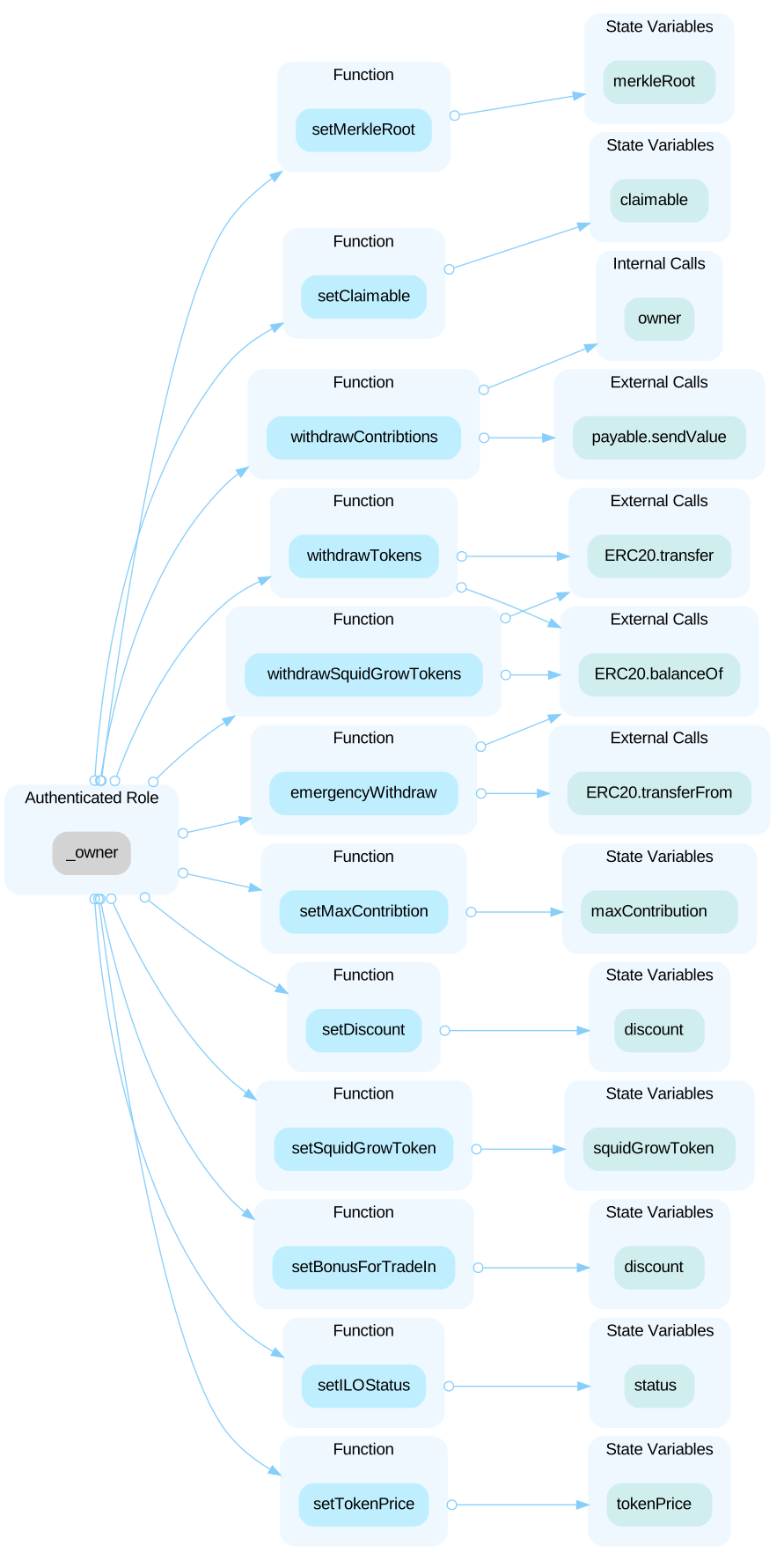
LowContract Should Be Separated By FunctionalityOpen
Based on discussion with the team, the contract `SquidGrowILO` has two separate purposes: 1. On BSC, users are supposed to interact with function `depositTokensForAirdrop()` to deposit their currently existing `squidGrowToken` into the contract. This is the only functionality that the user should interact with on BSC. 2. On ETH, users are supposed to interact with the following functions: - `publicContribution()` - `whitelistContribution()` - `claimAirdrop()` On ETH, a user can call `claimAirdrop()` to collect an airdrop reserved for them of the ETH `squidGrowToken` based on a snapshot of their deposit in the contract on BSC. Otherwise, they can purchase an initial offering of the token using native ether through function `publicContribution()` or `whitelistContribution()`. With this in mind, if the current version of `SquidGrowILO` is deployed on either platform, each instance of the contract will contain functionality that does not pertain to its intended purpose on that platform. Including extra functionality in a contract allows for the possibility of interaction with that functionality, if the contract is improperly set up. To remove this possibility, we recommend creating two separate contracts which only contain the logic that is specific to the contract's purpose on each platform.
LowInitial Offering and Airdrop Can Occur SimultaneoOpen
Function `setStatus()` does not check the state of bool `claimable` before being updated to `status` 1 or 2. Likewise, function `setClaimable()` does not check the `status` is 0 before allowing the variable to be updated to `true` If it is not the intention to allow users to purchase the `squidGrowToken` at the same time they can claim an airdrop, we recommend adding checks in each of these functions preventing the simultaneous activation of both. If the protocol allows for both to be activated at the same time by intention, then please confirm this is the case. --- Second, users can call function `depositTokensForAirdrop()` at any time, even when `claimable` is set to `true`. If `SGIOU` tokens are supposed to be acquired during a certain timeframe in order to be part of the airdrop, we recommend adding a mechanic that prevents users from using function `depositTokensForAirdrop()` after the timeframe is closed.
LowUse of `abi.encodePacked()`Open
As a general practice, use of `abi.encodePacked` is discouraged, since it is susceptible to hash collisions in some instances where dynamically-sized inputs are used consecutively. While this is not the case in this instance, we also note that `abi.encodePacked` may be removed in future solidity versions (see this issue: [https://github.com/ethereum/solidity/issues/11593](https://github.com/ethereum/solidity/issues/11593)).
Contracts in scope
No deployed address is recorded for this audit.
The report names a repository or files. Open the report to see its scope.
Repository and files the report names (1)
- contracts/ILO.sol
Part of SquidGrow’s security record
 SquidGrow
Security firm
 CertiK
1,045 projects reviewed · 1,376 reports · latest May 2025
See CertiK’s auditsSomething wrong on this page? A missing report, a wrong date, a finding that was fixed since. Tell us and we check it against its source.
Tell us