Bitonite has 1 public audit report from CertiK; dated 10 Jan 2024; no critical findings reported.
Last updated . It holds audits and findings, contracts and incidents up to Nov 2026. Trustblock does not review code.
Statuses are the security firms’ own
7 findings are still open or acknowledged in the firms’ reports: 3 high, 4 low (all open).
Centralization Related Risks
Bitonite · CertiK · 10 Jan 2024 · Report ↗
Centralized Control of Contract Upgrade
Bitonite · CertiK · 10 Jan 2024 · Report ↗
Initial Token Distribution
Bitonite · CertiK · 10 Jan 2024 · Report ↗
Incompatibility With Deflationary Tokens (Non-sta
Bitonite · CertiK · 10 Jan 2024 · Report ↗
Lack of Storage Gap in Upgradeable Contract
Bitonite · CertiK · 10 Jan 2024 · Report ↗
Potential for Disproportionate Rewards in New Poo
Bitonite · CertiK · 10 Jan 2024 · Report ↗
Unprotected Initializers
Bitonite · CertiK · 10 Jan 2024 · Report ↗
Newest first
| Report | Security firm | Date | Scope | Critical findings | Findings | Source |
|---|---|---|---|---|---|---|
| Bitonite | Security firm: CertiK | Date: | Scope: Files listed | None open | Findings: 3 high · 4 low 7 open | skynet.certik.com ↗ |
Statuses are the security firm’s own, from each report.
| Severity | Open | Acknowledged | Fixed |
|---|---|---|---|
| Critical | 0 | 0 | 0 |
| High | 3 | 0 | 0 |
| Medium | 0 | 0 | 0 |
| Low | 4 | 0 | 0 |
In the contract `OwnableUpgradeable` the role `_owner` has authority over the following functions: - transferOwnership() - renounceOwnership() Any compromise to the `_owner` account may allow the hacker to take advantage of this authority and transfer or renounce the ownership. --- In the contract `BitToken` the role `_owner` has authority over the functions shown in the diagram below. Any compromise to the `_owner` account may allow the hacker to take advantage of this authority and set the `beneficiary` addresses and transfer tokens to them. 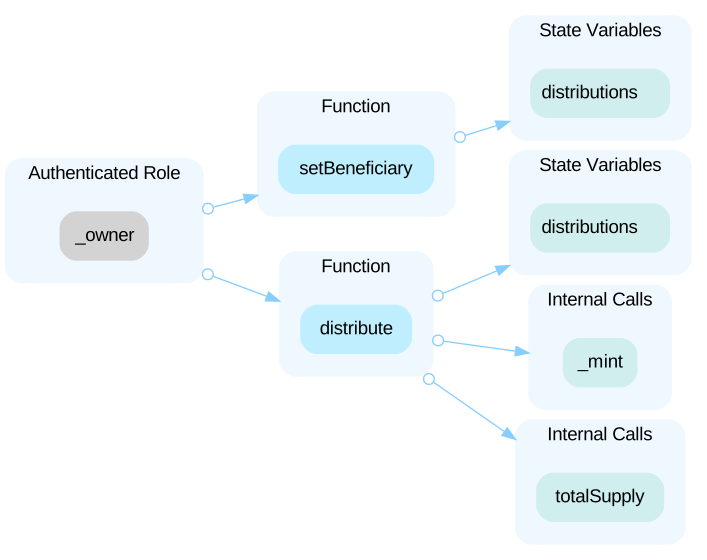 ----- In the contract `RewardsDistributor` the role `_owner` has authority over the functions shown in the diagram below. Any compromise to the `_owner` account may allow the hacker to take advantage of this authority and set the `rewardsTracker` address and withdraw tokens from the contract. 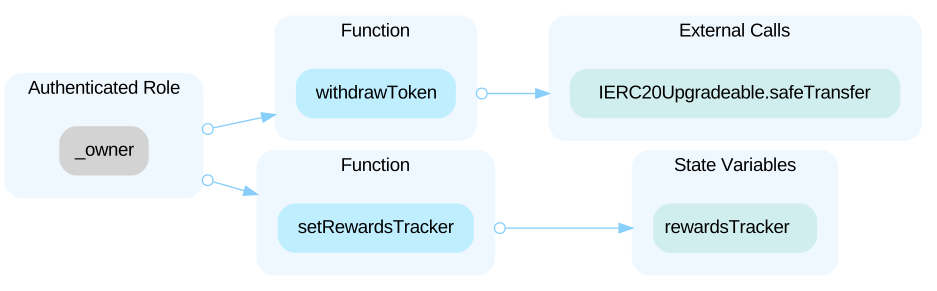 In the contract `RewardsDistributor` the role `rewardsTracker` has authority over the function shown in the diagram below. Any compromise to the `rewardsTracker` account may allow the hacker to take advantage of this authority and transfer `token` from the contract. 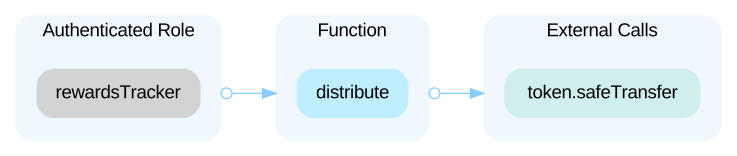 ----- In the contract `Staking` the role `_owner` has authority over the functions shown in the diagram below. Any compromise to the `_owner` account may allow the hacker to take advantage of this authority and set the reward provider, set the rewards burn rate (which can be up to 100%), add/update pools, and pause/unpause the contract. 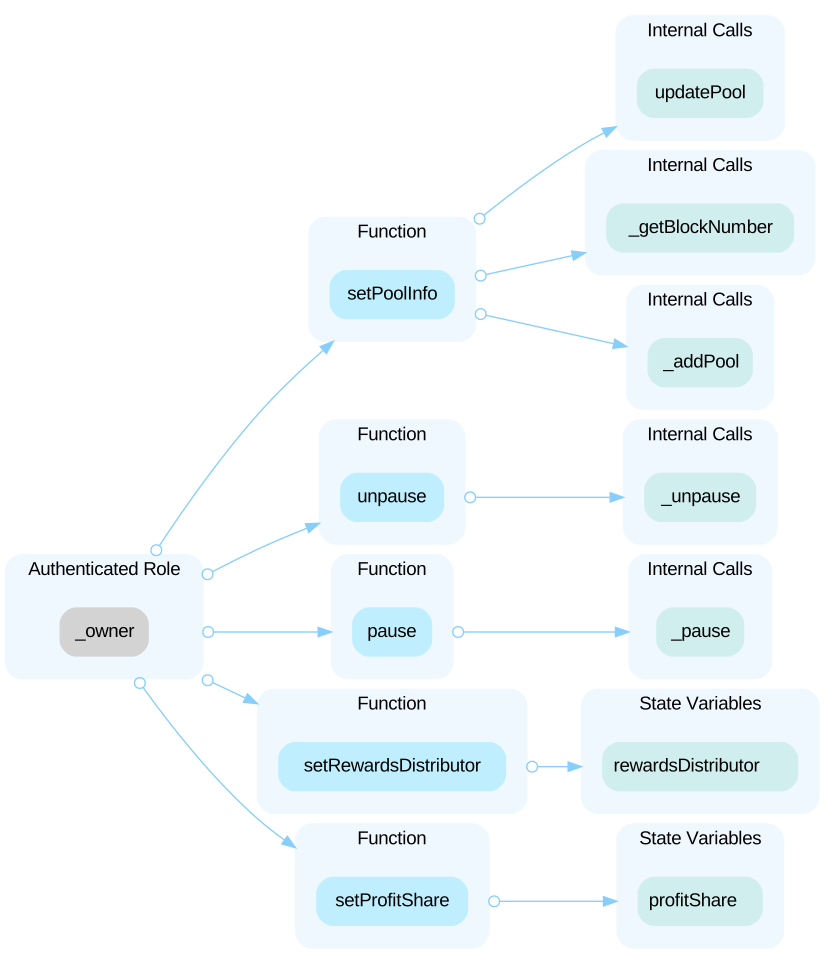 ----- In the contracts `LockBit` and `VestingBase`, the role `_owner` has authority over the following function: - setBeneficiary() Any compromise to the `_owner` account may allow the hacker to take advantage of this authority and set the `beneficiary` address. --- In the contracts `LockBit`, `Vesting`, and `VestingTge`, the role `beneficiary` has authority over the following function: - claim() Any compromise to the `beneficiary` account may allow the hacker to take advantage of this authority and transfer tokens from the contract.
Open the reportThe following contracts serve as implementation contracts behind the proxy contracts: - LockBit - Vesting - VestingTge - BitToken - RewardsDistributor - Staking The proxy admins have the authority to update the implementation contracts behind the proxy contracts. Any compromise to the proxy admins may allow a hacker to take advantage of this authority and change the implementation contract which is pointed by proxy and therefore execute potential malicious functionality in the implementation contract. For example, the staked tokens in the `Staking` contract can be swept out.
Open the reportAll of the BIT tokens will be sent to `beneficiary` addresses. This is a centralization risk because the addresses can distribute tokens without obtaining the consensus of the community. Any compromise to these addresses may allow a hacker to steal and sell tokens on the market, resulting in severe damage to the project.
Open the reportThe project design may not be compatible with non-standard ERC20 tokens, such as deflationary tokens or rebase tokens.
Open the reportThere is no storage gap preserved in the logic contract `VestingBase`. Any logic contract that acts as a base contract inherited by other upgradeable contracts should have a reasonable size of storage gap preserved for potential new state variables introduced in future upgrades. Otherwise, there could be potential storage slot collision.
Open the reportThe `_addPool()` function in the contract is responsible for adding new pools. It utilizes the `_mintStartBlock` parameter to set the initial block number for staking rewards. If this parameter is set to a very low number, such as 1, it could lead to a situation where the first staker in the new pool could claim an excessively large amount of rewards. This is because the rewards calculation would consider all the blocks from the `_mintStartBlock` to the current block, leading to a substantial reward accumulation for the initial blocks. The `setPoolInfo()` function shares the same issue. If an existing pool is updated with the `_mintStartBlock` parameter setting to a very low number, the stakers in the pool can get a lot of rewards. ```solidity=277 function _addPool( address _token, uint256 _rewardPerBlock, uint64 _cooldownPeriod, uint64 _mintStartBlock ) internal { if (_mintStartBlock == 0) { _mintStartBlock = _getBlockNumber(); } require(_rewardPerBlock != 0, "!rewardPerBlock"); poolTokens.push(_token); poolInfo[_token] = PoolInfo({ id: poolTokens.length.toUint64(), rewardPerBlock: _rewardPerBlock, lastRewardBlock: _mintStartBlock, cooldownPeriod: _cooldownPeriod, totalDeposits: 0, accPalmPerShare: 0 }); emit PoolUpdate( _token, poolTokens.length.toUint64(), _rewardPerBlock, _cooldownPeriod, _mintStartBlock ); } ```
Open the reportThe following logic contracts do not protect their initializers. An attacker can call the initializers and assume ownership of the logic contracts, whereby she can perform privileged operations that trick unsuspecting users into believing that she is the owner of the upgradeable contracts. ```solidity=8 contract BitToken is IBitToken, ERC20PermitUpgradeable, OwnableUpgradeable { ``` - `BitToken` is an upgradeable contract that does not protect its initializer. ```solidity=24 function initialize() external initializer { ``` - `initialize` is an unprotected initializer function. --- ```solidity=8 contract RewardsDistributor is IRewardsDistributor, OwnableUpgradeable { ``` - `RewardsDistributor` is an upgradeable contract that does not protect its initializer. ```solidity=16 function initialize(address _token, address _rewardsTracker) external initializer { ``` - `initialize` is an unprotected initializer function. --- ```solidity=12 contract Staking is OwnableUpgradeable, ReentrancyGuardUpgradeable, PausableUpgradeable { ``` - `Staking` is an upgradeable contract that does not protect its initializer. ```solidity=66 function initialize( ``` - `initialize` is an unprotected initializer function. --- ```solidity=7 contract LockBit is OwnableUpgradeable { ``` - `LockBit` is an upgradeable contract that does not protect its initializer. ```solidity=21 function initialize( ``` - `initialize` is an unprotected initializer function. --- ```solidity=7 contract Vesting is VestingBase { ``` - `Vesting` is an upgradeable contract that does not protect its initializer. ```solidity=17 function initialize( ``` - `initialize` is an unprotected initializer function. --- ```solidity=7 contract VestingTge is VestingBase { ``` - `VestingTge` is an upgradeable contract that does not protect its initializer. ```solidity=18 function initialize( ``` - `initialize` is an unprotected initializer function.
Open the reportThe reports name a repository or files. Open a report to see its scope.
Trustblock holds 1 public audit report for Bitonite, dated 10 Jan 2024. The latest is by CertiK (“Bitonite”).
CertiK wrote the report Trustblock holds for Bitonite.
7 findings are still open or acknowledged in the firms’ reports: 3 high, 4 low (all open). No critical finding is reported. Statuses are the security firms’ own.
Is this your project? Show this record on your own website. The label states what the record holds, links to this page and updates by itself. It is free and needs no sign-in.
Automatic: the three strongest facts of this project’s own record (its last audit and two more), highlighted. They update with the record. Picking a fact turns Automatic off.
<head><script src="https://widget.trustblock.run/project-widget.min.js" defer></script></head><body><divdata-tb-project-widgetdata-tb-project-slug="bitonite"></div></body>
Paste the code where the label should appear. It uses no API credit and updates by itself.
Something wrong on this page? A missing report, a wrong date, a finding that was fixed since. Tell us and we check it against its source.
Tell us