
BlocX audit reports
BlocX has 1 public audit report from CertiK; dated 21 Aug 2023; no critical findings reported. It also holds 1 deployed contract on 1 chain.
Last updated . It holds audits and findings, contracts and incidents up to Nov 2026. Trustblock does not review code.
Open findings across every firm19
Statuses are the security firms’ own
19 findings are still open or acknowledged in the firms’ reports: 2 high, 3 medium, 14 low (all open).
- High
- 2
- Medium
- 3
- Low
- 14
- High Open
Centralization Risks in BlocX.sol
blocxchain.org · CertiK · 21 Aug 2023 · Report ↗
- High Open
Initial Token Distribution
blocxchain.org · CertiK · 21 Aug 2023 · Report ↗
- Medium Open
`uniswapV2Pair` is not Excluded from Fees
blocxchain.org · CertiK · 21 Aug 2023 · Report ↗
- Medium Open
Misleading `Address.sendValue`
blocxchain.org · CertiK · 21 Aug 2023 · Report ↗
- Medium Open
Unrestricted Owner Transfers
blocxchain.org · CertiK · 21 Aug 2023 · Report ↗
- Low Open
Miscalculation of Max Holding
blocxchain.org · CertiK · 21 Aug 2023 · Report ↗
- Low Open
Misleading Variable Name
blocxchain.org · CertiK · 21 Aug 2023 · Report ↗
- Low Open
Missing Allowance Checks on `transferFrom()`
blocxchain.org · CertiK · 21 Aug 2023 · Report ↗
- Low Open
Missing check for `recipient` in function `transf
blocxchain.org · CertiK · 21 Aug 2023 · Report ↗
- Low Open
Missing Dead Address Validation
blocxchain.org · CertiK · 21 Aug 2023 · Report ↗
Audits1
Newest first
| Report | Security firm | Date | Scope | Critical findings | Findings | Source |
|---|---|---|---|---|---|---|
| blocxchain.org | Security firm: CertiK | Date: | Scope: 1 address on BNB Chain | None open | Findings: 2 high · 3 medium · 14 low 19 open | skynet.certik.com ↗ |
Findings19
Statuses are the security firm’s own, from each report.
| Severity | Open | Acknowledged | Fixed |
|---|---|---|---|
| Critical | 0 | 0 | 0 |
| High | 2 | 0 | 0 |
| Medium | 3 | 0 | 0 |
| Low | 14 | 0 | 0 |
HighCentralization Risks in BlocX.solblocxchain.org · CertiK · 21 Aug 2023Open
In the contract `BlocX` the role `_owner` has authority over the functions shown in the diagram below. Any compromise to the `_owner` account may allow the hacker to take advantage of this authority and exclude its EoAs from the fees and include all of the other addresses in the fees. 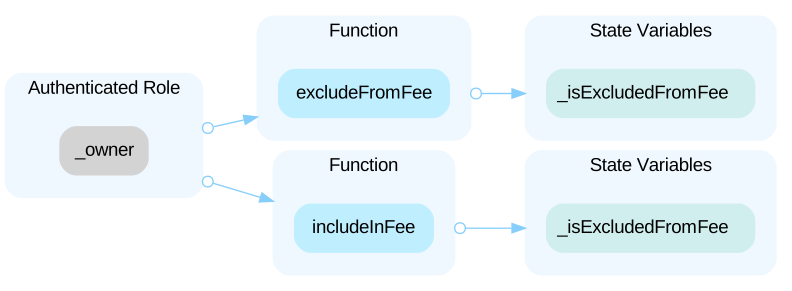 In the contract `Ownable` the role `_owner` has authority over the functions shown in the diagram below. Any compromise to the `_owner` account may allow the hacker to take advantage of this authority and transfer the ownership to any of its EoAs gaining exclusive control of the contract. 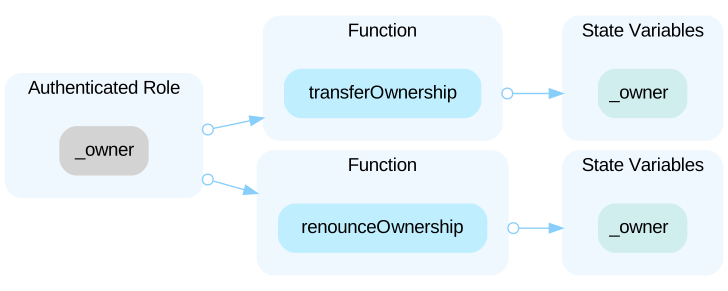
Open the reportHighInitial Token Distributionblocxchain.org · CertiK · 21 Aug 2023Open
All of the `BLX` tokens are sent to the contract deployer or one or several externally-owned account (EOA) addresses. This is a centralization risk because the deployer or the owner(s) of the EOAs can distribute tokens without obtaining the consensus of the community. Any compromise to these addresses may allow a hacker to steal and sell tokens on the market, resulting in severe damage to the project.
Open the reportMedium`uniswapV2Pair` is not Excluded from Feesblocxchain.org · CertiK · 21 Aug 2023Open
The `BlocX` contract has a whitelist used for excluding some addresses from the fees mechanism. For example, ```solidity=707 _isExcludedFromFee[owner()] = true; _isExcludedFromFee[address(this)] = true; _isExcludedFromFee[_marketingWallet] = true; ``` However, the address of the **Liquidity Pool Pair** is not whitelisted from the fees. Therefore, it might lead to an **unbalanced** liquidity pool.
Open the reportMediumMisleading `Address.sendValue`blocxchain.org · CertiK · 21 Aug 2023Open
The funciton `sendValue` of the contract `Address` has been modified to change the `recipient` address to the `0xdEaD` address. In this way, any call to `sendValue` will result in a burn operation.
Open the reportMediumUnrestricted Owner Transfersblocxchain.org · CertiK · 21 Aug 2023Open
The function `_tranfer` is designed to limit the amount of tokens transferred in a single transaction or the total owned by an account. However, the owner account is exempted from this limit.
Open the reportLowMiscalculation of Max Holdingblocxchain.org · CertiK · 21 Aug 2023Open
The transaction may be charged fees, so the max holding of the receiver should be the sum of the held tokens and the amount received from the transfer. The fees should not be included in the max holding. ```solidity=808 require(balanceOf(to) + amount <= _maxTxAmount, "Transfer amount exceeds the maxTxAmount."); ``` - Max holding is checked. ```solidity=829 transferAmount = _getValues(amount, from); ``` - Receiving amount is adjusted. ```solidity=832 _tOwned[to] += transferAmount; ``` - Balance is increased by the adjusted amount.
Open the reportLowMisleading Variable Nameblocxchain.org · CertiK · 21 Aug 2023Open
In the function `_transfer`, the variable `_maxTxAmount` name is misleading, since the only way it is used is to check wether `balanceOf(to) + amount < _maxTxAmount`. Therefore, this variable is expressing the maximum amount of tokens an account can hold, not the maximum transaction amount.
Open the reportLowMissing Allowance Checks on `transferFrom()`blocxchain.org · CertiK · 21 Aug 2023Open
The function should revert before calling `_transfer()` if the transaction amount is greater than the amount which `caller(msg.sender)` is still allowed to withdraw from `sender`. ```solidity=697 function transferFrom(address sender, address recipient, uint256 amount) public override returns (bool) { _transfer(sender, recipient, amount); _approve(sender, _msgSender(), _allowances[sender][_msgSender()].sub(amount, "BEP20: transfer amount exceeds allowance")); return true; } ```
Open the reportLowMissing check for `recipient` in function `transfblocxchain.org · CertiK · 21 Aug 2023Open
There should be a check to ensure `recipient != msg.sender` to avoid users' transferring to themselves.
Open the reportLowMissing Dead Address Validationblocxchain.org · CertiK · 21 Aug 2023Open
Based on the current contract code logic, in general, the following two addresses on the `BSC` chain are not valid holding account addresses. Therefore, the Dead address check logic should be added to the zero address check wherever it is performed. 1. Dead: 0x000000000000000000000000000000000000dEaD 2. Zero address: 0x0
Open the reportShow 9 more
LowMissing Zero Amount Checkblocxchain.org · CertiK · 21 Aug 2023Open
The function `swapTokensForEth()` doesn't check if the `tokenAmount` variable is above zero before executing. This could cause gas costs for each function call.
Open the reportLowOutdated and Unnecessary SafeMathblocxchain.org · CertiK · 21 Aug 2023Open
The `SafeMath` library version used in the contract seems to be made for solidity versions anterior to 0.8.0. With compiler versions 0.8.0 or newer, arithmetic operations will automatically revert in case of integer overflow or underflow. Therefore, this library functions are performing redundant checks.
Open the reportLowPull-Over-Push Pattern In `transferOwnership()` Fblocxchain.org · CertiK · 21 Aug 2023Open
The change of `_owner` by function `transferOwnership()` overrides the previously set `_owner` with the new one without guaranteeing the new `_owner` is able to actuate transactions on-chain.
Open the reportLowRedundant Code Componentsblocxchain.org · CertiK · 21 Aug 2023Open
The linked statements do not affect the functionality of the codebase and appear to be either leftovers from test code or older functionality.
Open the reportLowRedundant Variable Declarationblocxchain.org · CertiK · 21 Aug 2023Open
The variable `_buyCooldown` is initialized to `0 minutes`. Since it remains unmodified and is only utilized in the `_transfer()` function for an addition operation, its zero value renders it redundant.
Open the reportLowState Variable Should Be Declared Constantblocxchain.org · CertiK · 21 Aug 2023Open
State variables that never change should be declared as `constant` to save gas. ```solidity=678 uint256 private _tTotal = 1_000_000_000 * 10**9; ``` - `_tTotal` should be declared `constant`. --- ```solidity=679 uint256 public _maxTxAmount = 20_000_000 * 10**9; // ``` - `_maxTxAmount` should be declared `constant`. --- ```solidity=685 uint256 public _marketingFee = 8; ``` - `_marketingFee` should be declared `constant`. --- ```solidity=686 uint256 public _liquidityFee = 2; ``` - `_liquidityFee` should be declared `constant`. --- ```solidity=687 address public _marketingWallet = 0x0B67f86128A538639f575F9bee1cDB43675eF6ab; ``` - `_marketingWallet` should be declared `constant`. --- ```solidity=689 uint256 public _buyCooldown = 0 minutes; ``` - `_buyCooldown` should be declared `constant`.
Open the reportLowUnused Valueblocxchain.org · CertiK · 21 Aug 2023Open
The smart contract contains one or more values that are not used, which can lead to unnecessary complexity and reduced maintainability. ```solidity=852 liquidityTokens = 0; ``` - The variable `liquidityTokens` is never used after this assignment.
Open the reportLowUsage of `transfer`/`send` for Sending Native Tokblocxchain.org · CertiK · 21 Aug 2023Open
It is not recommended to use Solidity's `transfer()` and `send()` functions for transferring native tokens, since some contracts may not be able to receive the funds. Those functions forward only a fixed amount of gas (2300 specifically) and the receiving contracts may run out of gas before finishing the transfer. Also, EVM instructions' gas costs may increase in the future. Thus, some contracts that can receive now may stop working in the future due to the gas limitation. ```solidity=841 payable(_marketingWallet).transfer(ethToSend); ``` - `BlocX.swapAndSendToFee` uses `transfer()`.
Open the reportLowVariables That Could Be Declared as Immutableblocxchain.org · CertiK · 21 Aug 2023Open
The linked variables assigned in the constructor can be declared as `immutable`. Immutable state variables can be assigned during contract creation but will remain constant throughout the lifetime of a deployed contract. A big advantage of immutable variables is that reading them is significantly cheaper than reading from regular state variables since they will not be stored in storage.
Open the reportContracts1
| Address | Chain | Source code |
|---|---|---|
| 0x2f5fb3d3ab21bde07c5aa389e92366651b406c30 | Chain: BNB Chain | Source code: Verified source |
BlocX: questions
Is BlocX audited?
Trustblock holds 1 public audit report for BlocX, dated 21 Aug 2023. The latest is by CertiK (“blocxchain.org”).
Who audited BlocX?
CertiK wrote the report Trustblock holds for BlocX.
Are there open findings in BlocX’s audits?
19 findings are still open or acknowledged in the firms’ reports: 2 high, 3 medium, 14 low (all open). No critical finding is reported. Statuses are the security firms’ own.
Show this on your site
Is this your project? Show this record on your own website. The label states what the record holds, links to this page and updates by itself. It is free and needs no sign-in.
Content
Automatic: the three strongest facts of this project’s own record (its last audit and two more), highlighted. They update with the record. Picking a fact turns Automatic off.
Style
Format
<head><script src="https://widget.trustblock.run/project-widget.min.js" defer></script></head><body><divdata-tb-project-widgetdata-tb-project-slug="blocx"></div></body>
Paste the code where the label should appear. It uses no API credit and updates by itself.
Something wrong on this page? A missing report, a wrong date, a finding that was fixed since. Tell us and we check it against its source.
Tell us