
Byte Masons - Reliquary security record
As of 23 Oct 2026, Byte Masons - Reliquary has 2 audit reports by 1 security firm on Trustblock; the latest is by CertiK, dated 20 Nov 2022. Those reports list no open critical findings.
Record last updated . It holds audits and findings, contracts and incidents up to Oct 2026. Trustblock does not review code.
Audits2
Newest first
| Audit | Security firm | Date | Scope | Critical findings | Report |
|---|---|---|---|---|---|
| Granary v1 | Security firm: CertiK | Date: | Scope: Files named in the report | No open critical findings | Open · skynet.certik.com |
| Bytemasons - Multistrategy Vault | Security firm: CertiK | Date: | Scope: Files named in the report | No open critical findings | Open · skynet.certik.com |
Findings42
Statuses are the security firm’s own, from each report.
| Severity | Open | Acknowledged | Fixed |
|---|---|---|---|
| Critical | 0 | 0 | 0 |
| High | 2 | 2 | 0 |
| Medium | 0 | 3 | 0 |
| Low | 26 | 0 | 9 |
HighCentralization Related RisksBytemasons - Multistrategy Vault · CertiK · 8 Nov 2022Acknowledged
Linked functions are restricted to execute for valid roles only. Depending on access level, a DEFAULT_ADMIN_ROLE, ADMIN, GUARDIAN, or STRATEGIST role will be required. Any compromise to those accounts may allow a hacker to take advantage of this authority and execute restricted operations in the smart contract.
Open the reportHighCentralization Related Risks on UpgradeBytemasons - Multistrategy Vault · CertiK · 8 Nov 2022Acknowledged
In the contract `ReaperBaseStrategyv4.sol`, during the authorization process of the UUPS upgrade, the permissions are limited to the following address having the `DEFAULT_ADMIN_ROLE` set: * `msg.sender` address defined during initialization. * an unknown address set as `multisigRole[0]` during initialization. However, no multi-signature validations are found in the codebase that is verified upon a new upgrade request. #### Permissioned functions 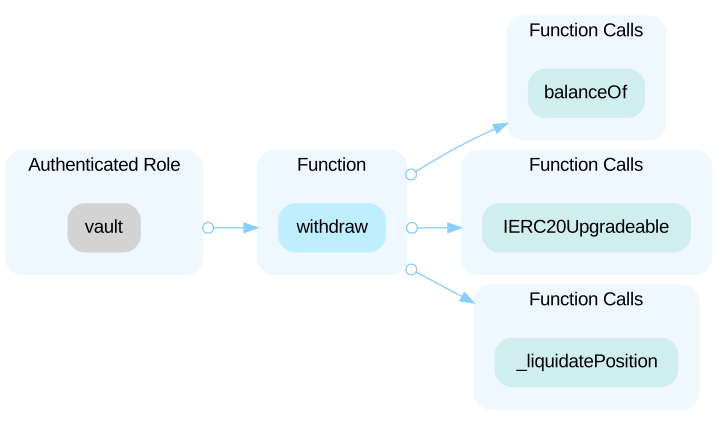 #### Upgrade requirements Additionally to this, to run the upgrade process successfully next operations are required to be executed: * The external function `initiateUpgradeCooldown()`must be called to refresh the value of `upgradeProposalTime` to current `block.timestamp`. * The waiting period between the last upgrade and the current upgrade must be bigger than `48h`. This behavior, while adding better reliability and security in a deployed smart contract, limits the ability of the team to face unknown issues and attacks that needs to be patched fast.
Open the reportMediumChecks-Effects-Interactions Pattern ViolationsGranary v1 · CertiK · 20 Nov 2022Acknowledged
The following `burn` function in line 214 of the LendingPoolCollateralManager.sol file could potentially result in reentrancy if the underlying token implementation has a built-in hook akin to ERC677, ERC777, and ERC721. Maliciously implemented hook in the attacker contract could re-enter upon transfer and borrow more by supplying more tokens. The design choice of the underlying chain that deploys the project could also result in an attack if the platform utilizes a different standard for token representation. For example, if a bridge uses an extended ERC677 token for every deposit of ERC20 this will also result in a re-entrancy risk. ```solidity=212 vars.collateralLToken.burn( user, msg.sender, vars.maxCollateralToLiquidate, collateralReserve.liquidityIndex ); ``` ```solidity=222 if (vars.maxCollateralToLiquidate == vars.userCollateralBalance) { userConfig.setUsingAsCollateral(collateralReserve.id, false); emit ReserveUsedAsCollateralDisabled(collateralAsset, user); } ```
Open the reportMediumPotential Flashloan AttackGranary v1 · CertiK · 20 Nov 2022Acknowledged
The function can be affected by a flashloan attack such that the new stable borrow rate becomes the lowest possible. A malicious actor can first request a flashloan to deposit into the reserve pool so that the reserve’s utilization rate is close to 0, then invoke `swapBorrowRateMode()` to perform the variable-to-borrow rate switch and enjoy the lowest `currentStableBorrowRate`, and finally withdraw to return the flashloan. A similar approach can also be applied to bypass `maxStableLoanPercent` enforcement in `validateBorrow()`.
Open the reportMediumIncompatibility With Deflationary TokensBytemasons - Multistrategy Vault · CertiK · 8 Nov 2022Acknowledged
When transferring standard ERC20 deflationary tokens, the input amount may not be equal to the received amount due to the charged transaction fee. For example, if a user stakes 100 deflationary tokens (with a 10% transaction fee) in a MasterChef, only 90 tokens actually arrived in the contract. However, the user can still withdraw 100 tokens from the contract, which causes the contract to lose 10 tokens in such a transaction. The MasterChef takes the pool token balance(the `lpSupply`) into account when calculating the users' reward. An attacker can repeat the process of deposit and withdraw to lower the token balance(`lpSupply`) in a deflationary token pool and cause the contract to increase the reward amount. Reference: https://thoreum-finance.medium.com/what-exploit-happened-today-for-gocerberus-and-garuda-also-for-lokum-ybear-piggy-caramelswap-3943ee23a39f
Open the reportContracts
No deployed address is recorded for these audits.
The reports name a repository or files. Open a report to see its scope.
Show this on your site
Is this your project? Show this record on your own website. The label states what the record holds, links to this page and updates by itself. It is free and needs no sign-in.
Content
Automatic: the three strongest facts of this project’s own record (its last audit and two more), highlighted. They update with the record. Picking a fact turns Automatic off.
Style
Format
<head><script src="https://widget.trustblock.run/project-widget.min.js" defer></script></head><body><divdata-tb-project-widgetdata-tb-project-slug="byte-masons-reliquary"></div></body>
Paste the code where the label should appear. It uses no API credit and updates by itself.
Something wrong on this page? A missing report, a wrong date, a finding that was fixed since. Tell us and we check it against its source.
Tell us