As of 14 Oct 2026, Froggy has 1 audit report on Trustblock, by CertiK, dated 10 Oct 2023. That report lists no open critical findings. It also holds 1 deployed contract on 1 chain.
Record last updated . It holds audits and findings, contracts and incidents up to Oct 2026. Statuses are the security firms’ own. Trustblock does not review code.
Newest first
| Audit | Security firm | Date | Scope | Critical findings | Report |
|---|---|---|---|---|---|
| Froggy - Audit | Security firm: CertiK | Date: | Scope: 1 address on BNB Chain | No open critical findings | Open · skynet.certik.com |
Statuses are the security firm’s own, from each report.
| Severity | Open | Acknowledged | Fixed |
|---|---|---|---|
| Critical | 0 | 0 | 0 |
| High | 0 | 2 | 0 |
| Medium | 0 | 1 | 0 |
| Low | 0 | 3 | 0 |
In the contract `Froggy` the role `_owner` has authority over the functions shown in the diagram below. Any compromise to the `_owner` account may allow the hacker to take advantage of this authority. - `claimStuckTokens`: withdraw the contract's eth and tokens - `setBuyTax`: update buy fee `marketingTaxBuy` - `setSellTax`: update sell fee `marketingTaxSell` - `setTransferTax`: update transfer fee `marketingTaxTransfer` - `setMarketingWallet`: update the marketing wallet `marketingWallet` - `setSwapTokensAtAmount`: update `swapTokensAtAmount` - `toggleSwapBack`: update `isSwapBackEnabled` - `setAutomatedMarketMakerPair`: update `_isAutomatedMarketMakerPair` - `setExcludeFromFees`: update `_isExcludedFromFees` 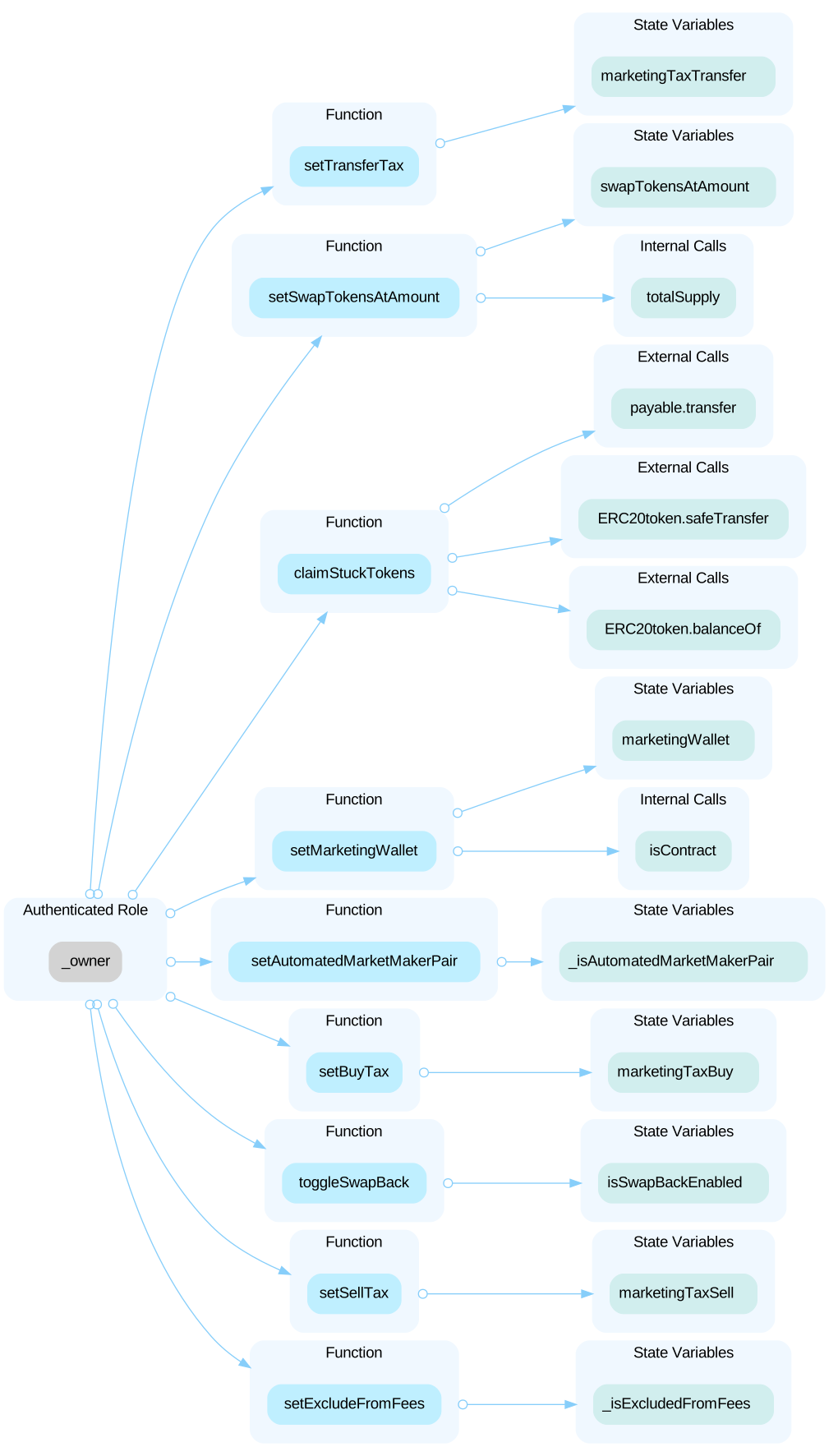 In the contract `Ownable` the role `_owner` has authority over the functions shown in the diagram below. Any compromise to the `_owner` account may allow the hacker to take advantage of this authority and transfer/renounce the ownership of the contract. 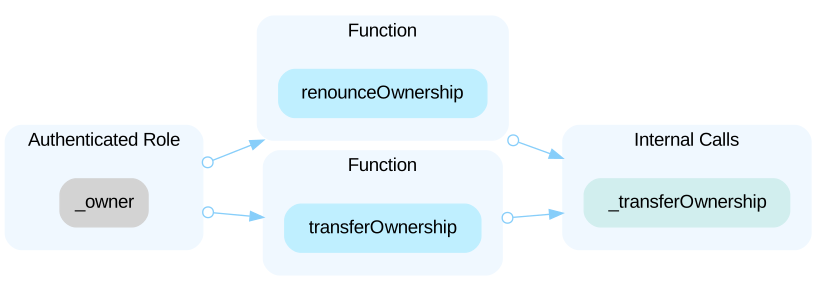
Open the reportAll of the `FROGGY` tokens are sent to the contract deployer or one or several externally-owned account (EOA) addresses. This is a centralization risk because the deployer or the owner(s) of the EOAs can distribute tokens without obtaining the consensus of the community. Any compromise to these addresses may allow a hacker to steal and sell tokens on the market, resulting in severe damage to the project.
Open the reportThe `Froggy` contract has a whitelist used for excluding some addresses from the fees mechanism. For example, ```solidity _isExcludedFromFees[address(this)] = true; _isExcludedFromFees[address(uniswapV2Router)] = true; _isExcludedFromFees[address(owner())] = true; _isExcludedFromFees[address(0xdead)] = true; ``` However, the address of the **Liquidity Pool Pair** is not whitelisted from the fees. Therefore, it might lead to an **unbalanced** liquidity pool.
Open the reportA sandwich attack may happen when an attacker observes a transaction swapping tokens or adding liquidity without setting restrictions on slippage or minimum output amount. The attacker can manipulate the exchange rate by frontrunning (executing before the target) a transaction to purchase one of the assets and make profits by backrunning (executing after the target) a transaction to sell the asset. The following functions are called without setting restrictions on slippage or minimum output amount, so transactions triggering these functions are vulnerable to sandwich attacks, especially when the input amount is large: - `swapExactTokensForTokensSupportingFeeOnTransferTokens()`
Open the reportThe contract is serving as the underlying entity to interact with one or more third party protocols. The scope of the audit treats third party entities as black boxes and assumes their functional correctness. However, in the real world, third parties can be compromised and this may lead to lost or stolen assets. In addition, upgrades of third parties can possibly create severe impacts, such as increasing fees of third parties, migrating to new LP pools, etc. ```solidity=864 IUniswapV2Router02 public immutable uniswapV2Router; ``` - The contract `Froggy` interacts with third party contract with `IUniswapV2Router02` interface via `uniswapV2Router`.
Open the reportIt is not recommended to use Solidity's `transfer()` and `send()` functions for transferring native tokens, since some contracts may not be able to receive the funds. Those functions forward only a fixed amount of gas (2300 specifically) and the receiving contracts may run out of gas before finishing the transfer. Also, EVM instructions' gas costs may increase in the future. Thus, some contracts that can receive now may stop working in the future due to the gas limitation. ```solidity=941 payable(msg.sender).transfer(address(this).balance); ``` - `Froggy.claimStuckTokens` uses `transfer()`.
Open the report| Address | Chain | Source code |
|---|---|---|
| 0x4c56…421b0x4c561c1ef2109fc6b230304b114671f72820421b | Chain: BNB Chain | Source code: Verified source |
Is this your project? Show this record on your own website. The label states what the record holds, links to this page and updates by itself. It is free and needs no sign-in.
Automatic: the three strongest facts of this project’s own record (its last audit and two more), highlighted. They update with the record. Picking a fact turns Automatic off.
<head><script src="https://widget.trustblock.run/project-widget.min.js" defer></script></head><body><divdata-tb-project-widgetdata-tb-project-slug="froggy"></div></body>
Paste the code where the label should appear. It uses no API credit and updates by itself.
Something wrong on this page? A missing report, a wrong date, a finding that was fixed since. Tell us and we check it against its source.
Tell us