
Hyperchain X security record
As of 3 Nov 2026, Hyperchain X has 1 audit report on Trustblock, by CertiK, dated 9 Mar 2023. That report lists no open critical findings. It also holds 1 deployed contract on 1 chain.
Record last updated . It holds audits and findings, contracts and incidents up to Nov 2026. Trustblock does not review code.
Audits1
Newest first
| Audit | Security firm | Date | Scope | Critical findings | Report |
|---|---|---|---|---|---|
| HyperChainX-Audit | Security firm: CertiK | Date: | Scope: 1 address on BNB Chain | No open critical findings | Open · skynet.certik.com |
Findings12
Statuses are the security firm’s own, from each report.
| Severity | Open | Acknowledged | Fixed |
|---|---|---|---|
| Critical | 0 | 0 | 0 |
| High | 2 | 0 | 0 |
| Medium | 0 | 0 | 0 |
| Low | 9 | 0 | 1 |
HighCentralization Risks in HYPERCHAIN.solHyperChainX-Audit · CertiK · 9 Mar 2023Open
In the contract `HYPERCHAIN` the role `_owner` has authority over the functions shown in the diagram below. Any compromise to the `_owner` account may allow the hacker to take advantage of this authority. 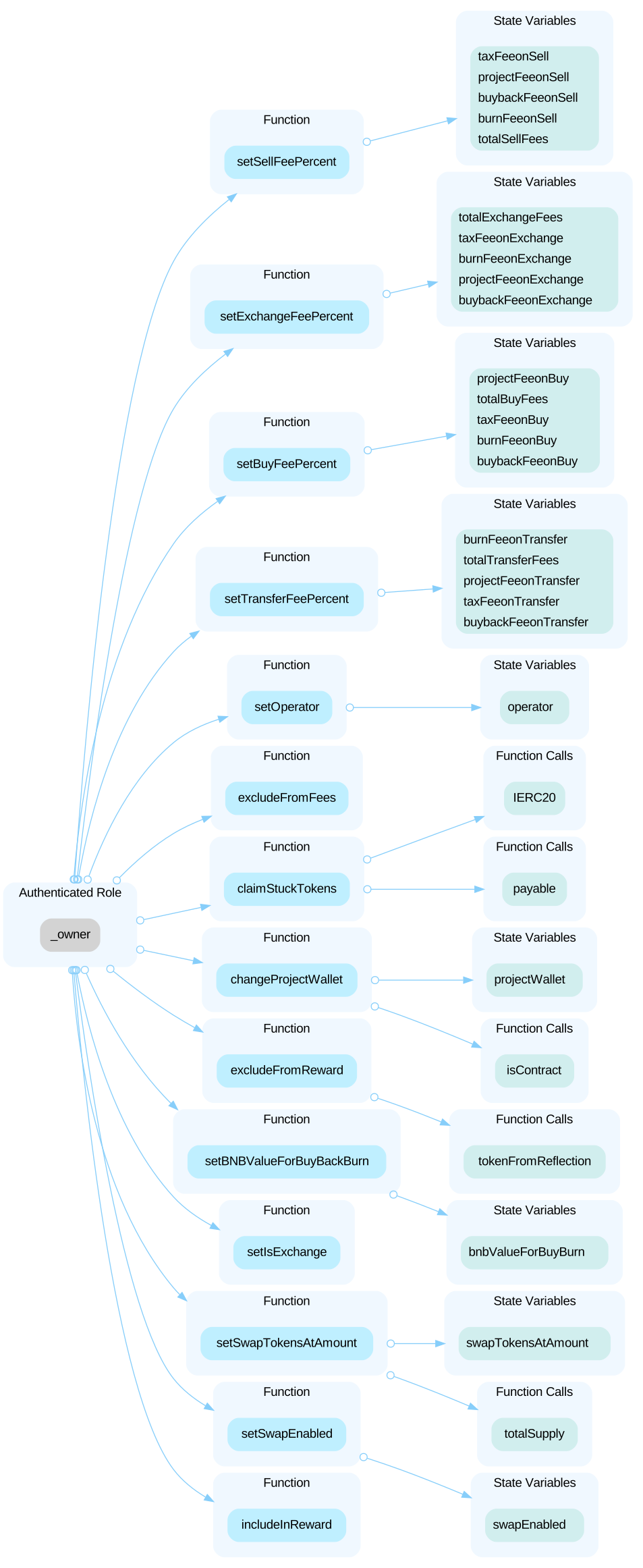 In the contract `HYPERCHAIN` the role `operator` has authority over the functions shown in the diagram below. Any compromise to the `operator` account may allow the hacker to take advantage of this authority. 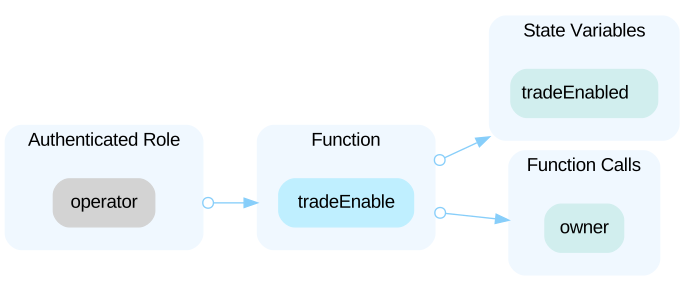 In the contract `Ownable` the role `_owner` has authority over the functions shown in the diagram below. Any compromise to the `_owner` account may allow the hacker to take advantage of this authority. 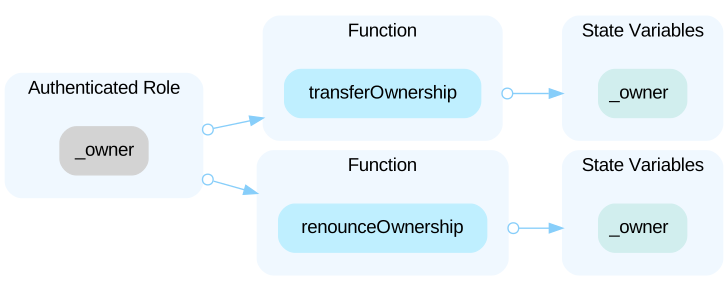
Open the reportHighInitial token distributionHyperChainX-Audit · CertiK · 9 Mar 2023Open
All of the `HYPER` tokens are sent to the `operator` when deploying the contract. This could be a centralization risk as the `operator` can distribute tokens without obtaining the consensus of the community. Since the privilege of the `operator`, it is possible of being maliciously manipulated by hackers if the account of the owner was compromised.
Open the reportLowIneffective `isContract` CheckHyperChainX-Audit · CertiK · 9 Mar 2023Open
The `isContract` check cannot cover all scenarios. The check can be bypassed if the call is from the constructor of a contract or when the contract is destroyed. In that case, `isContract` will return `false` because its `codesize` will be zero. The comment in the `isContract` implementation from the OpenZeppelin library also says that "it is unsafe to assume that an address for which this function returns false is an externally-owned account (EOA) and not a contract." - Reference: https://github.com/OpenZeppelin/openzeppelin-contracts/blob/3dac7bbed7b4c0dbf504180c33e8ed8e350b93eb/contracts/utils/Address.sol ```solidity=935 require(!isContract(newProjectWallet), "Cannot be contract address"); ```
Open the reportLowMissing Emit EventsHyperChainX-Audit · CertiK · 9 Mar 2023Open
There should always be events emitted in the sensitive functions that are controlled by centralization roles.
Open the reportLowMissing Zero Address ValidationHyperChainX-Audit · CertiK · 9 Mar 2023Open
Addresses should be checked before assignment or external call to make sure they are not zero addresses. ```solidity=394 operator = _operator; ``` - `_operator` is not zero-checked before being used.
Open the reportLowPotential sandwich attacksHyperChainX-Audit · CertiK · 9 Mar 2023Open
A sandwich attack might happen when an attacker observes a transaction swapping tokens or adding liquidity without setting restrictions on slippage or minimum output amount. The attacker can manipulate the exchange rate by frontrunning (before the transaction is attacked) a transaction to purchase one of the assets and make profits by back running (after the transaction is attacked) a transaction to sell the asset. The following functions are called without setting restrictions on slippage or minimum output amount, so transactions triggering these functions are vulnerable to sandwich attacks, especially when the input amount is large: - `uniswapV2Router.swapExactTokensForETHSupportingFeeOnTransferTokens()` - `uniswapV2Router.swapExactETHForTokensSupportingFeeOnTransferTokens()`
Open the reportLowRedundant codeHyperChainX-Audit · CertiK · 9 Mar 2023Open
The condition `!_isExcluded[sender] && !_isExcluded[recipient]` can be included in `else` .
Open the reportLowState Variable Should Be Declared ConstantHyperChainX-Audit · CertiK · 9 Mar 2023Open
State variables that never change should be declared as `constant` to save gas. ```solidity=275 string private _name = "HYPERCHAIN"; ``` - `_name` should be declared `constant`. --- ```solidity=276 string private _symbol = "HYPER"; ``` - `_symbol` should be declared `constant`. --- ```solidity=277 uint8 private _decimals = 7; ``` - `_decimals` should be declared `constant`.
Open the reportLowUnchecked ERC-20 `transfer()`/`transferFrom()` CaHyperChainX-Audit · CertiK · 9 Mar 2023Open
The return value of the transfer()/transferFrom() call is not checked. ```solidity=514 ERC20token.transfer(msg.sender, balance); ```
Open the reportLowVariable `_rOwned[account]` Not Updated in FunctiHyperChainX-Audit · CertiK · 9 Mar 2023Open
Variable `_rOwned[account]` is not updated in the function `includeInReward()`, which will make the accounts included siphon off the tokens out of the balances of all token holders. The Rate was higher at the moment of the `excludeFromReward(account)` call, so the `_rOwned[account] / _tOwned[account]` ratio is bigger than expected for accounts included in the reward. ```solidity=491 function includeInReward(address account) external onlyOwner() { require(_isExcluded[account], "Account is already included"); for (uint256 i = 0; i < _excluded.length; i++) { if (_excluded[i] == account) { _excluded[i] = _excluded[_excluded.length - 1]; _tOwned[account] = 0; _isExcluded[account] = false; _excluded.pop(); break; } } } ```
Open the reportShow 1 more
LowVariables That Could Be Declared as ImmutableHyperChainX-Audit · CertiK · 9 Mar 2023Open
The linked variables assigned in the constructor can be declared as `immutable`. Immutable state variables can be assigned during contract creation but will remain constant throughout the lifetime of a deployed contract. A big advantage of immutable variables is that reading them is significantly cheaper than reading from regular state variables since they will not be stored in storage.
Open the reportContracts1
| Address | Chain | Source code |
|---|---|---|
| 0xee5b03b769ca6c690d140cafb52fc8de3f38fc28 | Chain: BNB Chain | Source code: Verified source |
Show this on your site
Is this your project? Show this record on your own website. The label states what the record holds, links to this page and updates by itself. It is free and needs no sign-in.
Content
Automatic: the three strongest facts of this project’s own record (its last audit and two more), highlighted. They update with the record. Picking a fact turns Automatic off.
Style
Format
<head><script src="https://widget.trustblock.run/project-widget.min.js" defer></script></head><body><divdata-tb-project-widgetdata-tb-project-slug="hyperchain-x"></div></body>
Paste the code where the label should appear. It uses no API credit and updates by itself.
Something wrong on this page? A missing report, a wrong date, a finding that was fixed since. Tell us and we check it against its source.
Tell us