
Klink Finance security record
As of 2 Nov 2026, Klink Finance has 1 audit report on Trustblock, by CertiK, dated 7 Feb 2025. That report lists no open critical findings.
Record last updated . It holds audits, findings and contracts up to Nov 2026, and incidents up to Oct 2026. Trustblock does not review code.
Audits1
Newest first
| Audit | Security firm | Date | Scope | Critical findings | Report |
|---|---|---|---|---|---|
| Klink Finance | Security firm: CertiK | Date: | Scope: Files named in the report | No open critical findings | Open · skynet.certik.com |
Findings11
Statuses are the security firm’s own, from each report.
| Severity | Open | Acknowledged | Fixed |
|---|---|---|---|
| Critical | 0 | 0 | 0 |
| High | 3 | 0 | 0 |
| Medium | 0 | 2 | 1 |
| Low | 3 | 0 | 2 |
HighCentralization Related RisksKlink Finance · CertiK · 7 Feb 2025Open
In the contract `klinkStaking`, the role `_owner` has authority over the functions shown in the diagram below. Any compromise to the `_owner` account may allow the hacker to take advantage of this authority and set the interest rate and lock duration, as well as change the staking status. 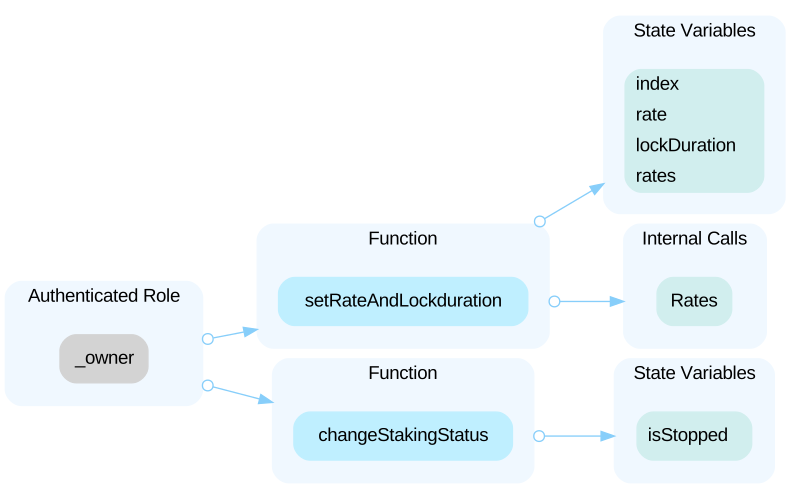 In the contract `KlinkToken`, the role `_owner` has authority over the functions shown in the diagram below. Any compromise to the `_owner` account may allow the hacker to take advantage of this authority and burn tokens from a specified account, burn tokens from a specific account, and mint tokens to a specified address. 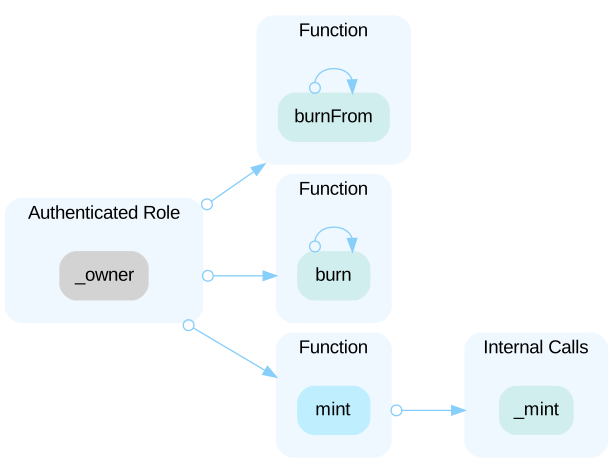
Open the reportHighCentralized Balance Manipulation Due to UnrestricKlink Finance · CertiK · 7 Feb 2025Open
In the contract `KlinkToken`, the role `owner` has the authority to update the token balance of an arbitrary account without sanity restriction through the functions `mint()` and `burnFrom()`. ```solidity=36 function mint(address to, uint256 amount) public onlyOwner { _mint(to, amount); } ``` ```solidity=57 function burnFrom(address account, uint256 amount) public override onlyOwner { super.burnFrom(account, amount); } ``` Any compromise to the owner account may allow a hacker to take advantage of this authority and mint arbitrary amount of tokens to any account.
Open the reportHighInitial Token DistributionKlink Finance · CertiK · 7 Feb 2025Open
All of the Klink tokens are sent to the contract deployer on deployment. This is a centralization risk because the deployer or the owner(s) of the EOAs can distribute tokens without obtaining the consensus of the community. Any compromise to these addresses may allow a hacker to steal and sell tokens on the market, resulting in severe damage to the project.
Open the reportLowIncompatibility With Deflationary TokensKlink Finance · CertiK · 7 Feb 2025Open
When transferring standard ERC20 deflationary tokens, the input amount may not be equal to the received amount due to the charged transaction fee. For example, if a user stakes 100 deflationary tokens (with a 10% transaction fee) into the staking contract, only 90 tokens actually arrive in the contract. However, the user can still withdraw 100 tokens from the contract, which causes the contract to lose 10 tokens in such a transaction.
Open the reportLowLock Duration MismatchKlink Finance · CertiK · 7 Feb 2025Open
The contract multiplies `lockDuration` by 3600 (1 hour in seconds). Yet the constructor and function docstrings suggest `lockduration_` is the number of days, which would normally be multiplied by 86400. If the intention is truly to lock for lockDuration days, then using `lockDuration.mul(3600)` is off by a factor of 24.
Open the reportLowMultiple Staking Rounds LogicKlink Finance · CertiK · 7 Feb 2025Open
When a user with an existing stake calls stake(amount) again, the contract checks that the current lock has not yet expired: ```solidity require(block.timestamp < deposits[from].endTime, "Lock expired, please withdraw and stake again"); ``` If the lock is still active, the contract recalculates and accrues the user’s existing rewards up to the current time, adds those rewards to `deposits[from].rewards`, and then increases the overall deposit. Notably, this process resets the user’s `depositTime` to the new `block.timestamp` and updates the lock end to `block.timestamp + lockDurationInSeconds`. This design compounds the deposit but also means that if the user had only a short time remaining on their current lock, adding more funds starts a new lock period. Consequently, the user cannot withdraw any part of their stake until the newly established lock expires. Projects should ensure users are aware that depositing additional funds before their existing lock ends will defer their withdrawal window accordingly.
Open the reportContracts
No deployed address is recorded for these audits.
The reports name a repository or files. Open a report to see its scope.
Show this on your site
Is this your project? Show this record on your own website. The label states what the record holds, links to this page and updates by itself. It is free and needs no sign-in.
Content
Automatic: the three strongest facts of this project’s own record (its last audit and two more), highlighted. They update with the record. Picking a fact turns Automatic off.
Style
Format
<head><script src="https://widget.trustblock.run/project-widget.min.js" defer></script></head><body><divdata-tb-project-widgetdata-tb-project-slug="klink-finance"></div></body>
Paste the code where the label should appear. It uses no API credit and updates by itself.
Something wrong on this page? A missing report, a wrong date, a finding that was fixed since. Tell us and we check it against its source.
Tell us