LionCEO has 1 public audit report from CertiK; dated 30 Mar 2023; no critical findings reported. It also holds 1 deployed contract on 1 chain.
Last updated . It holds audits and findings, contracts and incidents up to Nov 2026. Trustblock does not review code.
Newest first
| Report | Security firm | Date | Scope | Critical findings | Findings | Source |
|---|---|---|---|---|---|---|
| LionCEO - Audit | Security firm: CertiK | Date: | Scope: Files listed | None open | Findings: 2 high · 1 medium · 14 low 1 acknowledged · 16 open | skynet.certik.com ↗ |
17 findings in 1 report: 1 acknowledged (the team chose not to change the code), 16 open.
| Severity | Open | Acknowledged |
|---|---|---|
| Critical | 0 | 0 |
| High | 2 | 0 |
| Medium | 0 | 1 |
| Low | 14 | 0 |
In the contract `LIONCEO` the role `_owner` has authority over the functions shown in the diagram below. Any compromise to the `_owner` account may allow the hacker to take advantage of this authority and change sensitive state addresses and dividend data. 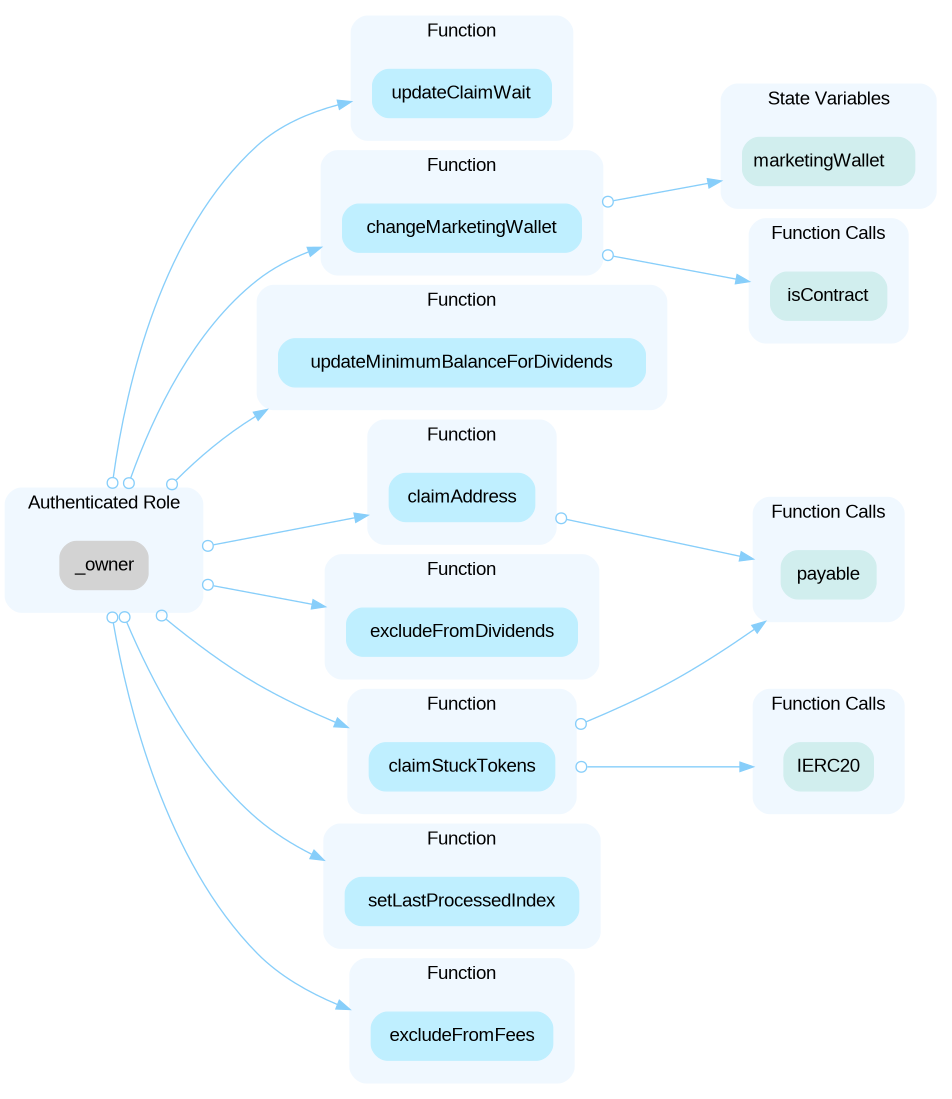 In the contract `Ownable` the role `_owner` has authority over the functions shown in the diagram below. Any compromise to the `_owner` account may allow the hacker to take advantage of this authority and transfer or renounce ownership. 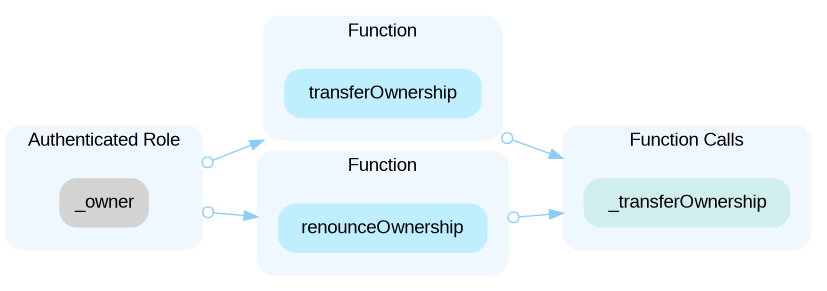
Report ↗All LCEO tokens are sent to the contract owner when deploying the contract. This is a potential centralization risk as the owner can distribute LCEO tokens without the consensus of the community.
Report ↗The function call `_transfer()` will not revert even when the external call to `dividendTracker.setBalance()` and `dividendTracker.process()` may fail. The current implementation applies `try-catch` statement for the mentioned external calls. Since no action is implemented in the `catch` statement, it will ignore any exceptions raised when executing the external function calls. Therefore, the function `_transfer()` will still take the fees and transfer the tokens, as if no exception has occurred. However, the function would fail to update the user's current reward, and the user could not receive rewards as expected. ```solidity=1111 super._transfer(from, to, amount); try dividendTracker.setBalance(payable(from), balanceOf(from)) {} catch {} try dividendTracker.setBalance(payable(to), balanceOf(to)) {} catch {} ```
Report ↗For a user to receive dividends, their token balance should exceed the `minimumTokenBalanceForDividends` variable. This variable can be changed via the `updateMinimumTokenBalanceForDividends()` function. However, when `minimumTokenBalanceForDividends` is changed, the users that can receive dividends is unchanged. This means that if `minimumTokenBalanceForDividends` is increased, users whose balance is below the new `minimumTokenBalanceForDividends` but above the old `minimumTokenBalanceForDividends` can still receive dividends.
Report ↗In the function `_transfer()`, the function `process()` is called to update state information. The execution of `process()` helps maintain intended tokenomics but passes the cost of gas to the address executing `_transfer()`.
Report ↗There should always be events emitted in the sensitive functions that are controlled by centralization roles.
Report ↗A sandwich attack may happen when an attacker observes a transaction swapping tokens or adding liquidity without setting restrictions on slippage or minimum output amount. The attacker can manipulate the exchange rate by frontrunning (executing before the target) a transaction to purchase one of the assets and make profits by backrunning (executing after the target) a transaction to sell the asset. The linked functions are called without setting restrictions on slippage or minimum output amount, so transactions triggering these functions are vulnerable to sandwich attacks, especially when the input amount is large: - `uniswapV2Router.swapExactTokensForETHSupportingFeeOnTransferTokens()` - `uniswapV2Router.swapExactETHForTokensSupportingFeeOnTransferTokens()`
Report ↗State variables that never change should be declared as `constant` to save gas. ```solidity=907 uint256 public gasForProcessing = 300_000; ``` - `gasForProcessing` should be declared `constant`.
Report ↗The contract is serving as the underlying entity to interact with one or more third party protocols. The scope of the audit treats third party entities as black boxes and assume their functional correctness. However, in the real world, third parties can be compromised and this may lead to lost or stolen assets. In addition, upgrades of third parties can possibly create severe impacts, such as increasing fees of third parties, migrating to new LP pools, etc. ```solidity=894 IUniswapV2Router02 public uniswapV2Router; ``` - The contract `LIONCEO` interacts with third party contract with `IUniswapV2Router02` interface via `uniswapV2Router`.
Report ↗The return value of the transfer()/transferFrom() call is not checked. ```solidity=985 ERC20token.transfer(msg.sender, balance); ```
Report ↗The `SafeMath` library is used unnecessarily. With Solidity compiler versions 0.8.0 or newer, arithmetic operations will automatically revert in case of integer overflow or underflow.
Report ↗```solidity=164 return int(map.indexOf[key]); ``` - The type conversion `int256(map.indexOf[key])` from type uint256 to type int256 may flip the value's sign. --- ```solidity=748 iterationsUntilProcessed = index.sub(int256(lastProcessedIndex)); ``` - The type conversion `int256(lastProcessedIndex)` from type uint256 to type int256 may flip the value's sign. --- ```solidity=756 iterationsUntilProcessed = index.add(int256(processesUntilEndOfArray)); ``` - The type conversion `int256(processesUntilEndOfArray)` from type uint256 to type int256 may flip the value's sign.
Report ↗The return value of an external call is not stored in a local or state variable. ```solidity=1214 dividendTracker.processAccount(payable(msg.sender), false); ``` --- ```solidity=1218 dividendTracker.processAccount(payable(claimee), false); ```
Report ↗One or more state variables are never used in the codebase. Variable `MAX_INT256` in `SafeMathInt` is never used in `SafeMathInt`. ```solidity=103 int256 private constant MAX_INT256 = ~(int256(1) << 255); ``` ```solidity=101 library SafeMathInt { ``` The variables `liquidityFeeOnBuy` and `liquidityFeeOnSell` are assigned but never meaningfully referenced in `LIONCEO`. ```solidity=932 liquidityFeeOnBuy = 0; ``` ```solidity=938 liquidityFeeOnSell = 0; ```
Report ↗The initial values for addresses `owner()` and `marketingWallet` are exempt from fees in the constructor. However, if the state addresses were to be modified from the respective functions `transferOwnership()` or `changeMarketingWallet`, the fee exemption would still be applied to the initial addresses, not the updated addresses.
Report ↗It is not recommended to use Solidity's `transfer()` and `send()` functions for transferring Ether, since some contracts may not be able to receive the funds. Those functions forward only a fixed amount of gas (2300 specifically) and the receiving contracts may run out of gas before finishing the transfer. Also, EVM instructions' gas costs may increase in the future. Thus, some contracts that can receive now may stop working in the future due to the gas limitation. ```solidity=980 payable(msg.sender).transfer(address(this).balance); ``` - `LIONCEO.claimStuckTokens` uses `transfer()`.
Report ↗The linked variables assigned in the constructor can be declared as `immutable`. Immutable state variables can be assigned during contract creation but will remain constant throughout the lifetime of a deployed contract. A big advantage of immutable variables is that reading them is significantly cheaper than reading from regular state variables since they will not be stored in storage.
Report ↗| Address | Chain | Source code |
|---|---|---|
| 0xc60d…4bb00xc60dee4852ee6190cc440e87fc06796ec5ed4bb0 | Chain: BNB Chain | Source code: Verified source |
Trustblock holds 1 public audit report for LionCEO, dated 30 Mar 2023. The latest is by CertiK (“LionCEO - Audit”).
CertiK wrote the report Trustblock holds for LionCEO.
17 findings are still open or acknowledged in the firms’ reports: 2 high, 1 medium, 14 low (16 open, 1 acknowledged). No critical finding is reported. Statuses are the security firms’ own.
Something wrong on this page? A missing report, a wrong date, a finding that was fixed since. Tell us and we check it against its source.
Tell us