
LiveArtX audit reports
LiveArtX has 1 public audit report from CertiK; dated 20 Sep 2022; no critical findings reported.
Last updated . It holds audits and findings, contracts and incidents up to Nov 2026. Trustblock does not review code.
Audits1
Newest first
| Report | Security firm | Date | Scope | Critical findings | Findings | Source |
|---|---|---|---|---|---|---|
| LiveArtX-Ⅱ | Security firm: CertiK | Date: | Scope: Not recorded; see the report | None open | Findings: 2 high · 1 medium · 10 low 2 fixed · 3 acknowledged · 8 open | skynet.certik.com ↗ |
Findings13
13 findings in 1 report: 2 fixed, 3 acknowledged (the team chose not to change the code), 8 open.
| Severity | Open | Acknowledged | Fixed |
|---|---|---|---|
| Critical | 0 | 0 | 0 |
| High | 0 | 2 | 0 |
| Medium | 0 | 1 | 0 |
| Low | 8 | 0 | 2 |
Not fixed (11)
HighAcknowledgedCentralization Risks in MetaMorphic.solLiveArtX-Ⅱ · CertiK · 20 Sep 2022
In the contract `MetaMorphic` the role `_owner` has authority over the functions shown in the diagram below. Any compromise to the `_owner` account may allow the hacker to take advantage of this authority and set the address `beneficiary` to a different address, change `startTime1` and `startTime2` to 0 so the minting functions cannot be used, or reset the selling price. 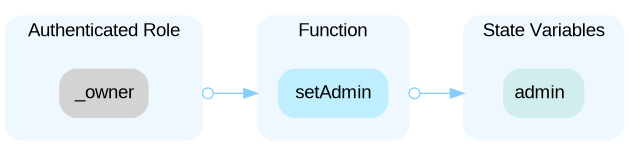
Report ↗HighAcknowledgedCentralized Control of Contract UpgradeLiveArtX-Ⅱ · CertiK · 20 Sep 2022
`MetaMorphic` is an upgradeable contract; the owner can upgrade the contract without the community's consent. If an attacker compromises the account, they can change the implementation of the contract and drain tokens from the contract.
Report ↗MediumAcknowledgedImplementation contract is not initialized automaLiveArtX-Ⅱ · CertiK · 20 Sep 2022
When an implementation contract is deployed and the function `initialize()` is called from the proxy contract, it will execute in the context of the proxy contract storage. Hence the state variable `_initialized` and `_initializing` will be 0 and false, respectively. Attackers can directly call the function `initialize()` in the context of the implementation's storage, and feed in malicious inputs which can, in turn, affect the proxy.
Report ↗LowOpenFunction Should Be Declared ExternalLiveArtX-Ⅱ · CertiK · 20 Sep 2022
Functions which are never called internally within the contract should have external visibility. --- ```solidity=103 function totalSupply() public view returns (uint) { ``` ```solidity=107 function tokenURI(uint256 tokenId) public view virtual override returns (string memory) { ``` --- ```solidity=117 function params() public view returns (Params memory) { ``` --- ```solidity=191 function burn(uint256 tokenId) public { ``` --- ```solidity=200 function setAdmin(address _admin) public onlyOwner { ``` --- ```solidity=206 function setBaseURI(string memory _baseURI) public onlyAdmin { ``` --- ```solidity=210 function setBeneficiary(address _beneficiary) public onlyAdmin { ``` --- ```solidity=214 function reveal(string memory _baseURI) public onlyAdmin { ``` --- ```solidity=222 function setParams1(bytes32 _merkleRoot, uint256 _price, uint256 _maxAmount, uint256 _startTime, uint256 _endTime) public onlyAdmin { ``` --- ```solidity=233 function setParams2(bytes32 _merkleRoot, uint256 _price, uint256 _maxAmount, uint256 _startTime, uint256 _endTime) public onlyAdmin { ```
Report ↗LowOpenMissing Access Control for functions `mint1()` anLiveArtX-Ⅱ · CertiK · 20 Sep 2022
Anyone can call functions `mint1()` and `mint2()` on behalf of another account, as long as they provide a valid `merkleProof` corresponding to inputs `index`, `account`, and `maxAmount`. If the functions are called once, and the `amount` value does not exceed `maxAmount`, then the inputs can be used to call the function again by another entity. Additionally, it appears that if `maxAmount1` (or respectively, `maxAmount2`) are met before a user's `maxAmount` is met, then the specified `account` cannot mint the `maxAmount` of tokens for which they have been whitelisted. Please clarify whether each user's `maxAmount` is calculated so that the total sum of `maxAmount` values for all whitelisted users does not exceed the `maxAmount1` or `maxAmount2` amount respectively.
Report ↗LowOpenMissing Emit EventsLiveArtX-Ⅱ · CertiK · 20 Sep 2022
One or more state changes do not emit events to pass the changes out of chain. ```solidity=201 admin = _admin; ``` ```solidity=224 price1 = _price; ``` ```solidity=225 maxAmount1 = _maxAmount; ``` ```solidity=226 startTime1 = _startTime; ``` *Note: Only a sample of 3 state variable assignments (out of 4) are shown above.* --- ```solidity=235 price2 = _price; ``` ```solidity=236 maxAmount2 = _maxAmount; ``` ```solidity=237 startTime2 = _startTime; ``` *Note: Only a sample of 3 state variable assignments (out of 4) are shown above.*
Report ↗LowOpenMissing Input ValidationLiveArtX-Ⅱ · CertiK · 20 Sep 2022
The given input is missing a check for a non-zero value.
Report ↗LowOpenMissing Zero Address ValidationLiveArtX-Ⅱ · CertiK · 20 Sep 2022
Addresses should be checked before assignment or external call to make sure they are not zero addresses. ```solidity=99 admin = _admin; ``` - `_admin` is not zero-checked before being used. --- ```solidity=100 beneficiary = _beneficiary; ``` - `_beneficiary` is not zero-checked before being used. --- ```solidity=201 admin = _admin; ``` - `_admin` is not zero-checked before being used. --- ```solidity=211 beneficiary = _beneficiary; ``` - `_beneficiary` is not zero-checked before being used.
Report ↗LowOpenUnlocked Compiler VersionLiveArtX-Ⅱ · CertiK · 20 Sep 2022
The contract has an unlocked compiler version. An unlocked compiler version in the source code of the contract permits the user to compile it at or above a particular version. This, in turn, leads to differences in the generated bytecode between compilations due to differing compiler version numbers. This can lead to an ambiguity when debugging as compiler-specific bugs may occur in the codebase that would be hard to identify over a span of multiple compiler versions rather than a specific one.
Report ↗LowOpenUnnecessary Use of SafeMathLiveArtX-Ⅱ · CertiK · 20 Sep 2022
The `SafeMathUpgradeable` library is used unnecessarily. With Solidity compiler versions 0.8.0 or newer, arithmetic operations will automatically revert in the case of integer overflow or underflow.
Report ↗Show all 11
LowOpenUser-Defined Getters Already Present In ContractLiveArtX-Ⅱ · CertiK · 20 Sep 2022
The function `params()` appears unnecessary since all state variables are public and have getter functions.
Report ↗Contracts
No deployed address is recorded for these audits.
The reports name a repository or files. Open a report to see its scope.
LiveArtX: questions
Is LiveArtX audited?
Trustblock holds 1 public audit report for LiveArtX, dated 20 Sep 2022. The latest is by CertiK (“LiveArtX-Ⅱ”).
Who audited LiveArtX?
CertiK wrote the report Trustblock holds for LiveArtX.
Are there open findings in LiveArtX’s audits?
11 findings are still open or acknowledged in the firms’ reports: 2 high, 1 medium, 8 low (8 open, 3 acknowledged). No critical finding is reported. Statuses are the security firms’ own.
Something wrong on this page? A missing report, a wrong date, a finding that was fixed since. Tell us and we check it against its source.
Tell us