
OPEX Token security record
As of 3 Nov 2026, OPEX Token has 1 audit report on Trustblock, by CertiK, dated 25 Oct 2023. That report lists no open critical findings. It also holds 1 deployed contract on 1 chain.
Record last updated . It holds audits, findings and contracts up to Nov 2026, and incidents up to Oct 2026. Trustblock does not review code.
Audits1
Newest first
Findings13
Statuses are the security firm’s own, from each report.
| Severity | Open | Acknowledged | Fixed |
|---|---|---|---|
| Critical | 0 | 0 | 0 |
| High | 3 | 0 | 0 |
| Medium | 0 | 0 | 0 |
| Low | 10 | 0 | 0 |
HighCentralization Risks in MyToken.solOPX Token · CertiK · 25 Oct 2023Open
In the contract `MyToken` the role `_owner` has authority over the functions shown in the diagram below. Any compromise to the `_owner` account may allow the hacker to take advantage of this authority and perform, including but not limited to, the following operations: - Pause/Unpause the contract at will. - Add/remove users to the blacklist. - Mint an indefinite amount to any account at will. - Burn tokens of all the blacklisted users. 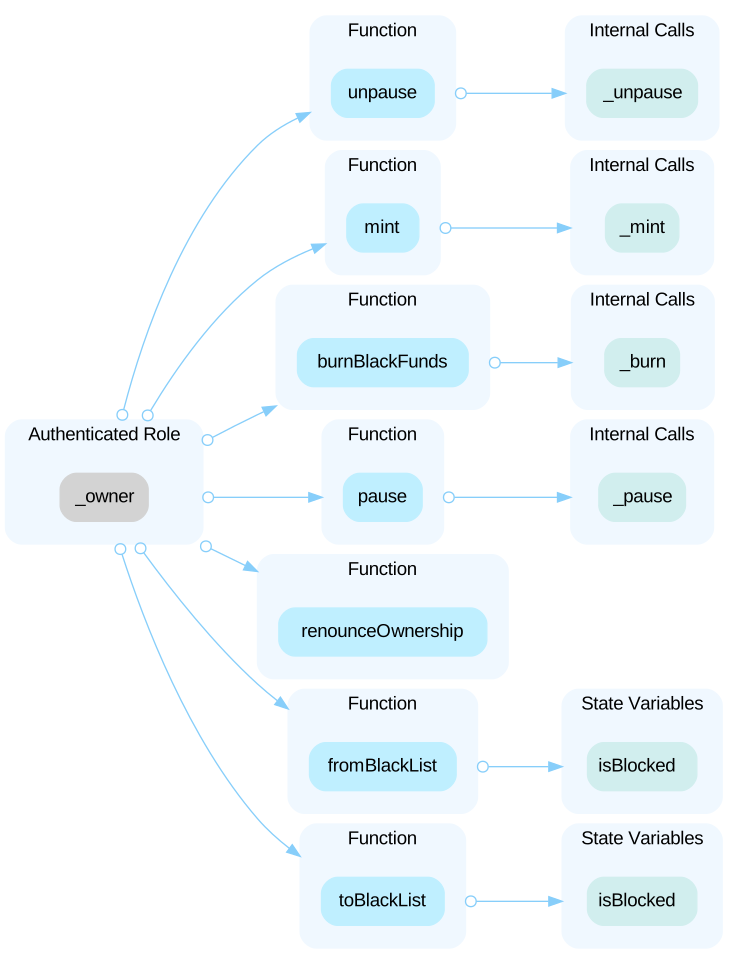 In the contract `Ownable` the role `_owner` has authority over the functions shown in the diagram below. Any compromise to the `_owner` account may allow the hacker to take advantage of this authority and transfer ownership to another account. Note that the ownership cannot be renounced because the function is overridden and set as a no-op. 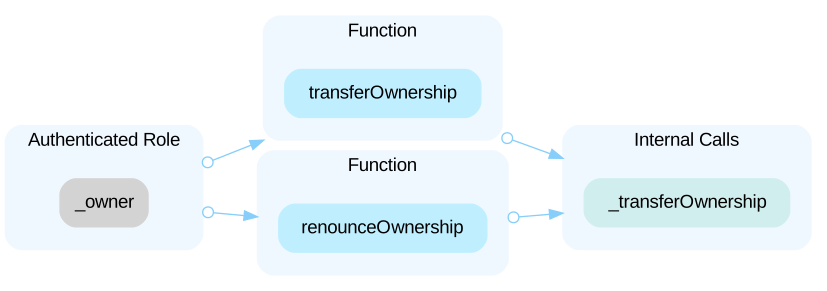
Open the reportHighCentralized Balance ManipulationOPX Token · CertiK · 25 Oct 2023Open
In the contract `MyToken`, the role `owner` has the authority to update the token balance of an arbitrary account without sanity restriction. Any compromise to the `owner` account may allow a hacker to take advantage of this authority and manipulate users' balances. The attacker could also update his/her balance to a large number by minting, selling these tokens, and causing the token price to drop.
Open the reportHighInitial Token DistributionOPX Token · CertiK · 25 Oct 2023Open
All of the tokens are sent to the contract deployer or one or several externally-owned account (EOA) addresses. This is a centralization risk because the deployer or the owner(s) of the EOAs can distribute tokens without obtaining the consensus of the community. Any compromise to these addresses may allow a hacker to steal and sell tokens on the market, resulting in severe damage to the project.
Open the reportLowBlacklisted User Can Call `transferFrom`OPX Token · CertiK · 25 Oct 2023Open
The function `transferFrom` of the contract `MyToken` prevents blacklisted users to receive or send tokens with the following lines: ```solidity=743 require(isBlocked[from] == false, "From address is blacklisted!"); require(isBlocked[to] == false, "To address is blacklisted!"); ``` Although, a blacklisted user could still be approved by another user and call the transfer from. Because the `_msgSender()` is not checked.
Open the reportLowComparison to Boolean ConstantOPX Token · CertiK · 25 Oct 2023Open
Boolean constants can be used directly and do not need to be compared to true or false. ```solidity=732 require(isBlocked[msg.sender] == false, "This address is blacklisted!"); ``` --- ```solidity=743 require(isBlocked[from] == false, "From address is blacklisted!"); ``` --- ```solidity=744 require(isBlocked[to] == false, "To address is blacklisted!"); ``` --- ```solidity=752 require(isBlocked[msg.sender] == false, "This address is blacklisted!"); ``` --- ```solidity=757 require(isBlocked[account] == true, "User is not in black list!"); ```
Open the reportLowLocal Variable ShadowingOPX Token · CertiK · 25 Oct 2023Open
A local variable is shadowing another component defined elsewhere. This means that when the contract accesses the variable by its name, it will use the one defined locally, not the one defined in the other place. The use of the variable may lead to unexpected results and unintended behavior. ```solidity=708 constructor(uint256 initialsupply, address supplyaddress, uint8 decimals, string memory name, string memory symbol) ERC20(name, symbol) { ``` - Local variable `decimals` in `MyToken.constructor` shadows: - Function `decimals` in `MyToken` - Function `decimals` in `ERC20` - Function `decimals` in `IERC20Metadata` --- ```solidity=708 constructor(uint256 initialsupply, address supplyaddress, uint8 decimals, string memory name, string memory symbol) ERC20(name, symbol) { ``` - Local variable `name` in `MyToken.constructor` shadows: - Function `name` in `ERC20` - Function `name` in `IERC20Metadata` --- ```solidity=708 constructor(uint256 initialsupply, address supplyaddress, uint8 decimals, string memory name, string memory symbol) ERC20(name, symbol) { ``` - Local variable `symbol` in `MyToken.constructor` shadows: - Function `symbol` in `ERC20` - Function `symbol` in `IERC20Metadata` --- ```solidity=733 address owner = _msgSender(); ``` - Local variable `owner` in `MyToken.transfer` shadows the function `owner` in `Ownable`.
Open the reportLowMissing Emit EventsOPX Token · CertiK · 25 Oct 2023Open
There should always be events emitted in the sensitive functions that are controlled by centralization roles.
Open the reportLowMissing Input Validation on `from` in function `tOPX Token · CertiK · 25 Oct 2023Open
It's recommended to check if `from == msg.sender` because transferring from yourself to others equals directly transferring to others. The condition rarely happens that the user approve for himself/herself.
Open the reportLowMissing sanity check in function `transfer()`OPX Token · CertiK · 25 Oct 2023Open
It's recommended to check if `msg.sender == to` in the function `transfer()` since transferring to self makes no sense.
Open the reportLowProper Usage of `public` and `external` TypeOPX Token · CertiK · 25 Oct 2023Open
`public` functions that are never called by the contract could be declared `external`.
Open the reportShow 3 more
LowPull-Over-Push Pattern In `transferOwnership()` FOPX Token · CertiK · 25 Oct 2023Open
`transferOwnership()` sets the new `owner` without guaranteeing they are able to actuate transactions on-chain.
Open the reportLowUser-Defined GettersOPX Token · CertiK · 25 Oct 2023Open
The linked functions are equivalent to the compiler-generated getter functions for the respective variables.
Open the reportLowVariables That Could Be Declared as ImmutableOPX Token · CertiK · 25 Oct 2023Open
The linked variables assigned in the constructor can be declared as `immutable`. Immutable state variables can be assigned during contract creation but will remain constant throughout the lifetime of a deployed contract. A big advantage of immutable variables is that reading them is significantly cheaper than reading from regular state variables since they will not be stored in storage.
Open the reportContracts1
| Address | Chain | Source code |
|---|---|---|
| 0xa3fb72cbf2e07dc1b34aea569ed40755fd978bd8 | Chain: Polygon (POS) | Source code: Verified source |
Show this on your site
Is this your project? Show this record on your own website. The label states what the record holds, links to this page and updates by itself. It is free and needs no sign-in.
Content
Automatic: the three strongest facts of this project’s own record (its last audit and two more), highlighted. They update with the record. Picking a fact turns Automatic off.
Style
Format
<head><script src="https://widget.trustblock.run/project-widget.min.js" defer></script></head><body><divdata-tb-project-widgetdata-tb-project-slug="opex-token"></div></body>
Paste the code where the label should appear. It uses no API credit and updates by itself.
Something wrong on this page? A missing report, a wrong date, a finding that was fixed since. Tell us and we check it against its source.
Tell us