
PlayDapp audit reports
PlayDapp has 2 public audit reports from CertiK; the latest is CertiK, 22 Jul 2024; no critical findings reported.
Last updated . It holds audits and findings, contracts and incidents up to Nov 2026. Trustblock does not review code.
Open findings across every firm38
Statuses are the security firms’ own
38 findings are still open or acknowledged in the firms’ reports: 4 high, 3 medium, 31 low (34 open, 4 acknowledged).
- High
- 4
- Medium
- 3
- Low
- 31
- High Acknowledged
Centralization Related Risks
PlayDapp - Audit 2 · CertiK · 22 Jul 2024 · Report ↗
- High Open
Centralization Risks
PlayDapp - Audit · CertiK · 17 Feb 2024 · Report ↗
- High Open
Initial Token Distribution
PlayDapp - Audit · CertiK · 17 Feb 2024 · Report ↗
- High Open
Pausing Centralization Risks
PlayDapp - Audit · CertiK · 17 Feb 2024 · Report ↗
- Medium Acknowledged
Deposit Record May Not Match Data
PlayDapp - Audit 2 · CertiK · 22 Jul 2024 · Report ↗
- Medium Acknowledged
Potential Issues If `lenDestinationRecipientAddre
PlayDapp - Audit 2 · CertiK · 22 Jul 2024 · Report ↗
- Medium Acknowledged
Users Are Allowed To Submit Data In Any Form
PlayDapp - Audit 2 · CertiK · 22 Jul 2024 · Report ↗
- Low Open
`_bridgeAddress` Must Be Set By Inheriting Contra
PlayDapp - Audit 2 · CertiK · 22 Jul 2024 · Report ↗
- Low Open
`_destinationChainID` May Be Confused With EVM `C
PlayDapp - Audit 2 · CertiK · 22 Jul 2024 · Report ↗
- Low Open
`burnable` Cannot Be Reversed
PlayDapp - Audit 2 · CertiK · 22 Jul 2024 · Report ↗
Audits2
Newest first
| Report | Security firm | Date | Scope | Critical findings | Findings | Source |
|---|---|---|---|---|---|---|
| PlayDapp - Audit 2 | Security firm: CertiK | Date: | Scope: Files listed | None open | Findings: 1 high · 6 medium · 39 low 11 fixed · 4 acknowledged · 31 open | skynet.certik.com ↗ |
| PlayDapp - Audit | Security firm: CertiK | Date: | Scope: Not recorded; see the report | None open | Findings: 3 high · 1 low 1 fixed · 3 open | skynet.certik.com ↗ |
Findings50
Statuses are the security firm’s own, from each report.
| Severity | Open | Acknowledged | Fixed |
|---|---|---|---|
| Critical | 0 | 0 | 0 |
| High | 3 | 1 | 0 |
| Medium | 0 | 3 | 3 |
| Low | 31 | 0 | 9 |
HighCentralization RisksPlayDapp - Audit · CertiK · 17 Feb 2024Open
In the contract `Ownable` the role `_owner` has authority over the functions shown in the diagram below. Any compromise to the `_owner` account may allow the hacker to take advantage of this authority. 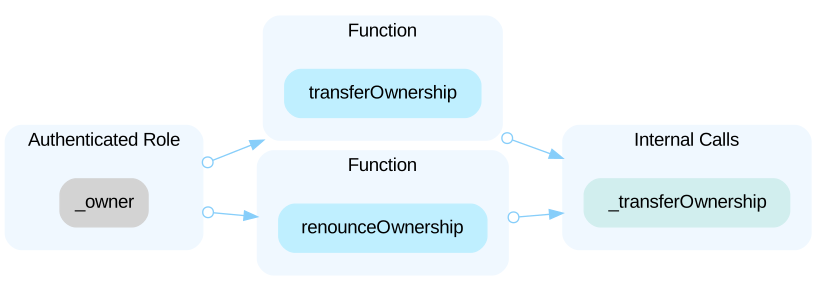 In the contract `AccessControl` the role `_role` has authority over the functions shown in the diagram below. Any compromise to the `_role` account may allow the hacker to take advantage of this authority, grant or revoke roles to any users. 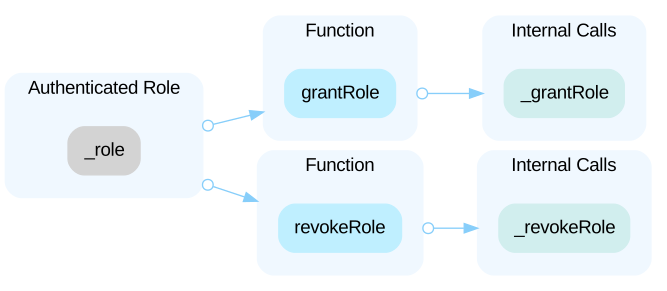 In the contract `AccessControl` the role `account` has authority over the functions shown in the diagram below. Any compromise to the `account` account may allow the hacker to take advantage of this authority. 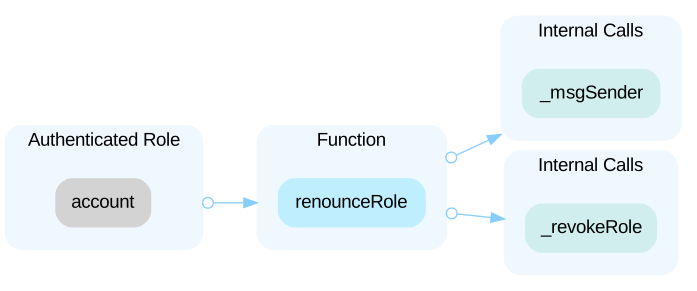 In the contract `PDA` the role `PAUSER_ROLE` has authority over the functions shown in the diagram below. Any compromise to the `PAUSER_ROLE` account may allow the hacker to take advantage of this authority, pause and unpause the contract. 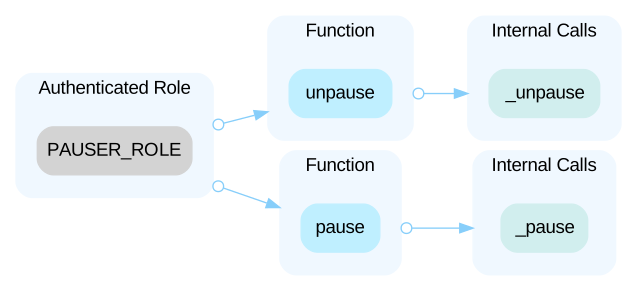 In the contract `PDA` the role `SNAPSHOT_ROLE` has authority over the functions shown in the diagram below. Any compromise to the `SNAPSHOT_ROLE` account may allow the hacker to take advantage of this authority and create snapshots. 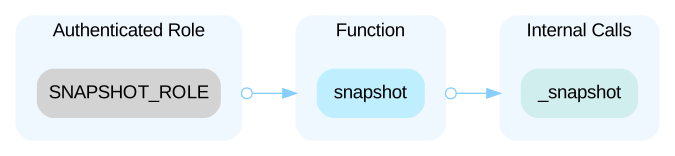 In the contract `PDA` the role `_owner` has authority over the functions shown in the diagram below. Any compromise to the `_owner` account may allow the hacker to take advantage of this authority and grant roles to other users. 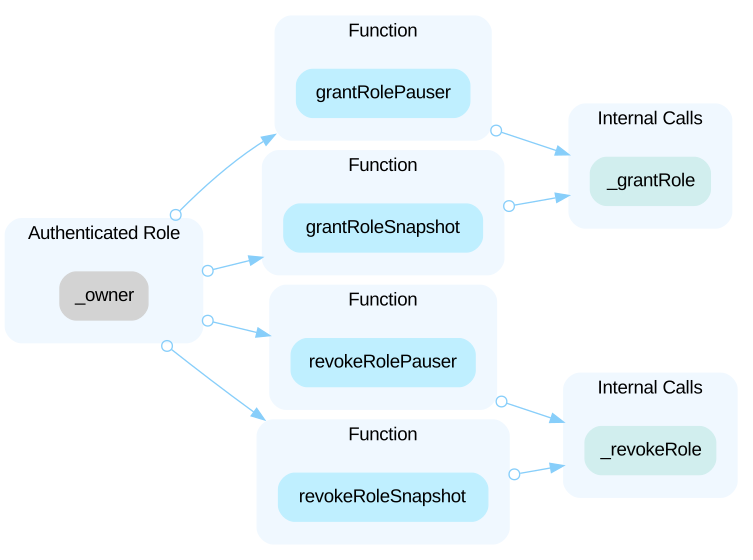
Open the reportHighInitial Token DistributionPlayDapp - Audit · CertiK · 17 Feb 2024Open
All of the `PDA` tokens are sent to the `_owner`. This is a centralization risk because the `_owner` can distribute tokens without obtaining the consensus of the community. Any compromise to the `_owner` address may allow a hacker to steal and sell tokens on the market, resulting in severe damage to the project.
Open the reportHighPausing Centralization RisksPlayDapp - Audit · CertiK · 17 Feb 2024Open
In the contract `PDA.sol`, the `PAUSER_ROLE` has the authority to update the status of the `_paused` and further pause/resume the functionality of the token transfers. Any compromise to the private key of the `PAUSER_ROLE` may allow hackers to take advantage of this authority and allow/prevent user access to token transfer functionalities.
Open the reportLow`_bridgeAddress` Must Be Set By Inheriting ContraPlayDapp - Audit 2 · CertiK · 22 Jul 2024Open
The variable `_bridgeAddress` is used in the `_onlyBridge` modifier, which is used with functions in the `HandlerHelpers` contract. However, it is not set in the constructor and does not have a setter function. Thus, it must be set by any contracts that inherit it.
Open the reportLow`_destinationChainID` May Be Confused With EVM `CPlayDapp - Audit 2 · CertiK · 22 Jul 2024Open
The `_destinationChainID` is a unique identifier for a chain. The comments state that it is the `ChainID`, however, for example, a `CHAIN_ID` on an EVM chain can exceed the `type(uint8).max` so that this identifier must represent a number the protocol associates to each chain it supports.
Open the reportLow`burnable` Cannot Be ReversedPlayDapp - Audit 2 · CertiK · 22 Jul 2024Open
If a token is set to be burnable on accident or the token revokes the ability for the bridge to mint/burn, then there is no functionality to reverse the operation. As such, the token will not be able to be used with the same handler contract. If the token is to be supported then it may require the deployment of a new handler.
Open the reportLowChange `uint` to `uint256`PlayDapp - Audit 2 · CertiK · 22 Jul 2024Open
The `uint` type is an alias for `uint256`. It is recommended to use `uint256` instead of `uint` for better readability.
Open the reportLowCommented Out CodePlayDapp - Audit 2 · CertiK · 22 Jul 2024Open
There is functionality that is commented out throughout the codebase. We assume that this code is to be omitted, however, it may accidentally be left commented out.
Open the reportLowConsider Removing Recipient From Locking FunctionPlayDapp - Audit 2 · CertiK · 22 Jul 2024Open
When locking ERC20 or ERC721 tokens, they should always be transferred to the safe, which is `address(this)`. As such the `recipient` parameter can be removed and the logic can be hardcoded to send tokens to `address(this)`.
Open the reportLowDiscussion On Daily And Transactional LimitsPlayDapp - Audit 2 · CertiK · 22 Jul 2024Open
The relayers provide a centralization risk, that if a `_relayerThreshold` of the relayers are compromised, then all funds can be stolen. A recommended mitigation is to implement transactional and daily limits for each token. These can be used to prevent the loss of all funds in such a scenario and can be set individually for each token.
Open the reportShow 10 more
LowFunction Can Be Modified With `pure` Or `view`PlayDapp - Audit 2 · CertiK · 22 Jul 2024Open
`GenericHandler._onlyBridge()` and `HandlerHelpers._onlyBridge()` do not require modifying the contract state, nor do they need to receive Ether. However, these functions are not labeled with `pure` or `view` modifiers.
Open the reportLowLogic May Be Simplified Depending On Intended SupPlayDapp - Audit 2 · CertiK · 22 Jul 2024Open
Can you please provide the intended chains that you plan to support? In particular, do you plan on supporting chains whose addresses utilize different numbers of bytes? If the bridge is designed to only interact with specific chains, then some logic may be able to be simplified.
Open the reportLowMissing ChecksPlayDapp - Audit 2 · CertiK · 22 Jul 2024Open
### HandlerHelpers - The function `setResource()` does not check that `_resourceIDToContractAddress[resourceID]` and `_contractAddressToResourceID[contractAddress]` are not already set. - The function `setBurnable()` does not check if `_burnList[contractAddress]` is already true. ### GenericHandler - The function `setGenericResource()` does not check that `_resourceIDToContractAddress[resourceID]`, `_contractAddressToResourceID[contractAddress]`, ` _contractAddressToDepositFunctionSignature[contractAddress]`, and `_contractAddressToExecuteFunctionSignature[contractAddress]` are not already set. - The functions `deposit()` and `executeProposal()` make a low level call to the `contractAddress`. While these are set via privileged roles, these contracts may self destructor or be set accidentally to EOA's, in which case the low level call will return true without executing any functionality. We recommend adding a check that the `contractAddress` is a contract. ### GenericERC20NativeHandler - The function `setGenericResource()` does not check that `_resourceIDToContractAddress[resourceID]`, `_contractAddressToResourceID[contractAddress]`, ` _contractAddressToDepositFunctionSignature[contractAddress]`, and `_contractAddressToExecuteFunctionSignature[contractAddress]` are not already set. - The functions `deposit()`, `depositWithPermit()`, and `executeProposal()` make a low level call to the `contractAddress`. While these are set via privileged roles, these contracts may self destructor or be set accidentally to EOA's, in which case the low level call will return true without executing any functionality. We recommend adding a check that the `contractAddress` is a contract. ### Bridge - The function `adminChangeRelayerThreshold()` does not check that the input `newThreshold` is greater than or equal to some minimum. In particular, the threshold should always be at least one, as a proposal must be proposed (which yields one yes vote). - The function `adminSetTrustedHandlers()` does not check if the input `_handlerAddress` already has the role. - The function `adminChangeFee()` does not check that the input `newFee` is within some bounds. In particular, if a fee should always be charged the input should be greater than zero and the fee may not want to exceed a theoretical maximum amount. - In the `Bridge.executeProposal()` function, the potential expiration of a proposal is not checked. If `proposal._status == ProposalStatus.Passed` and `block.number - proposal._proposedBlock > _expiry`. A relayer can decide to execute a proposal or cancel it.
Open the reportLowMissing Emit EventsPlayDapp - Audit 2 · CertiK · 22 Jul 2024Open
There should always be events emitted in any function that updates an important state variable.
Open the reportLowMissing License IdentifiersPlayDapp - Audit 2 · CertiK · 22 Jul 2024Open
The linked files do not include an SPDX license identifier. We recommend adding a license identifier to clarify how users are able to use the source code. See [https://spdx.org/licenses/](https://spdx.org/licenses/) for details.
Open the reportLowMissing/Incomplete NatSpecPlayDapp - Audit 2 · CertiK · 22 Jul 2024Open
Throughout the codebase there are NatSpec comments included for some functions but not all. Throughout the handler contracts, the `resourceID` is a parameter, but not included in the NatSpec comments.
Open the reportLowOptimization in `Bridge.executeProposal()`PlayDapp - Audit 2 · CertiK · 22 Jul 2024Open
In `Bridge.executeProposal()`, the following checks: ```solidity=505 require(proposal._status != ProposalStatus.Inactive, "proposal is not active"); require(proposal._status == ProposalStatus.Passed, "proposal already transferred"); ``` are both checking the status of a proposal, since a proposal cannot be `Inactive` and `Passed` the first **require** statement is redundant. Moreover, a proposal not passed can be `Inactive`, `Active`, `Executed` or `Cancelled`, therefore the error message `"proposal already transferred"` is not always accurate.
Open the reportLowOutdated Openzeppelin VersionPlayDapp - Audit 2 · CertiK · 22 Jul 2024Open
The contract `ERC721MinterBurnerPauser` utilizes Openzeppelin's library v3.0.0, which is outdated. Outdated versions are not as well maintained and miss the new optimizations, features, and security enhancements included in the more recent versions version.
Open the reportLowOutdated Solidity VersionPlayDapp - Audit 2 · CertiK · 22 Jul 2024Open
The highlighted files use solidity version 0.6.4. Outdated versions might contain security issues and miss the new features and security enhancements included in the recent solidity version.
Open the reportLowPermit Parameter DecodingPlayDapp - Audit 2 · CertiK · 22 Jul 2024Open
The `uint8 v`, `bytes32 r`, and `bytes32 s` parameters for permit functions are encoded in the input data for deposits. However, when `abi.decode()` is used, they are first decoded as `uint256` values and then recast as their respective types when used in the external call to `permit()`. Since `abi.encode()` pads parameters to 32 bytes, this should not create any issues, however, it decreases the readability of the codebase when they can be directly decoded to their respective types.
Open the reportShow 10 more
LowPotential Underflow/OverflowPlayDapp - Audit 2 · CertiK · 22 Jul 2024Open
In `Bridge.adminRemoveRelayer()`, `_totalRelayers` is decremented. Due to potential inconsistency between `_totalRelayers` and the real number of relayers, an underflow can occur.
Open the reportLowRedundant CheckPlayDapp - Audit 2 · CertiK · 22 Jul 2024Open
In the contract `Bridge.sol`, when a proposal is created in `voteProposal()`, `dataHash` is provided as input, and the `proposal` is then created as: ```solidity=427 _proposals[nonceAndID][dataHash] = Proposal({ _resourceID : resourceID, _dataHash : dataHash, _yesVotes : new address[](1), _noVotes : new address[](0), _status : ProposalStatus.Active, _proposedBlock : block.number }); ``` Therefore everytime the following check is made: ```solidity require(dataHash == proposal._dataHash, "datahash mismatch"); ``` it will pass because `dataHash == proposal._dataHash` is always true.
Open the reportLowSafeMath Is UnusedPlayDapp - Audit 2 · CertiK · 22 Jul 2024Open
The contracts `ERC721Safe` and `ERC20Safe` use `SafeMath` for `uint256`. However, no SafeMath operations are utilized in the contract.
Open the reportLowSafeMath Used For OZ Library And ContractPlayDapp - Audit 2 · CertiK · 22 Jul 2024Open
The contract `SafeMath` is a stripped down version of OpenZeppelin's `SafeMath` library, that is used in the `Bridge.sol` file. However, the `SafeMath` library is also imported and used in other contracts. As they have the same name, this can cause confusion.
Open the reportLowSolidity Style Guide Is Not FollowedPlayDapp - Audit 2 · CertiK · 22 Jul 2024Open
The codebase does not follow the [Solidity Style Guide](https://docs.soliditylang.org/en/latest/style-guide.html#). For example variables and functions to not follow the naming conventions for non-external facing variables and functions. In addition, the order of functions is not followed where view and pure functions should be put in the end of a grouping.
Open the reportLowSpecific Imports Are Not UsedPlayDapp - Audit 2 · CertiK · 22 Jul 2024Open
Specific imports are recommended to be used to avoid unpredictable pollution of the namespace. For example: import {A, B, C} from "X";
Open the reportLowThe Surplus Native Tokens Are Not ReturnedPlayDapp - Audit 2 · CertiK · 22 Jul 2024Open
In the `payable` functions `Bridge.deposit()` and `Bridge.depositWithPermit()`, there's a validation to ensure `msg.value` meets the minimum required amount of native tokens. However, it's important to note that if `msg.value` exceeds this amount, the function currently lacks a mechanism to refund the excess. This oversight could lead to unintentional loss of funds for the caller, as any surplus in `msg.value` is not returned.
Open the reportLowTypos And InconsistenciesPlayDapp - Audit 2 · CertiK · 22 Jul 2024Open
### ERC721Safe - In the comments above the function `lockERC721()`, "custoday" should be "custody". ### Bridge - In the comments for the contract `Bridge`, "voting" is misspelled as "votiing". - The comments above the function `cancelProposal()` do not match its functionality. - In the function `voteProposal` both the storage variable reference `proposal` and `_proposals[nonceAndID][dataHash]` are used to update states of `_proposals[nonceAndID][dataHash]`. - The function `_onlyTrustedHandlers` uses the role `RELEASE_ETH_FUND_ROLE` which does not match its naming. ### Handler Contracts - Throughout the handler contracts the comments include the `resourceID` in the input `data`. However, the `resourceID` is taken as a separate input.
Open the reportLowUnnecessary modifierPlayDapp - Audit 2 · CertiK · 22 Jul 2024Open
In functions `Bridge.renounceAdmin()`, `Bridge.adminSetTrustedHandlers()`, `Bridge.adminAddRelayer()`, `Bridge.adminRemoveRelayer()` the use of `onlyAdmin` modifier is redundant since the same check is made by functions inherited from `AccessControl`.
Open the reportLowUnused `_noVotes` in Struct `Proposal`PlayDapp - Audit 2 · CertiK · 22 Jul 2024Open
When the relayers vote for the proposals through `voteProposal()`, they can only vote `yes`. The `_noVotes` field in the following struct is never used. ```solidity=30 struct Proposal { bytes32 _resourceID; bytes32 _dataHash; address[] _yesVotes; address[] _noVotes; ProposalStatus _status; uint256 _proposedBlock; } ```
Open the reportShow 4 more
LowUnused VariablePlayDapp - Audit 2 · CertiK · 22 Jul 2024Open
This temporary variable `_recipientAddress` is not used within the function `executeProposal()`.
Open the reportLowUser-Defined GettersPlayDapp - Audit 2 · CertiK · 22 Jul 2024Open
The linked functions are equivalent to the compiler-generated getter functions for the respective variables.
Open the reportLowVariables That Could Be Declared as ImmutablePlayDapp - Audit 2 · CertiK · 22 Jul 2024Open
The linked variables assigned in the constructor can be declared as `immutable`. Immutable state variables can be assigned during contract creation but will remain constant throughout the lifetime of a deployed contract. A big advantage of immutable variables is that reading them is significantly cheaper than reading from regular state variables since they will not be stored in storage.
Open the reportLowWraps In Contract Not InterfacePlayDapp - Audit 2 · CertiK · 22 Jul 2024Open
In the contract `ERC20Safe`, input addresses are wrapped in the contract `ERC20PresetMinterPauser` or `ERC20Burnable` as opposed to an interface. In the contract `ERC721Safe`, input address are wrapped in the contract `ERC721MinterBurnerPauser` as opposed to an interface.
Open the reportContracts
No deployed address is recorded for these audits.
The reports name a repository or files. Open a report to see its scope.
PlayDapp: questions
Is PlayDapp audited?
Trustblock holds 2 public audit reports for PlayDapp, dated 17 Feb 2024 to 22 Jul 2024. The latest is by CertiK (“PlayDapp - Audit 2”).
Who audited PlayDapp?
CertiK wrote the 2 reports Trustblock holds for PlayDapp.
Are there open findings in PlayDapp’s audits?
38 findings are still open or acknowledged in the firms’ reports: 4 high, 3 medium, 31 low (34 open, 4 acknowledged). No critical finding is reported. Statuses are the security firms’ own.
Show this on your site
Is this your project? Show this record on your own website. The label states what the record holds, links to this page and updates by itself. It is free and needs no sign-in.
Content
Automatic: the three strongest facts of this project’s own record (its last audit and two more), highlighted. They update with the record. Picking a fact turns Automatic off.
Style
Format
<head><script src="https://widget.trustblock.run/project-widget.min.js" defer></script></head><body><divdata-tb-project-widgetdata-tb-project-slug="playdapp"></div></body>
Paste the code where the label should appear. It uses no API credit and updates by itself.
Something wrong on this page? A missing report, a wrong date, a finding that was fixed since. Tell us and we check it against its source.
Tell us