As of 3 Nov 2026, ToDing has 1 audit report on Trustblock, by CertiK, dated 1 Aug 2024. That report lists no open critical findings. It also holds 1 deployed contract on 1 chain.
Record last updated . It holds audits, findings and contracts up to Nov 2026, and incidents up to Oct 2026. Trustblock does not review code.
Newest first
Statuses are the security firm’s own, from each report.
| Severity | Open | Acknowledged | Fixed |
|---|---|---|---|
| Critical | 0 | 0 | 0 |
| High | 1 | 0 | 1 |
| Medium | 0 | 0 | 1 |
| Low | 5 | 0 | 2 |
In the contract `ToDing` the role `_owner` has authority over the functions shown in the diagram below. Any compromise to the `_owner` account may allow the hacker to take advantage of this authority and - call `startTrade()` to add liquidity to the DEX and enable the trading. - call `setWL()` to set whitelist. Whitelisted accounts are exempt from fees. - call `Airdrop()` to distribute tokens to accounts. - call `setBuyFee()` to set buy fees. The `buyBurnFee` will be burned when buying tokens. The `buyMarketingFee` will be sent to the [marketingWallet](https://bscscan.com/address/0x25D9847505483436C258435951f7e801381c9116). The `buyPowersFee` collects `ToDing` tokens and sells them for BNBs, which are then used as liquidity in the token contract for selling `ToDing` tokens back to the contract itself. - call `setSellFee()` to set sell fees. The `sellBurnFee` will be burned when selling tokens. The `sellMarketingFee` will be sent to the [marketingWallet](https://bscscan.com/address/0x25D9847505483436C258435951f7e801381c9116). The `sellPowersFee` collects `ToDing` tokens and sells them for BNBs, which are then used as liquidity in the token contract for selling `ToDing` tokens back to the contract itself. - call `wToken()` to withdraw ERC20 tokens or all of BNBs from the contract. 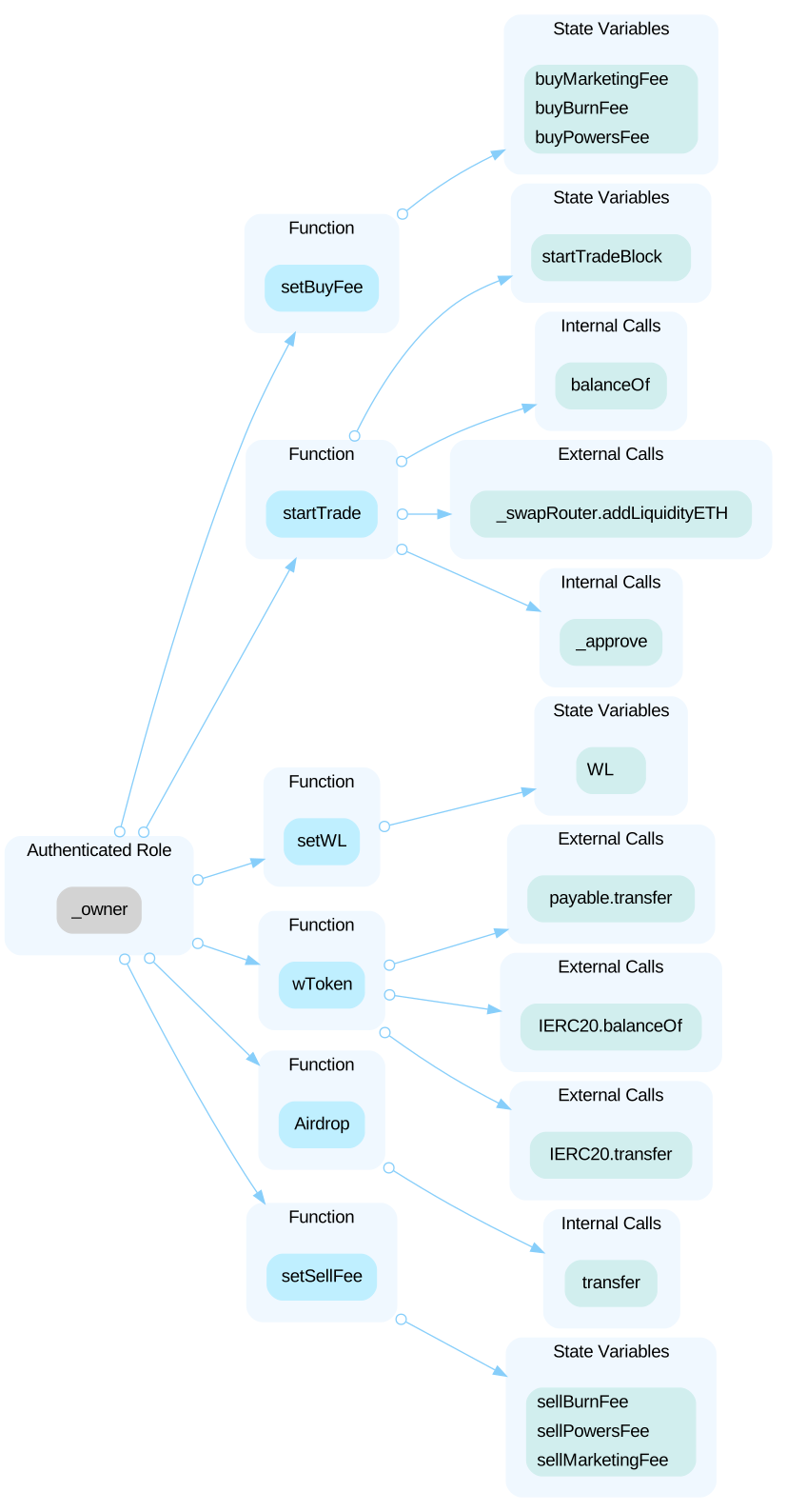 --- In the contract `TokenDistributor` the role `_feeWhiteList` has authority over the functions shown in the diagram below. Any compromise to the `_feeWhiteList` account may allow the hacker to take advantage of this authority and - call `claimToken()` to withdraw arbitrary ERC20 tokens from the contract. - call `claimBalance()` to withdraw BNB and WBNB from the contract. 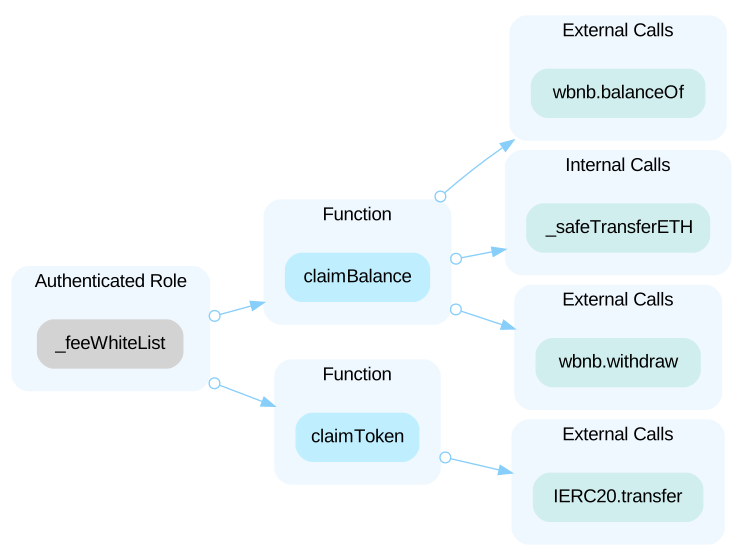 --- In the contract `Ownable` the role `_owner` has authority over the functions shown in the diagram below. Any compromise to the `_owner` account may allow the hacker to take advantage of this authority. 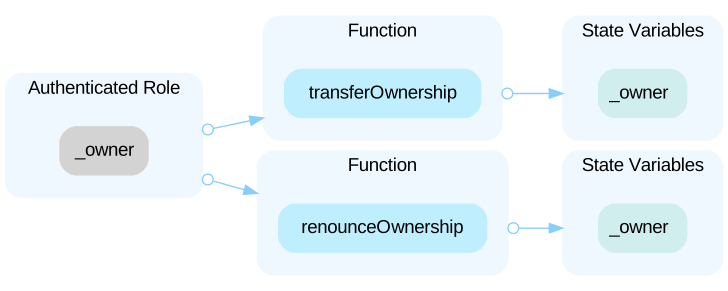
Open the reportThe buy and sell fees in the contract have no set limits, allowing fees to potentially reach 100%. If this occurs, users would receive no tokens from the contract, resulting in a complete loss of their investment. Various fees are allocated to different purposes: - **Burn Fees**: These are used to burn tokens, reducing the total circulative supply. - **Marketing Fees**: These are sent to a designated [marketing wallet](https://bscscan.com/address/0x25D9847505483436C258435951f7e801381c9116). - **Power Fees**: These involve collecting `ToDing` tokens, selling them for BNB, and then using the BNB as liquidity within the token contract. The contract owner has the authority to withdraw both `ToDing` tokens and BNB from the contract. If the marketing wallet accumulates a substantial amount of `ToDing` tokens or if the contract collects large amounts of tokens and BNB, there is a potential for these entities to sell a large volume of `ToDing` tokens on the market and withdraw collected BNBs. This action could severely impact the token's price, harming the community and investors.
Open the reportThe `Airdrop()` function distributes tokens to multiple recipients by taking two arrays as input: `addrs`, which contains the addresses of the recipients, and `amounts`, which specifies the amount of tokens to be allocated to each corresponding address. However, the function does not include a check to ensure that these two arrays are of the same length. If the lengths of `addrs` and `amounts` differ, the function may attempt to access elements that do not exist in one of the arrays, leading to out-of-bounds errors and transaction failures.
Open the reportA sandwich attack can occur when an attacker notices a transaction involving token swaps or liquidity additions that lacks slippage restrictions or minimum output amount settings. The attacker can exploit this by frontrunning the transaction to purchase one of the assets, thereby manipulating the exchange rate, and then backrunning the transaction to sell the asset for a profit. The referenced functions are invoked without setting slippage restrictions or minimum output amounts, making transactions that trigger these functions particularly vulnerable to sandwich attacks, especially when large input amounts are involved. If the token deployer transfers tokens to a malicious actor, who can sandwich the `startTrade()` transaction and make a swap that changes the ratio of assets in the pool. Due to the attacker’s interference, the LP ends up adding more of one asset than planned.
Open the report| Address | Chain | Source code |
|---|---|---|
| 0x1592…12c00x1592c5704f9e8c20bf7707c5d42626cecda912c0 | Chain: BNB Chain | Source code: Verified source |
Is this your project? Show this record on your own website. The label states what the record holds, links to this page and updates by itself. It is free and needs no sign-in.
Automatic: the three strongest facts of this project’s own record (its last audit and two more), highlighted. They update with the record. Picking a fact turns Automatic off.
<head><script src="https://widget.trustblock.run/project-widget.min.js" defer></script></head><body><divdata-tb-project-widgetdata-tb-project-slug="toding"></div></body>
Paste the code where the label should appear. It uses no API credit and updates by itself.
Something wrong on this page? A missing report, a wrong date, a finding that was fixed since. Tell us and we check it against its source.
Tell us