
The Unseen security record
As of 3 Nov 2026, The Unseen has 1 audit report on Trustblock, by CertiK, dated 5 Aug 2024. That report lists 1 open critical finding.
Record last updated . It holds audits, findings and contracts up to Nov 2026, and incidents up to Oct 2026. Trustblock does not review code.
Audits1
Newest first
| Audit | Security firm | Date | Scope | Critical findings | Report |
|---|---|---|---|---|---|
| Unseen - Audit | Security firm: CertiK | Date: | Scope: Files named in the report | 1 open critical finding | Original removed |
Findings21
Statuses are the security firm’s own, from each report.
| Severity | Open | Acknowledged | Fixed |
|---|---|---|---|
| Critical | 1 | 0 | 1 |
| High | 2 | 0 | 1 |
| Medium | 0 | 0 | 0 |
| Low | 2 | 0 | 14 |
CriticalRegistry Owner Can Directly or Indirectly ControlUnseen - Audit · CertiK · 5 Aug 2024Open
Line 133 of the `AuthenticatedProxy` contract is intended to control who can call the `proxy` function. The owner of the proxy can call the `proxy()` function which is intended. Additionally, if `revoked` is `false` (and it defaults to `false` when first deployed) AND the caller is authenticated in the `ProxyRegistry` contract, then the check also passes. In the `ProxyRegistry` contract, the owner can grant authentication to any address, which means that the owner of the `ProxyRegistry` contract can perform arbitrary function call / delegatecall of any user's proxy via an affiliated address. This is a critical risk, as the owner affiliated address can drain the asset of any user from its proxy, or destroy any user's proxy contract via a delegate call to `selfdestrct()` etc.
Open the reportHighCentralization Related RisksUnseen - Audit · CertiK · 5 Aug 2024Open
In the contract `BaseFeeCollector` the role `_owner` has authority over the functions shown in the diagram below. Any compromise to the `_owner` account may allow the hacker to take advantage of this authority and change the withdraw address and set `_operator` address. 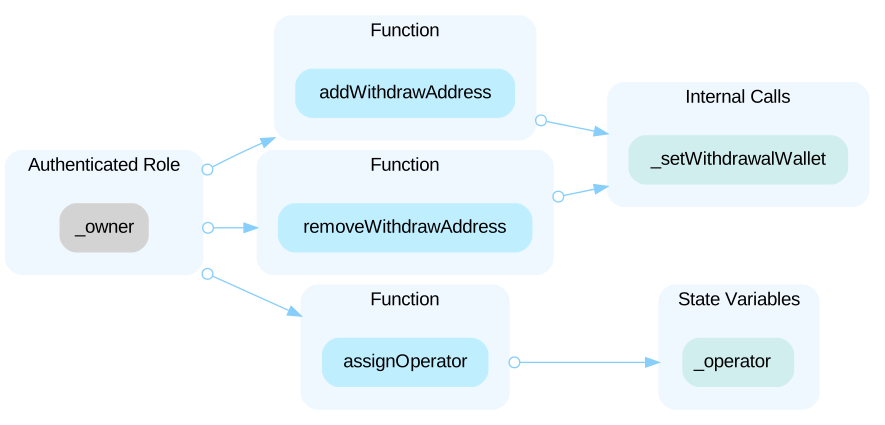 In the contract `BaseFeeCollector` the role `_operator` has authority over the functions `withdrawERC20Tokens()` and `withdraw()`. Any compromise to the `_operator` account may allow the hacker to take advantage of this authority and withdraw ERC20 and native token from the contract. In the contract `FeeCollector` the role `_operator` has authority over the function `unwrapAndWithdraw()`. Any compromise to the `_operator` account may allow the hacker to take advantage of this authority and unwrap token into its associated native token and withdraw it from the contract. In the contract `UnseenRegistry` the role `_owner` has authority over the functions shown in the diagram below. Any compromise to the `_owner` account may allow the hacker to take advantage of this authority and grant authentication to an arbitrary non-zero address.  In the contract `ProxyRegistry` the role `_owner` has authority over the functions shown in the diagram below. Any compromise to the `_owner` account may allow the hacker to take advantage of this authority and grant and revoke authentication on any non-zero address. 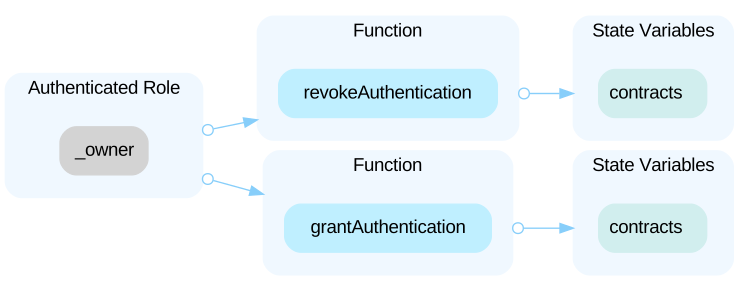 In the contract `AuthenticatedProxy` the role `_proxyowner` has authority over the functions `setRevoke()`, `transferProxyOwnership()`, and `proxy()`. Any compromise to the `_proxyowner` account may allow the hacker to take advantage of this authority and execute arbitrary external call and delegate call. In the contract `ExchangeCore` the role `_owner` has authority over the functions shown in the diagram below. Any compromise to the `_owner` account may allow the hacker to take advantage of this authority and change protocol fee and fee recipient. 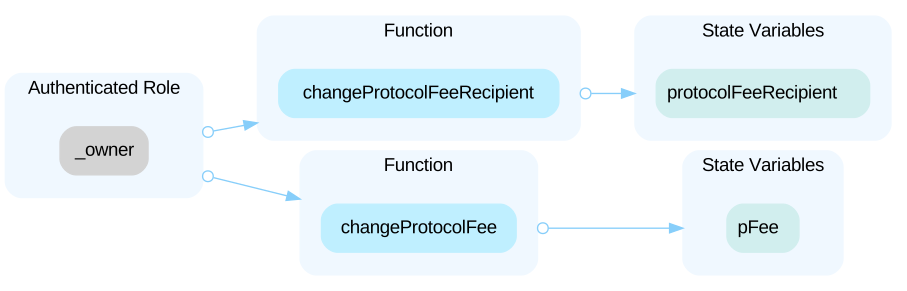 In the contract `ContractMetadata` the role `_owner` has authority over the functions shown in the diagram below. Any compromise to the `_owner` account may allow the hacker to take advantage of this authority and change transfer validator address and `unseenMarketRegistry` address. 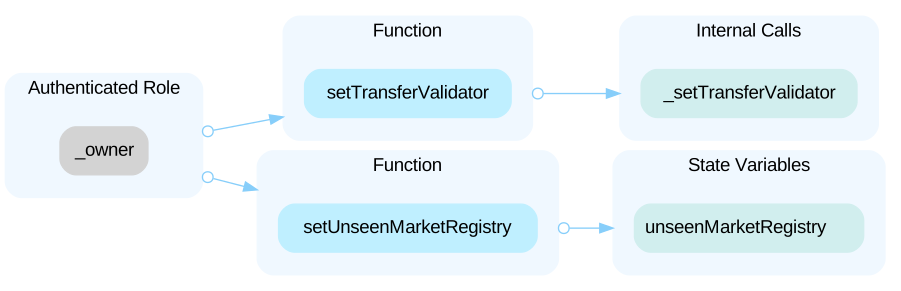 In the contract `ContractMetadata` the role `_owner` and `_CONFIGURER` have authority over the functions `setBaseURI()`, `setContractURI()`, `emitBatchMetadataUpdate()`, `setMaxSupply()`, `setProvenanceHash()`, and `setDefaultRoyalty()`. Any compromise to the `_owner` or `_CONFIGURER` account may allow the hacker to take advantage of this authority and change important project parameters such as the base URI and contract URI, token max supply and default royalties, etc. In the contract `UnseenToken` the role `_owner` has authority over the functions shown in the diagram below. Any compromise to the `_owner` account may allow the hacker to take advantage of this authority and pause or unpause the contract, and change `tokenId` and add minter. 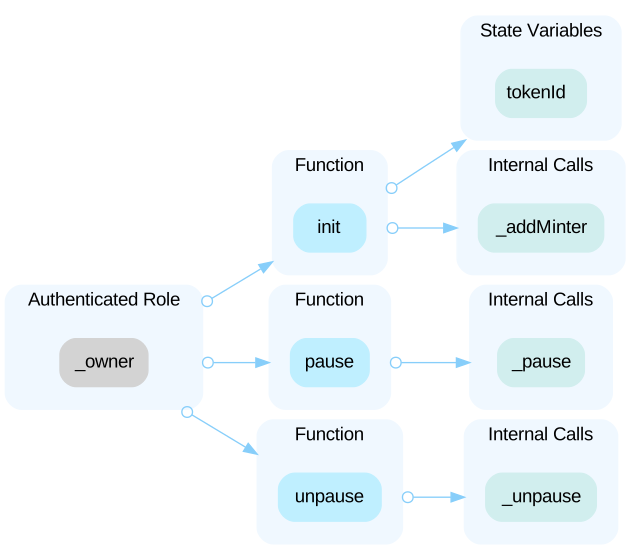 In the contract `UnseenToken` the role `MINTER` has authority over the functions shown in the diagram below. Any compromise to the `_role` account may allow the hacker to take advantage of this authority and mint tokens to arbitrary address. 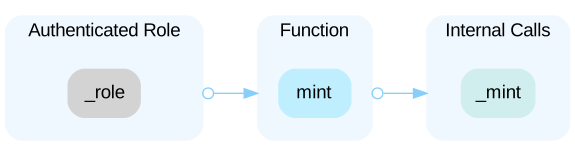 In the contract `UnseenVesting` the role `_owner` has authority over the functions shown in the diagram below. Any compromise to the `_owner` account may allow the hacker to take advantage of this authority and create vesting schedule. 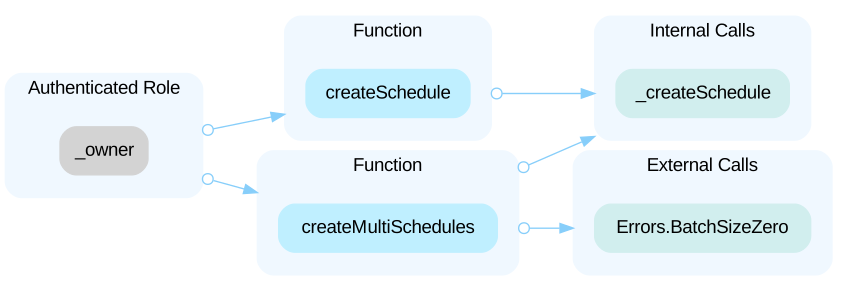 In the contract `VestingLockup` the role `_owner` has authority over the functions shown in the diagram below. Any compromise to the `_owner` account may allow the hacker to take advantage of this authority and change NFT descriptor. , there is a clear separation of proxy and logic, in that all contract logic (with the possible exception of contract upgrade) are implemented in the logic contract, and the proxy contract delegate function calls via the `fallback()` function. However, for `TheGenerates`, the usage of proxy and logic are commingled. `TheGenerates` inherits `TGenContract` which contains a `fallback()` function that delegate calls to the `TheGeneratesConfigurer` contract. At the same time, all contracts in the inheritance chain, including `TheGenerates`, `TGenContract`, `ContractMetadata`, `MarketsPreapproved`, `TokenTransferValidator` etc. all contain function logic as well. Furthermore, within the `fallback()` function itself, some logic are delegated to the external `TheGeneratesConfigurer` contract, and some are redirected to functions implemented in the contract itself.
Open the reportLowThird-Party DependenciesUnseen - Audit · CertiK · 5 Aug 2024Open
The code base contains interaction with third-party or out-of-scope contracts. For example, the `TokenTransferValidator` contract contains a setter function that sets the `_transferValidator` address, and the `ContractMetadata` contract utilizes the `_transferValidator` in the `_beforeTokenTransfers` hook. If the external `_transferValidator` contract fails to properly validate token transfers, then users' token transfer could be adversely impacted. Additionally, the `UnseenToken` contract interacts with third-party `interchainTokenService_` contract that is out of the scope of this audit. The scope of the audit treats third-party/out-of-scope entities as black boxes and assumes their functional correctness. However, in the real world, third parties can be compromised and this may lead to lost or stolen assets.
Open the reportContracts
No deployed address is recorded for these audits.
The reports name a repository or files. Open a report to see its scope.
Show this on your site
Is this your project? Show this record on your own website. The label states what the record holds, links to this page and updates by itself. It is free and needs no sign-in.
Content
Automatic: the three strongest facts of this project’s own record (its last audit and two more), highlighted. They update with the record. Picking a fact turns Automatic off.
Style
Format
<head><script src="https://widget.trustblock.run/project-widget.min.js" defer></script></head><body><divdata-tb-project-widgetdata-tb-project-slug="unseen"></div></body>
Paste the code where the label should appear. It uses no API credit and updates by itself.
Something wrong on this page? A missing report, a wrong date, a finding that was fixed since. Tell us and we check it against its source.
Tell us