0x87d6f8edeccbcca766d2880d19b2c3777d322c22
As of 21 Nov 2026, Trustblock’s record holds 0x87d6f8edeccbcca766d2880d19b2c3777d322c22 on Polygon (POS) as a contract of Miracle Play. 1 audit report on Trustblock lists this address: CertiK, 21 Jun 2024. 7 findings in it are recorded as open or acknowledged.
Each report’s scope as stored on Trustblock names this address on Polygon (POS).
| Audit | Security firm | Date | Commit named in the report | Report |
|---|---|---|---|---|
| Miracle Play - Audit | CertiK | Not recorded (see the report) | Open |
3 High, 4 Low. In the firm’s own words; statuses are the firm’s, from each report.
In the contract `TokenMigrateERC20` the role `MIGRATION_ROLE` has authority over the functions `setMerkleRoot()`. Any compromise to the `MIGRATION_ROLE` account may allow the hacker to take advantage of this authority and change the `ownershipMerkleRoot`. In the contract `TokenERC20M` the role `DEFAULT_ADMIN_ROLE` has authority over the functions shown in the diagram below. Any compromise to the `DEFAULT_ADMIN_ROLE` account may allow the hacker to take advantage of this authority and set `primarySaleRecipient`, `platformFeeBps`, `platformFeeRecipient`, and `contractURI`. 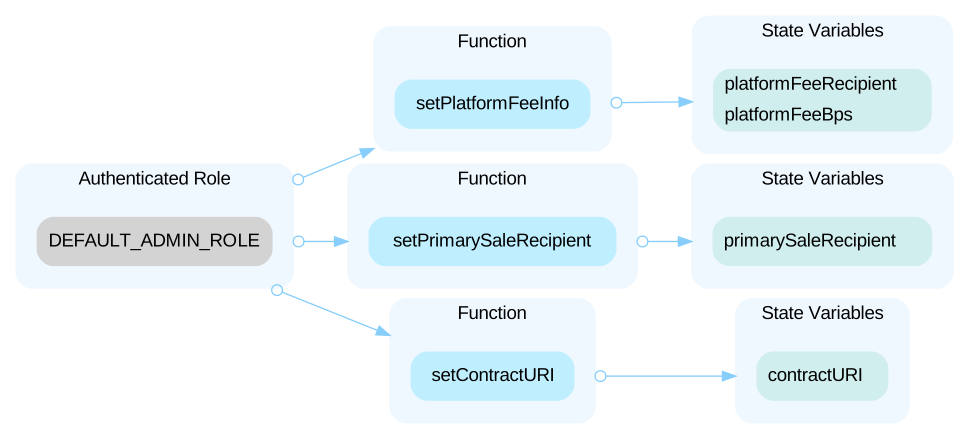 In the contract `BridgeCore` the role `DEFAULT_ADMIN_ROLE` has authority over the functions `changeFeeRecipient()`. Any compromise to the `DEFAULT_ADMIN_ROLE` account may allow the hacker to take advantage of this authority and change the `feeRecipient`. In the contract `ERC1155Staking` the role `DEFAULT_ADMIN_ROLE` has authority over the functions as follows: - `adminUnstakeUser()`, to unstake tokens on behalf of a user. - `adminUnstakeAll()`, to unstake all tokens from all users. - `confiscateERC1155FromUser()`, to confiscate staked ERC-1155 tokens from a specific user. - `setDaoAddress()`, to change the value of `daoAddress`. - `setManagerFeeWallet()`, to change the value of `ManagerWallet`. - `setDAOFeePercentage()`, to change the value of `DAO_FEE_PERCENTAGE`. - `setFeeManagerPercentage()`, to change the value of `MANAGER_FEE_PERCENTAGE`. - `setAgentFeePercentage()`, to change the value of `AGENT_FEE_PERCENTAGE`. - `setPoolStartTime()`, to change the value of `poolStartTime`. - `setPoolFinished()`, to change the value of `POOL_FINISHED`.
The audit on Trustblock · Open the reportIn the contract `Bridge`, the role admin has the authority to update the implementation contract behind the `Bridge` contract. Any compromise to the admin account may allow a hacker to take advantage of this authority and change the implementation contract which is pointed by proxy and therefore execute potential malicious functionality in the implementation contract.
The audit on Trustblock · Open the reportIn the contract `TokenERC20M` the role `MINTER_ROLE` has authority over the functions shown in the diagram below. Any compromise to the `MINTER_ROLE` account may allow the hacker to take advantage of this authority and mint any amount of tokens to any address. 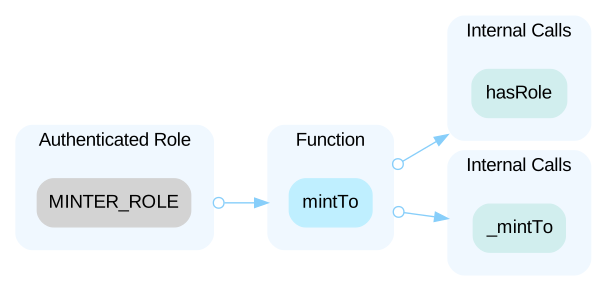 In the contract `BridgeCore` the role `minterAndBurnerRole` has authority over the functions as follows: - `sendERC1155ToUser()`, to mint Drop1155 to order receiver. - `sendERC20ToUser()`, to mint TokenERC20 to order receiver. Any compromise to the `minterAndBurnerRole` account may allow the hacker to take advantage of this authority. In the contract `ERC1155Staking` the role `FACTORY_ROLE` has authority over the functions `claimAgent()`. Any compromise to the `FACTORY_ROLE` account may allow the hacker to take advantage of this authority and claim the reward for a user.
The audit on Trustblock · Open the reportThe logic to ensure the cross-chain transaction atomicity is not implemented in the contract, it could be a message server host by the owner or an intermediate 3rd party application, for example, PolyNetwork, or Chainlink CCIP. If the cross-chain protocol is hacked, the protocol in the source chain cannot confirm the transaction status correctly. As a result, the user exchanges tokens in the source chain but cannot receive them in the target chain. The scope of the audit treats the above-mentioned application entities as black boxes and assumes their functional correctness. However, in the real world, 3rd parties can be compromised and this may lead to lost or stolen assets. If the cross-chain transaction atomicity is not guaranteed properly, the user deposits tokens into the source chain, but not be able to redeem the correct token amount from the target chain.
The audit on Trustblock · Open the reportAddresses are not validated before assignment or external calls, potentially allowing the use of zero addresses and leading to unexpected behavior or vulnerabilities. For example, transferring tokens to a zero address can result in a permanent loss of those tokens. ```solidity=111 primarySaleRecipient = TokenERC20M(__originalContract).primarySaleRecipient(); ``` ```solidity=112 (platformFeeRecipient, platformFeeBps) = TokenERC20M(__originalContract).getPlatformFeeInfo(); ``` - `__originalContract` is not zero-checked before being used. --- ```solidity=208 primarySaleRecipient = _saleRecipient; ``` - `_saleRecipient` is not zero-checked before being used. --- ```solidity=220 platformFeeRecipient = _platformFeeRecipient; ``` - `_platformFeeRecipient` is not zero-checked before being used.
The audit on Trustblock · Open the reportThe linked statements do not affect the functionality of the codebase and appear to be either leftovers from test code or older functionality.
The audit on Trustblock · Open the reportThe above-mentioned contracts are serving as the underlying entities to interact with third party protocols such as ThirdWeb and OpenZeppelin. The scope of the audit treats third party entities as black boxes and assumes their functional correctness. However, in the real world, third parties can be compromised and this may lead to lost or stolen assets. ```solidity=8840 function _mintERC20(address token, address account, uint256 amount) internal isValidAmount(amount) { TokenERC20(token).mintTo(account, amount); } function _mintERC1155(AdminERC1155Order calldata order) internal isValidAmount(order.amount) { DropERC1155(order.token).claim( order.receiver, order.tokenId, order.amount, order.currency, order.pricePerToken, order.allowlistProof, order.data ); } ``` - The contract `BridgeCore` interacts with third party contracts `DropERC1155` and `TokenERC20`. ```solidity=43 contract TokenERC20M is Initializable, IThirdwebContract, IPrimarySale, IPlatformFee, ReentrancyGuardUpgradeable, Multicall, ERC20BurnableUpgradeable, ERC20VotesUpgradeable, ITokenERC20, AccessControlEnumerableUpgradeable, TokenMigrateERC20 { ``` - The contract `TokenERC20M` interacts with third party protocols such as ThirdWeb and OpenZeppelin. ```solidity=20 contract ERC1155Staking is ReentrancyGuard, PermissionsEnumerable, ERC1155Holder, ContractMetadata, Multicall{ ... erc1155Token = DropERC1155(_erc1155Token); rewardsToken = TokenERC20(_erc20Token); ``` - The contract `ERC1155Staking` interacts with third party contracts `DropERC1155` and `TokenERC20`.
The audit on Trustblock · Open the reportThe Miracle Play security record · Every Miracle Play address · This address on the explorer