Venus - Multichain Governance
Part of CertiK’s series
CertiK reviewed Venus Protocol (Venus - Multichain Governance) on 26 Feb 2024: 29 findings, 0 critical; 24 marked fixed, 5 open.
Report hosted on skynet.certik.com.
Trustblock does not review code.
Findings29
Statuses are the security firm’s own, from its report.
| Severity | Open | Acknowledged | Fixed |
|---|---|---|---|
| Critical | 0 | 0 | 0 |
| High | 2 | 0 | 0 |
| Medium | 0 | 0 | 1 |
| Low | 3 | 0 | 23 |
HighCentralization Related RisksOpen
### TimelockV8 In the contract `TimelockV8` the role `admin` has authority over the functions shown in the diagram below. Any compromise to the `admin` account may allow the hacker to take advantage of this authority and do the following: - Queue a malicious transaction. - Cancel a transaction causing it to have to be queued again. - Execute a transaction when it was not intended to be or execute a malicious transaction they had previously queued. 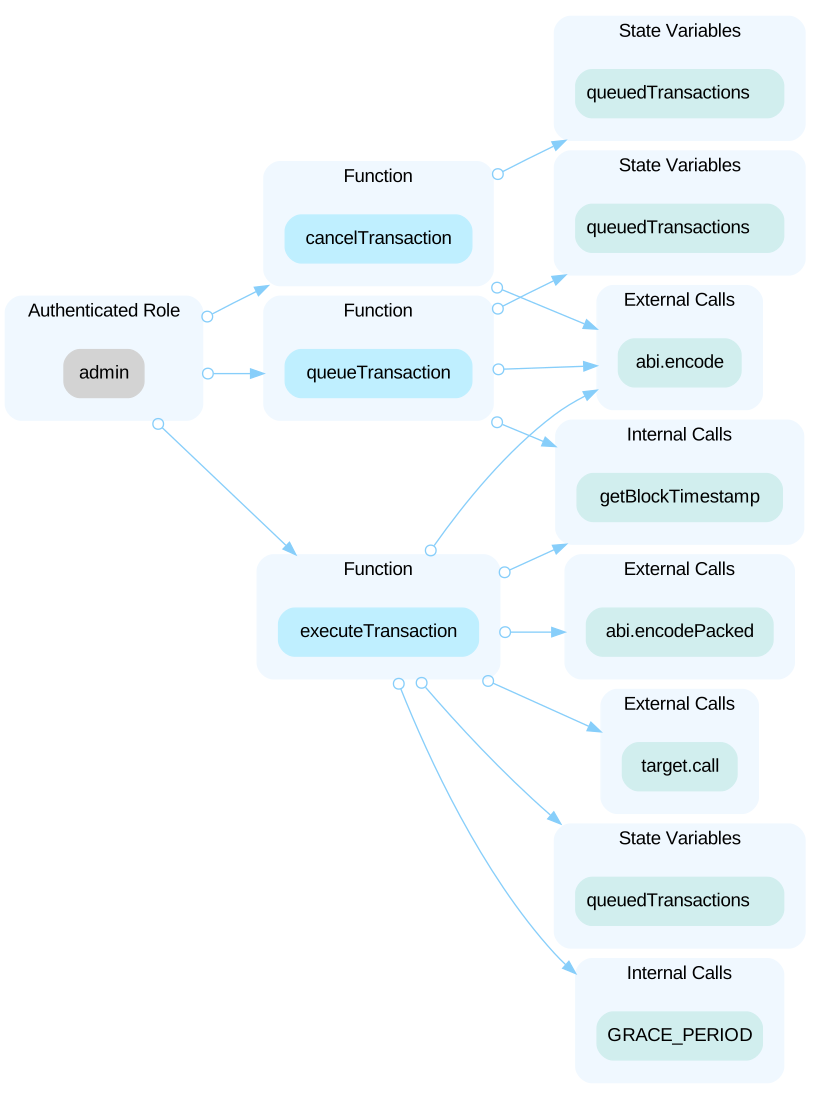 In addition to this, they also have control over the following functions which can only be called by queueing a transaction that will call them and then executing that transaction: - `setDelay()` - `setPendingAdmin()` Any compromise to the `admin` account may allow a hacker to queue and then execute a transaction that will change the delay between the MINIMUM_DELAY and MAXIMUM_DELAY. It will also allow them to set the pending admin to an account they control, which can then call `acceptAdmin()` so that the team cannot recover the role from the hacker. --- ### BaseOmnichainControllerSrc In the contract `BaseOmnichainControllerSrc` the `DEFAULT_ADMIN_ROLE` of the `AccessControlManager` can grant addresses the privilege to call the following functions: - `setMaxDailyLimit()` - `pause()` - `unpause()` Any compromise to the `DEFAULT_ADMIN_ROLE` or accounts granted this privilege may allow the hacker to take advantage of this authority and do the following: - Update the max daily receive limit to 0 in order to prevent sending any proposals, or set it to a high value to allow more proposals to be sent than intended. - Pause or unpause the contract during a crucial period. --- In the contract `BaseOmnichainControllerSrc`, the role `_owner` has authority over the following functions: - `setAccessControlManager()` Any compromise to the `_owner` account may allow a hacker to take advantage of this authority and update the `accessControlManager` address to a malicious contract and gain control over setting the privilege of the functions above. --- ### BaseOmnichainControllerDest In the contract BaseOmnichainControllerDest, the role `_owner` has authority over the following functions: - `setMaxDailyReceiveLimit()`; - `pause()`; - `unpause()`; Any compromise to the `_owner` account may allow a hacker to take advantage of this authority and - Update the max daily receive limit to 0 in order to prevent receiving any proposals, or set it to a high value to allow more proposals to be accepted than intended. - Pause or unpause the contract during a crucial period. --- ### OmnichainExecutorOwner In the contract `OmnichainExecutorOwner` the role `_owner` has authority over the following functions: - `upsertSignature()` Any compromise to the `_owner` account may allow the hacker to take advantage of this authority and make a function signature active within the `functionRegistry` mapping in order to give their account access to this Omnichain Governance logic through the privilege outlined below. --- In the contract `OmnichainExecutorOwner` the role `DEFAULT_ADMIN_ROLE` of the `AccessControlManager` can grant addresses the privilege to call the following functions: - Functions within the Omnichain Governance via the `fallback()` function in `OmnichainExecutorOwner` - `transferBridgeOwnership()` Any compromise to the `DEFAULT_ADMIN_ROLE` or accounts granted this privilege may allow the hacker to take advantage of this authority and do the following: - Call privileged functions that the `OmnichainExecutorOwner` controls within the Omnichain Governance. - Give an account they control the owner privilege of the bridge in order to access other functions so they can take steps to perform the above. --- ### OmnichainProposalSender In the contract `OmnichainProposalSender` the role `_owner` has authority over the following functions: - `fallbackWithdraw()` Any compromise to the `_owner` account may allow the hacker to take advantage of this authority and clear a message that was intended to be retried and recover the `msg.value` for themselves. --- In the contract `OmnichainProposalSender` the role `DEFAULT_ADMIN_ROLE` of the `AccessControlManager` can grant addresses the privilege to call the following functions: - `execute()` - `setTrustedRemoteAddress()` - `setConfig()` - `setSendVersion()` - `updateValidChainId()` Any compromise to the `DEFAULT_ADMIN_ROLE` or accounts granted this privilege may allow the hacker to take advantage of this authority and do the following: - Submit a malicious proposal and send it to the remote chain so that it can be executed there. - Change the remote message receiver address to cause a denial of service or to execute malicious functionality. - Change the configuration of the LayerZero messaging library to cause a denial of service. - Update the list of valid chain Id
HighCentralized Control of Contract UpgradeOpen
The contract `OmnichainExecutorOwner` is upgradeable; the corresponding `admin` role in each respective proxy has the authority to update the implementation contract behind each contract. Any compromise to the `admin` account in each proxy may allow a hacker to take advantage of this authority and change the implementation contract the proxy points to, and therefore execute potential malicious functionality in the implementation contract.
Low`whenNotPaused` Could Revert SoonerOpen
The function `_blockingLzReceive()` was overridden to include the `whenNotPaused` modifier. However, if the protocol is paused, then it will cause the transaction to revert without storing the failed message. If it is intended to not store any messages when paused, then the `whenNotPaused` modifier can be moved to an overrided external facing `lzReceive()` function so that it reverts sooner. Alternatively if messages should be stored when paused, then the `whenNotPaused` modifer can be moved to the `_nonblockingLzReceive()` function. However, if this is done a method should be added allowing failed messages to be canceled before unpausing in case malicious failed messages are stored and could be retried. Also we recommend considering adding a method to cancel stored failed messages, because if a malicious proposal is stored as a failed message and then is retried successfully. Canceling each individual transaction could be much more intensive than canceling the failed messages proposal.
LowMapping `proposalTimelocks` Can Be Optimized As aOpen
If the mapping `proposalTimelocks` is updated to a fixed-length array, deployment cost and the cost to call function `addTimelocks()` will increase slightly, but the calls to functions `execute()` and `cancel()` will decrease in gas cost.
LowMissing Input ValidationOpen
### OmnichainGovernanceExecutor.sol - The constructor is missing a check that `guardian_` is a nonzero address. - The function `addTimelocks()` is missing a check to ensure that each of the entries of `proposalTimelocks` is distinct by the end of all updates. - The function `addTimelocks()` is missing a check to prevent updating to a new timelock while transactions have been queued but not executed or canceled - The function `_nonblockingLzReceive()` is missing a check that all arrays are the same length. - Function `_nonblockingLzReceive()` is missing a check that the `proposalType` decoded in the sent payload is a value between 0 and 2, inclusive. Anything larger will correspond to a `proposalType` that is not implemented. ### OmnichainProposalSender.sol - Function `execute()` is missing a check that all arrays are the same length. - Function `execute()` is missing a check that the `proposalType` decoded in the sent payload is a value between 0 and 2, inclusive. Anything larger will correspond to a `proposalType` that is not implemented.
Contracts in scope
No deployed address is recorded for this audit.
The report names a repository or files. Open the report to see its scope.
Repository and files the report names (7)
- contracts/Governance/TimelockV8.sol
- contracts/Cross-chain/OmnichainProposalSender.sol
- contracts/Cross-chain/interfaces/ITimelock.sol
- contracts/Cross-chain/BaseOmnichainControllerSrc.sol
- contracts/Cross-chain/BaseOmnichainControllerDest.sol
- contracts/Cross-chain/OmnichainExecutorOwner.sol
- contracts/Cross-chain/OmnichainGovernanceExecutor.sol
Part of Venus Protocol’s security record
Security firm
 CertiK
1,045 projects reviewed · 1,376 reports · latest May 2025
See CertiK’s auditsSomething wrong on this page? A missing report, a wrong date, a finding that was fixed since. Tell us and we check it against its source.
Tell us