1cent dream
CertiK reviewed 1Cent (1cent dream) on 21 Sep 2022: 14 findings, 0 critical; none marked fixed.
Report hosted on skynet.certik.com.
Trustblock does not review code.
Findings14
Statuses are the security firm’s own, from its report.
| Severity | Open | Acknowledged | Fixed |
|---|---|---|---|
| Critical | 0 | 0 | 0 |
| High | 3 | 0 | 0 |
| Medium | 0 | 0 | 0 |
| Low | 11 | 0 | 0 |
HighCentralization Risks in 1Cent.solOpen
In the contract `BABYTOKEN`, the role `_owner` has authority over the functions shown in the diagram below. Any compromise to the `_owner` account may allow the hacker to take advantage of this authority. 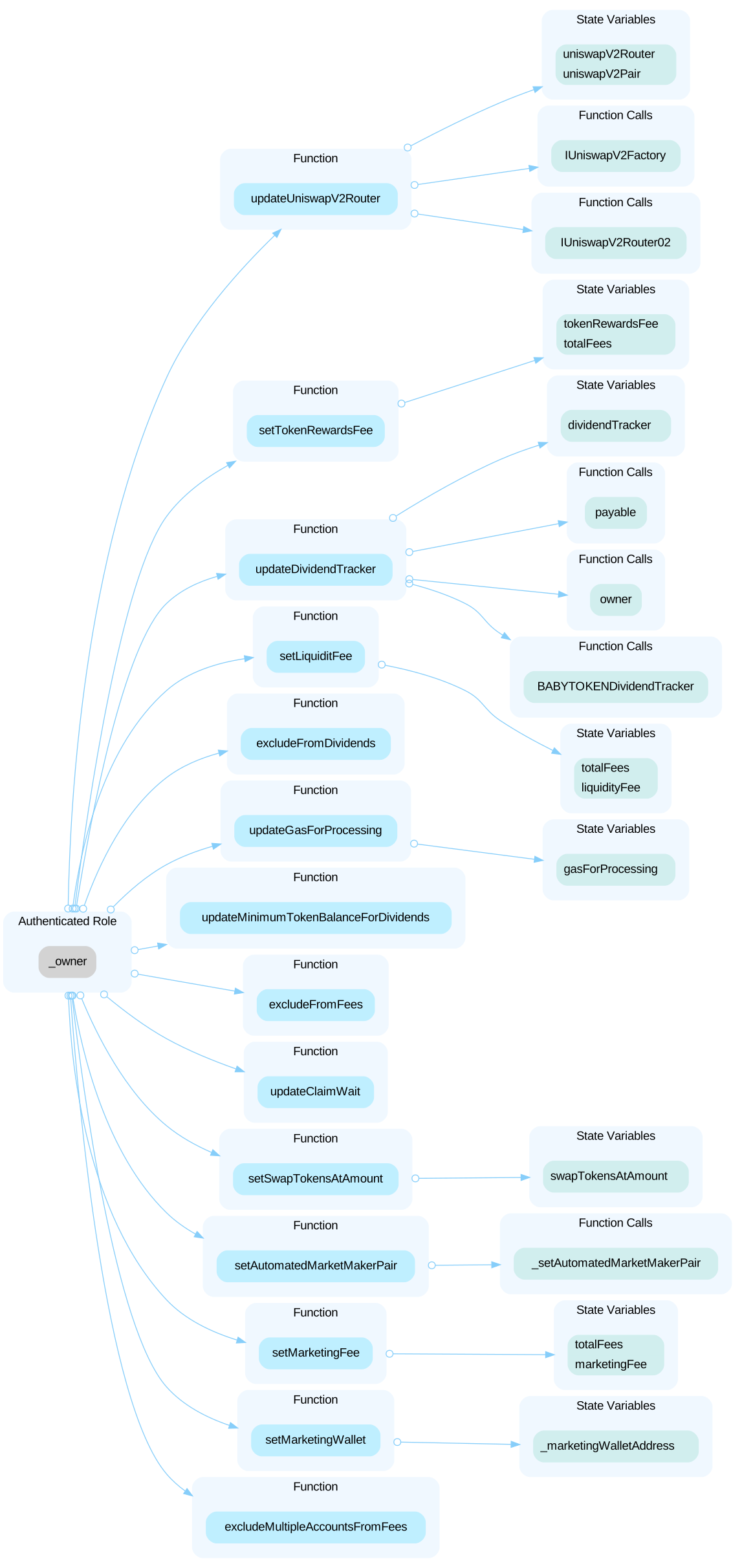
HighCentralized Control of Contract UpgradeOpen
ERC20Upgradeable are upgradeable contracts, the owner can upgrade the contract without the community's commitment. If an attacker compromises the account, he can change the implementation of the contract and drain tokens from the contract.
HighInitial Token DistributionOpen
All of the tokens are distributed to the contract deployer when deploying the contract, which could be a centralization risk as the deployer can distribute tokens without obtaining the consensus of the community.
LowInconsistency between Function Name and FunctionaOpen
According to the function name, this function `distributeCAKEDividends()` is supposed to distribute dividends to token holders. However, the function appears to only update `magnifiedDividendPerShare` and `totalDividendsDistributed`, and not actually sends dividends to token holders.
LowMissing Emit EventsOpen
There should always be events emitted in the sensitive functions that are controlled by centralization roles.
LowMissing Error MessagesOpen
The **require** can be used to check for conditions and throw an exception if the condition is not met. It is better to provide a string message containing details about the error that will be passed back to the caller.
LowMissing Zero Address ValidationOpen
Address should be checked before assignment to make sure it is not zero addresses.
LowPotential Reentrancy AttackOpen
A reentrancy attack can occur when the contract creates a function that makes an external call to another untrusted contract before resolving any effects. If the attacker can control the untrusted contract, they can make a recursive call back to the original function, repeating interactions that would have otherwise not run after the external call resolved the effects.
LowRedundant StatementsOpen
When the transfer amount is 0, calling super._transfer() has no effect but waste gas.
LowThird Party DependenciesOpen
The contract is serving as the underlying entity to interact with third party Pancakeswap protocols. The scope of the audit treats 3rd party entities as black boxes and assume their functional correctness. However, in the real world, 3rd parties can be compromised and this may lead to lost or stolen assets. In addition, upgrades of 3rd parties can possibly create severe impacts, such as increasing fees of 3rd parties, migrating to new LP pools, etc.
Show 4 more
LowTypo in the CommentOpen
The spelling of 'exlcude' is a typo.
LowUnreachable CodeOpen
Given the require(false) statement, the code block from line 2233 to line 2239 in function `transfer()` will never be executed and is unnecessary.
LowUnused Return ValueOpen
The return value of an external call is not stored in a local or state variable.
LowVariables That Could Be Declared as ImmutableOpen
The linked variables assigned in the constructor can be declared as `immutable`. Immutable state variables can be assigned during contract creation but will remain constant throughout the lifetime of a deployed contract. A big advantage of immutable variables is that reading them is significantly cheaper than reading from regular state variables since they will not be stored in storage.
Contracts in scope
No deployed address is recorded for this audit.
The report names a repository or files. Open the report to see its scope.
Repository and files the report names (1)
- Contracts/1Cent.sol
Part of 1Cent’s security record
 1Cent
Security firm
 CertiK
1,044 projects reviewed · 1,375 reports · latest May 2025
See CertiK’s auditsSomething wrong on this page? A missing report, a wrong date, a finding that was fixed since. Tell us and we check it against its source.
Tell us