Fastex has 4 public audit reports from CertiK and Hexens; the latest is CertiK, 18 Jan 2024; 1 critical finding, marked fixed by the firm. 73 findings in 4 reports: 60 fixed, 6 acknowledged (the team chose not to change the code), 7 open.
Last updated . It holds audits and findings, contracts and incidents up to Nov 2026. Trustblock does not review code.
Select a mark to open it.
A taller bar is a report with more findings.
By CertiK and Hexens, from Oct 2022 to Jan 2024. 7 findings are still open.
In the contract `Casino` the role `OWNER_ROLE` has authority over the functions shown in the diagram below. 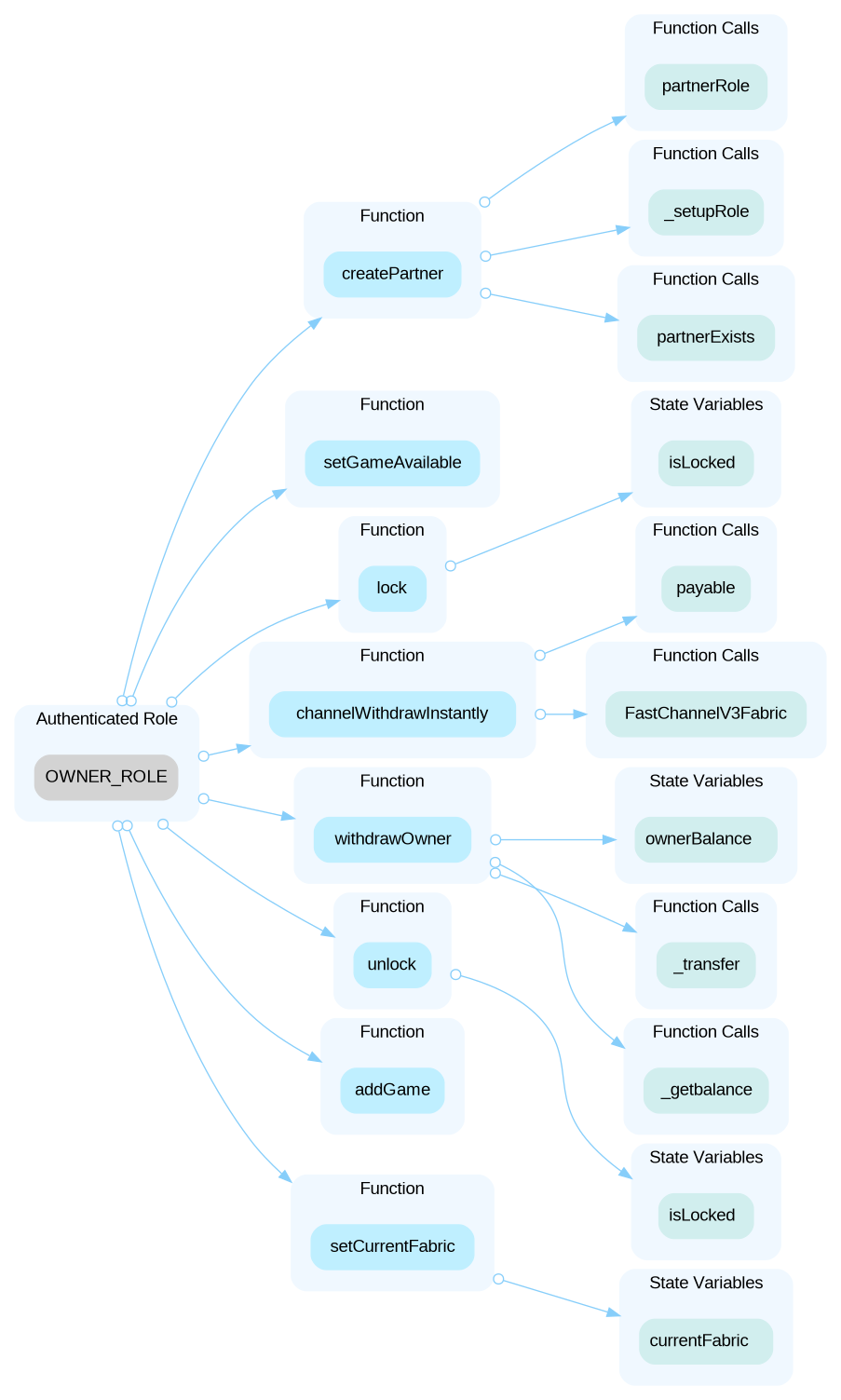 Any compromise to the `OWNER_ROLE` account may allow the hacker to take advantage of this authority and - Withdraw owner profit to arbitrary addresses - Migrate to a new fabric contract - Withdraw instantly from player channels - Add/Set available games - Lock/Unlock FastChannel and partner - Transfer `OWNER_ROLE` to other address In the contract `FastChannelV3Fabric` the role `CasinoSigner` has authority over the following functions: - serverStep() - updateStateAsUser() - updateGameStateAsUser() - updateStateAsServer() Any compromise to the `CasinoSigner` account may allow the hacker to take advantage of this authority and modify the game states inside of the fabric contract. In the contract `BaseGame` the role `Owner` has authority over the following functions: - setBetProperties() Any compromise to the `Owner` account may allow the hacker to take advantage of this authority and modify the `minBet`, `maxBet` and `maxWin`.
Report ↗The functions `updateStateAsServer()` and `updateGameStateAsServer()` should only be accessible to the backend server according to their naming. While in the current implementation, these two functions enable the player to choose the signer of the signature, who can create arbitrary messages. For instance, the signer could collude with the channel player and sign an incorrect `balanceChange_`, allowing the player channel to receive more assets from the casino contracts than intended through the function `_changeBalanceByFC()`. Besides, the signer can manipulate the internal game states using the `updateGameStateAsServer()` function, which could potentially facilitate cheating. For instance, they could increase the `freeSpinStateIndex` to obtain additional free spin opportunities. ```solidity=267 function updateStateAsServer( address channelAddress_, uint256[] memory gameNonces_, int256 balanceChange_, uint32 newNonce_, bytes memory sSign_, address signerAddress_, bytes memory uSign_) public { require(recoverSigner(signerAddress_, uSign_) == V3Channels[channelAddress_].player, 'Error: Wrong signature for setting signer'); require(V3Channels[channelAddress_].nonce + NONCE_JUMP <= newNonce_, 'Error: New nonce should be higher than existing one'); require(recoverSigner(channelAddress_, gameNonces_, balanceChange_, newNonce_, sSign_) == signerAddress_, 'Error: Wrong signature'); V3Channels[channelAddress_].nonce = newNonce_; V3Channels[channelAddress_].nonceList = gameNonces_; _changeBalanceByFC(channelAddress_, balanceChange_); emit ServerUpdatedState(channelAddress_, balanceChange_, newNonce_); } ```
Report ↗In the contract **FTNVault**, the role **owner** has authority over the functions shown in the diagram below. 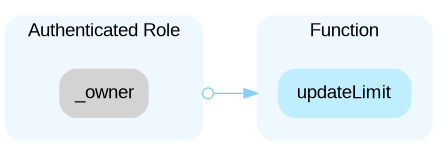 - **updateLimit(address minterAddress_, uint256 limit_)** to update the maximum amount of the native FTN token that an `minterAddress_` is able to withdraw. According to the project design, the native FTN tokens will be initialized to the FTNVault contact in the genesis. In this case, any compromise to the **owner** account may allow a hacker to take advantage of this authority and drain the FTN tokens from the contract **FTNVault**. If the hacker controls the **owner** role, the hacker is able to call the function `updateLimit()` to set the maximum amount of the native FTN token to the hacker's account, then invokes `processBurnTransaction()` to withdraw the native FTN tokens, resulting in severe damage to the project.
Report ↗In the contract `FasttokenDistribution`, the role `FOUNDERS_DISTRIBUTOR_ROLE` has authority over setting and canceling the `Founders` type allocation. Any compromise to the `FOUNDERS_DISTRIBUTOR_ROLE` account may allow a hacker to take advantage of this authority and set or cancel address's `Founders` allocations. In the contract `FasttokenDistribution`, the role `ADVISORS_DISTRIBUTOR_ROLE` has authority over setting and canceling the `Advisors` type allocation. Any compromise to the `ADVISORS_DISTRIBUTOR_ROLE` account may allow a hacker to take advantage of this authority and set or cancel address's `Advisors` allocations. In the contract `FasttokenDistribution`, the role `TOKEN_SALE_DISTRIBUTOR_ROLE` has authority over setting, burning and canceling the `Private1`, `Private2`, `Public`, or `Presale` type allocation. Any compromise to the `TOKEN_SALE_DISTRIBUTOR_ROLE` account may allow a hacker to take advantage of this authority and set, burn or cancel address's `Private1`, `Private2`, `Public`, or `Presale` allocations. In the contract `FasttokenDistribution`, the role `MARKETING_PR_DISTRIBUTOR_ROLE` has authority over setting and canceling the `Marketing` and `Partners` type allocation. Any compromise to the `MARKETING_PR_DISTRIBUTOR_ROLE` account may allow a hacker to take advantage of this authority and set or cancel address's `Marketing` and `Partners` allocations. In the contract `FasttokenDistribution`, the role `ECOSYSTEM_DISTRIBUTOR_ROLE` has authority over setting and canceling the `Ecosystem` type allocation. Any compromise to the `ECOSYSTEM_DISTRIBUTOR_ROLE` account may allow a hacker to take advantage of this authority and set or cancel address's `Ecosystem` allocations. In the contract `FasttokenDistribution`, the role `BLOCKCHAIN_BURN_ROLE` has authority over setting, burning and canceling the `Blockchain` type allocation. Any compromise to the `BLOCKCHAIN_BURN_ROLE` account may allow a hacker to take advantage of this authority and set, burn or cancel address's `Blockchain` allocations. In the contract `FasttokenDistribution`, the role `DEFAULT_ADMIN_ROLE` has authority over the functions setting and revoking roles as well as the following functions: - `refundTokens()` - `refund()` Any compromise to the `DEFAULT_ADMIN_ROLE` account may allow a hacker to take advantage of this authority and change the currently assigned roles and transfer tokens or ether from the contract. In the contract `MultiSigWallet` the role `isOwner` has authority over the functions shown in the diagram below. Any compromise to the `isOwner` account may allow the hacker to take advantage of this authority and affect the status of transactions and confirmations. 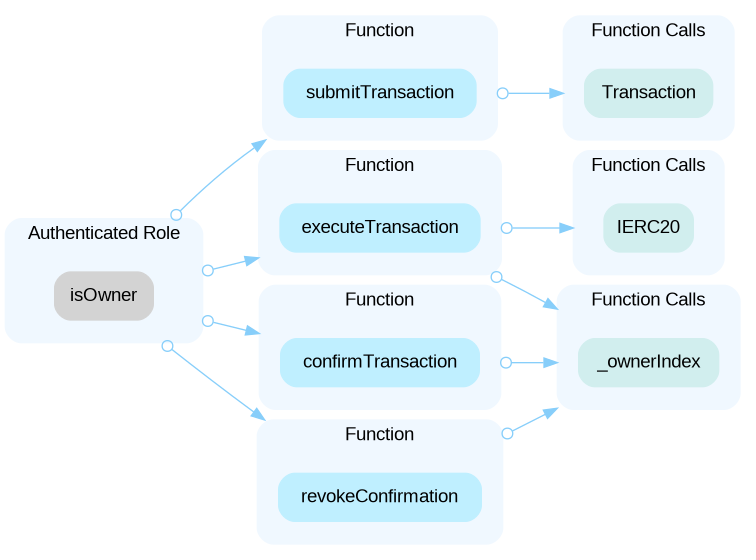
Report ↗The current withdraw function provides a 3-hour window (defined by FRZ_HRS) for the casino contract to update its internal states. We would like to understand if it's possible for the casino to fail to update the states within this timeframe, potentially allowing users to withdraw an incorrect amount of assets from the channel.
Report ↗There should always be events emitted in the sensitive functions that are controlled by centralization roles.
Report ↗We did not find any unit test files, and there is no `test` folder in the project. ``` js npm test ./test/[fileName].js. Will test all functions in that file ```
Report ↗Contracts in this project are serving as the underlying entities to interact with the backend `Casino server` and privileged role `signer`. The scope of the audit treats out-of-scope entities as black boxes and assumes their functional correctness. However, in the real world, these entities can be compromised and this may lead to lost or stolen assets.
Report ↗Files: - `bahamut/FTNVault.sol` Commit: - [`1f2392be6927c2227a0061a5c7c9f7c937545971`](https://github.com/fasttoken1/fasttoken-distribution-eth-contracts/tree/1f2392be6927c2227a0061a5c7c9f7c937545971) The contract `FTNVault` serves as a vault of native FTN tokens to redeem the same amount of FTN tokens that the user has burnt on Ethereum. By design, the user burns the FTN token on Ethereum and redeems the same amount of the burnt FTN token from the contract `FTNVault` through the function `processBurnTransaction()` with the burn transaction: ```solidity=64 function processBurnTransaction(bytes32 burnTxHash_, address recipient_, uint256 amount_) external { require(initialized, 'Contract has not been initialized'); require(amount_ <= limits[msg.sender], 'Limit exceeded'); limits[msg.sender] -= amount_; _processBurnTransaction(burnTxHash_, recipient_, amount_); } ``` However, the current implementation seems to miss some logic to validate the burner and amount that is burnt on Ethereum. 1. There is no validation to ensure the passed amount is the amount burnt in the transaction; 2. Similarly, no validation to make sure the user is related to the burner that burns the FTN tokens. The only way is to set the limits to a user via the function `updateLimit()` in a centralized manner; 3. No validation to ensure the passed `burnTxHash_` is actually a burn transaction that happened on Ethereum; Any user that has the limit is able to withdraw all the allowed balance by passing an unused `bytes32`.
Report ↗Files: - `beacon-chain/core/helpers/validators.go` Commit: - [`3226f8330911cb8df77e775f0155b335ba771bd8`](https://github.com/fastexlabs/bahamut-consensus/tree/3226f8330911cb8df77e775f0155b335ba771bd8) According to the Fasttoken consensus whitepaper, the $i$-th validator's (denoted as $V_i$) power is defined as: $$ P^e_i = T_e \cdot \frac{s_i}{S} + A^e_{V_i},$$ where - $T_e$ is the sum of all transaction constant gas usage components, that is, $T_e = 21000 ∗ N$ where N is the number of all transactions which have been executed during the epoch $e$. - $s_i$ is the staked amount of the $i$-th validator; - $S$ is the sum of all validators' staked balances; - $A^e_{V_i}$ is the activity score assigned to the validator $V_i$ for the epoch $e$. In the implementation, the $\frac{s_i}{S}$ is assumed that the staked amounts of all the validators are the equal, so it is $\frac{1}{n}$ (n is the number of active validators): ```go transactionsGas := sharedActivity.TransactionsGasPerPeriod / length ``` Moreover, the $T_e$ and $A^e_{V_i}$ is the rolling sum of window size `period` given by the formula ```go effectiveActivity := ((val.EffectiveActivity+activity)*period - val.EffectiveActivity) / period ``` and ```go sharedActivity.TransactionsGasPerPeriod = ((gasPerPeriod+gasPerEpoch)*period - gasPerPeriod) / period ``` , which are not the values in the current epoch $e$.
Report ↗Files: - `bahamut/FTNVault.sol` Commit: - [`1f2392be6927c2227a0061a5c7c9f7c937545971`](https://github.com/fasttoken1/fasttoken-distribution-eth-contracts/tree/1f2392be6927c2227a0061a5c7c9f7c937545971) The contract `FTNVault.sol` serves as a vault of native FTN tokens to redeem the same amount of FTN tokens that the user has burnt on Ethereum. However, no receive, fallback, or any payable function is implemented in the contract to accept the native FTN tokens. In this case, there is no FTN token in the vault except for tokens obtained from the self-destruct of other contracts or before the deployment. Both methods do not align with the current design because the amount of native FTN tokens is determined by the burnt amount on Ethereum.
Report ↗Files: - `bahamut/FTNVault.sol` Commit: - [`1f2392be6927c2227a0061a5c7c9f7c937545971`](https://github.com/fasttoken1/fasttoken-distribution-eth-contracts/tree/1f2392be6927c2227a0061a5c7c9f7c937545971) In the contract `FTNVault`, the function `initialize()` can be called by anyone due to no access restriction, which enables anyone to initialize the contract, and gain ownership of the contract. Malicious users could observe the pending transaction which will execute the `initialize()` function in the mempool, and launch a similar transaction to front-run the pending transaction. ```solidity=43 function initialize(bytes32 burnTxHash_) public { require(!initialized, 'Contract has already been initialized'); initialized = true; _transferOwnership(msg.sender); burnTransactionHashes[burnTxHash_] = true; uint256 amount = 1000 * 10**18; emit BurnTransactionProcessed(burnTxHash_, msg.sender, amount); } ``` In the case that the contract has some native FTN tokens after the deployment, then the malicious users that control the contract will be able to drain the contract via the functions `updateLimit()` and `processBurnTransaction()`.
Report ↗The linked variables assigned in the constructor can be declared as `immutable`. Immutable state variables can be assigned during contract creation but will remain constant throughout the lifetime of a deployed contract. A big advantage of immutable variables is that reading them is significantly cheaper than reading from regular state variables since they will not be stored in storage.
Report ↗Newest first
| Report | Security firm | Date | Scope | Critical findings | Findings | Source |
|---|---|---|---|---|---|---|
| DECA | Security firm: CertiK | Date: | Scope: Files listed | None open | Findings: 4 high · 5 medium · 20 low 23 fixed · 6 open | skynet.certik.com ↗ |
| Bahamut Execution and Consensus | Security firm: CertiK | Date: | Scope: Files listed | None open | Findings: 1 high · 5 medium · 24 low 25 fixed · 5 acknowledged | skynet.certik.com ↗ |
| Bahamut security review | Security firm: Hexens | Date: | Scope: —Not recorded; see the report | 1 critical finding, fixed | Findings: 1 critical · 2 high · 1 medium · 5 low 9 fixed | GitHub ↗ |
| Fastex - Token Distribution SC | Security firm: CertiK | Date: | Scope: Files listed | None open | Findings: 1 high · 2 medium · 2 low 3 fixed · 1 acknowledged · 1 open | skynet.certik.com ↗ |
The reports name a repository or files. Open a report to see its scope.
When an incident is reported, it appears here with its date, the amount as the source reports it, the contract involved, and whether a report had covered that code.
Know of one? Send the sourceFacts added by projects and providers, each with its source.
Trustblock holds 4 public audit reports for Fastex, dated 14 Oct 2022 to 18 Jan 2024. The latest is by CertiK (“DECA”).
2 security firms wrote the reports Trustblock holds for Fastex: CertiK and Hexens.
73 findings in 4 reports: 60 fixed, 6 acknowledged (the team chose not to change the code), 7 open. Of 1 critical finding: marked fixed by the firm. Statuses are the security firms’ own.
No incident is on record for Fastex. Public incident reports, last checked 22 Nov 2026.
Something wrong on this page? A missing report, a wrong date, a finding that was fixed since. Tell us and we check it against its source.
Tell us