
Fastex security record
As of 3 Nov 2026, Fastex has 4 audit reports by 2 security firms on Trustblock; the latest is by CertiK, dated 18 Jan 2024. Those reports list no open critical findings.
Record last updated . It holds audits, findings and contracts up to Nov 2026, and incidents up to Oct 2026. Trustblock does not review code.
Audits4
Newest first
| Audit | Security firm | Date | Scope | Critical findings | Report |
|---|---|---|---|---|---|
| DECA | Security firm: CertiK | Date: | Scope: Files named in the report | No open critical findings | Open · skynet.certik.com |
| Bahamut Execution and Consensus | Security firm: CertiK | Date: | Scope: Files named in the report | No open critical findings | Open · skynet.certik.com |
| Bahamut security review | Security firm: Hexens | Date: | Scope: Not recorded (see the report) | 1 critical finding, fixed | Open · GitHub |
| Fastex - Token Distribution SC | Security firm: CertiK | Date: | Scope: Files named in the report | No open critical findings | Open · skynet.certik.com |
Findings73
Statuses are the security firm’s own, from each report.
| Severity | Open | Acknowledged | Fixed |
|---|---|---|---|
| Critical | 0 | 0 | 1 |
| High | 2 | 2 | 4 |
| Medium | 1 | 0 | 12 |
| Low | 4 | 4 | 43 |
HighInitial Distribution Centralization Risk in ContrBahamut Execution and Consensus · CertiK · 13 Aug 2023Acknowledged
In the contract **FTNVault**, the role **owner** has authority over the functions shown in the diagram below. 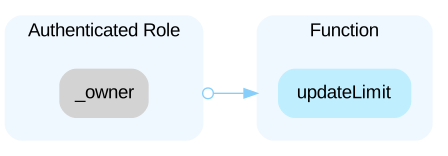 - **updateLimit(address minterAddress_, uint256 limit_)** to update the maximum amount of the native FTN token that an `minterAddress_` is able to withdraw. According to the project design, the native FTN tokens will be initialized to the FTNVault contact in the genesis. In this case, any compromise to the **owner** account may allow a hacker to take advantage of this authority and drain the FTN tokens from the contract **FTNVault**. If the hacker controls the **owner** role, the hacker is able to call the function `updateLimit()` to set the maximum amount of the native FTN token to the hacker's account, then invokes `processBurnTransaction()` to withdraw the native FTN tokens, resulting in severe damage to the project.
Open the reportHighCentralization Related RisksFastex - Token Distribution SC · CertiK · 14 Oct 2022Acknowledged
In the contract `FasttokenDistribution`, the role `FOUNDERS_DISTRIBUTOR_ROLE` has authority over setting and canceling the `Founders` type allocation. Any compromise to the `FOUNDERS_DISTRIBUTOR_ROLE` account may allow a hacker to take advantage of this authority and set or cancel address's `Founders` allocations. In the contract `FasttokenDistribution`, the role `ADVISORS_DISTRIBUTOR_ROLE` has authority over setting and canceling the `Advisors` type allocation. Any compromise to the `ADVISORS_DISTRIBUTOR_ROLE` account may allow a hacker to take advantage of this authority and set or cancel address's `Advisors` allocations. In the contract `FasttokenDistribution`, the role `TOKEN_SALE_DISTRIBUTOR_ROLE` has authority over setting, burning and canceling the `Private1`, `Private2`, `Public`, or `Presale` type allocation. Any compromise to the `TOKEN_SALE_DISTRIBUTOR_ROLE` account may allow a hacker to take advantage of this authority and set, burn or cancel address's `Private1`, `Private2`, `Public`, or `Presale` allocations. In the contract `FasttokenDistribution`, the role `MARKETING_PR_DISTRIBUTOR_ROLE` has authority over setting and canceling the `Marketing` and `Partners` type allocation. Any compromise to the `MARKETING_PR_DISTRIBUTOR_ROLE` account may allow a hacker to take advantage of this authority and set or cancel address's `Marketing` and `Partners` allocations. In the contract `FasttokenDistribution`, the role `ECOSYSTEM_DISTRIBUTOR_ROLE` has authority over setting and canceling the `Ecosystem` type allocation. Any compromise to the `ECOSYSTEM_DISTRIBUTOR_ROLE` account may allow a hacker to take advantage of this authority and set or cancel address's `Ecosystem` allocations. In the contract `FasttokenDistribution`, the role `BLOCKCHAIN_BURN_ROLE` has authority over setting, burning and canceling the `Blockchain` type allocation. Any compromise to the `BLOCKCHAIN_BURN_ROLE` account may allow a hacker to take advantage of this authority and set, burn or cancel address's `Blockchain` allocations. In the contract `FasttokenDistribution`, the role `DEFAULT_ADMIN_ROLE` has authority over the functions setting and revoking roles as well as the following functions: - `refundTokens()` - `refund()` Any compromise to the `DEFAULT_ADMIN_ROLE` account may allow a hacker to take advantage of this authority and change the currently assigned roles and transfer tokens or ether from the contract. In the contract `MultiSigWallet` the role `isOwner` has authority over the functions shown in the diagram below. Any compromise to the `isOwner` account may allow the hacker to take advantage of this authority and affect the status of transactions and confirmations. 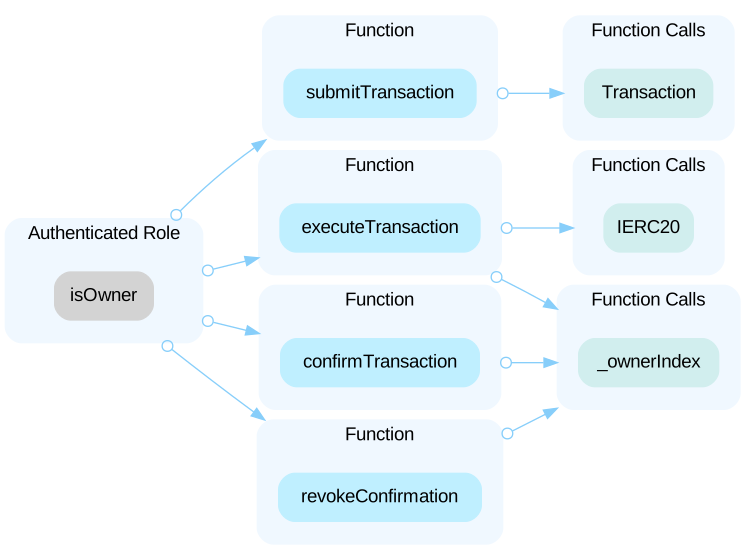
Open the reportLowDiscussion on The Mint Workflow with Function `prBahamut Execution and Consensus · CertiK · 13 Aug 2023Acknowledged
Files: - `bahamut/FTNVault.sol` Commit: - [`1f2392be6927c2227a0061a5c7c9f7c937545971`](https://github.com/fasttoken1/fasttoken-distribution-eth-contracts/tree/1f2392be6927c2227a0061a5c7c9f7c937545971) The contract `FTNVault` serves as a vault of native FTN tokens to redeem the same amount of FTN tokens that the user has burnt on Ethereum. By design, the user burns the FTN token on Ethereum and redeems the same amount of the burnt FTN token from the contract `FTNVault` through the function `processBurnTransaction()` with the burn transaction: ```solidity=64 function processBurnTransaction(bytes32 burnTxHash_, address recipient_, uint256 amount_) external { require(initialized, 'Contract has not been initialized'); require(amount_ <= limits[msg.sender], 'Limit exceeded'); limits[msg.sender] -= amount_; _processBurnTransaction(burnTxHash_, recipient_, amount_); } ``` However, the current implementation seems to miss some logic to validate the burner and amount that is burnt on Ethereum. 1. There is no validation to ensure the passed amount is the amount burnt in the transaction; 2. Similarly, no validation to make sure the user is related to the burner that burns the FTN tokens. The only way is to set the limits to a user via the function `updateLimit()` in a centralized manner; 3. No validation to ensure the passed `burnTxHash_` is actually a burn transaction that happened on Ethereum; Any user that has the limit is able to withdraw all the allowed balance by passing an unused `bytes32`.
Open the reportLowInconsistency Between Implementation And WhitepapBahamut Execution and Consensus · CertiK · 13 Aug 2023Acknowledged
Files: - `beacon-chain/core/helpers/validators.go` Commit: - [`3226f8330911cb8df77e775f0155b335ba771bd8`](https://github.com/fastexlabs/bahamut-consensus/tree/3226f8330911cb8df77e775f0155b335ba771bd8) According to the Fasttoken consensus whitepaper, the $i$-th validator's (denoted as $V_i$) power is defined as: $$ P^e_i = T_e \cdot \frac{s_i}{S} + A^e_{V_i},$$ where - $T_e$ is the sum of all transaction constant gas usage components, that is, $T_e = 21000 ∗ N$ where N is the number of all transactions which have been executed during the epoch $e$. - $s_i$ is the staked amount of the $i$-th validator; - $S$ is the sum of all validators' staked balances; - $A^e_{V_i}$ is the activity score assigned to the validator $V_i$ for the epoch $e$. In the implementation, the $\frac{s_i}{S}$ is assumed that the staked amounts of all the validators are the equal, so it is $\frac{1}{n}$ (n is the number of active validators): ```go transactionsGas := sharedActivity.TransactionsGasPerPeriod / length ``` Moreover, the $T_e$ and $A^e_{V_i}$ is the rolling sum of window size `period` given by the formula ```go effectiveActivity := ((val.EffectiveActivity+activity)*period - val.EffectiveActivity) / period ``` and ```go sharedActivity.TransactionsGasPerPeriod = ((gasPerPeriod+gasPerEpoch)*period - gasPerPeriod) / period ``` , which are not the values in the current epoch $e$.
Open the reportLowMissing Receive FunctionBahamut Execution and Consensus · CertiK · 13 Aug 2023Acknowledged
Files: - `bahamut/FTNVault.sol` Commit: - [`1f2392be6927c2227a0061a5c7c9f7c937545971`](https://github.com/fasttoken1/fasttoken-distribution-eth-contracts/tree/1f2392be6927c2227a0061a5c7c9f7c937545971) The contract `FTNVault.sol` serves as a vault of native FTN tokens to redeem the same amount of FTN tokens that the user has burnt on Ethereum. However, no receive, fallback, or any payable function is implemented in the contract to accept the native FTN tokens. In this case, there is no FTN token in the vault except for tokens obtained from the self-destruct of other contracts or before the deployment. Both methods do not align with the current design because the amount of native FTN tokens is determined by the burnt amount on Ethereum.
Open the reportLowPotential Initialization By FrontrunnerBahamut Execution and Consensus · CertiK · 13 Aug 2023Acknowledged
Files: - `bahamut/FTNVault.sol` Commit: - [`1f2392be6927c2227a0061a5c7c9f7c937545971`](https://github.com/fasttoken1/fasttoken-distribution-eth-contracts/tree/1f2392be6927c2227a0061a5c7c9f7c937545971) In the contract `FTNVault`, the function `initialize()` can be called by anyone due to no access restriction, which enables anyone to initialize the contract, and gain ownership of the contract. Malicious users could observe the pending transaction which will execute the `initialize()` function in the mempool, and launch a similar transaction to front-run the pending transaction. ```solidity=43 function initialize(bytes32 burnTxHash_) public { require(!initialized, 'Contract has already been initialized'); initialized = true; _transferOwnership(msg.sender); burnTransactionHashes[burnTxHash_] = true; uint256 amount = 1000 * 10**18; emit BurnTransactionProcessed(burnTxHash_, msg.sender, amount); } ``` In the case that the contract has some native FTN tokens after the deployment, then the malicious users that control the contract will be able to drain the contract via the functions `updateLimit()` and `processBurnTransaction()`.
Open the reportContracts
No deployed address is recorded for these audits.
The reports name a repository or files. Open a report to see its scope.
Show this on your site
Is this your project? Show this record on your own website. The label states what the record holds, links to this page and updates by itself. It is free and needs no sign-in.
Content
Automatic: the three strongest facts of this project’s own record (its last audit and two more), highlighted. They update with the record. Picking a fact turns Automatic off.
Style
Format
<head><script src="https://widget.trustblock.run/project-widget.min.js" defer></script></head><body><divdata-tb-project-widgetdata-tb-project-slug="bahamut"></div></body>
Paste the code where the label should appear. It uses no API credit and updates by itself.
Something wrong on this page? A missing report, a wrong date, a finding that was fixed since. Tell us and we check it against its source.
Tell us