
BXN audit reports
BXN has 2 public audit reports from CertiK; the latest is CertiK, 31 Oct 2024; 8 critical findings, all marked fixed by the firms.
Last updated . It holds audits and findings, contracts and incidents up to Nov 2026. Trustblock does not review code.
Open findings across every firm7
Statuses are the security firms’ own
7 findings are still open or acknowledged in the firms’ reports: 2 high, 1 medium, 4 low (6 open, 1 acknowledged).
- High
- 2
- Medium
- 1
- Low
- 4
- High Acknowledged
Centralization Related Risks
Blackfort Exchange Network - Audit 2 · CertiK · 31 Oct 2024 · Report ↗
- High Open
Centralization Related Risks
BlackFort Group · CertiK · 13 Oct 2022 · Report ↗
- Medium Open
No Validation for String input in `approve()`
BlackFort Group · CertiK · 13 Oct 2022 · Report ↗
- Low Open
Check Effect Interaction Pattern Violated
BlackFort Group · CertiK · 13 Oct 2022 · Report ↗
- Low Open
Logic issue when adding users to candidates
BlackFort Group · CertiK · 13 Oct 2022 · Report ↗
- Low Open
Non-adherence to `AccessControl` instructions
BlackFort Group · CertiK · 13 Oct 2022 · Report ↗
- Low Open
Underflow Vulnerability through use of signed int
BlackFort Group · CertiK · 13 Oct 2022 · Report ↗
Audits2
Newest first
| Report | Security firm | Date | Scope | Critical findings | Findings | Source |
|---|---|---|---|---|---|---|
| Blackfort Exchange Network - Audit 2 | Security firm: CertiK | Date: | Scope: Files listed | 5 critical findings, fixed | Findings: 5 critical · 11 high · 2 medium · 16 low 33 fixed · 1 acknowledged | skynet.certik.com ↗ |
| BlackFort Group | Security firm: CertiK | Date: | Scope: Files listed | 3 critical findings, fixed | Findings: 3 critical · 3 high · 6 medium · 37 low 43 fixed · 6 open | skynet.certik.com ↗ |
Findings83
Statuses are the security firm’s own, from each report.
| Severity | Open | Acknowledged | Fixed |
|---|---|---|---|
| Critical | 0 | 0 | 8 |
| High | 1 | 1 | 12 |
| Medium | 1 | 0 | 7 |
| Low | 4 | 0 | 49 |
HighCentralization Related RisksBlackFort Group · CertiK · 13 Oct 2022Open
In the contract `AccessControlHub` the role `DEFAULT_ADMIN_ROLE_ADDRESS` has authority over the functions shown in the diagram below. Any compromise to the `DEFAULT_ADMIN_ROLE_ADDRESS` account may allow the hacker to take advantage of this authority and change the address for privileged roles such as `ACCESS_CONTROL_MANAGER_ROLE`, and any of the roles in contracts that inherit from `SystemAccess` contract. In addition, any compromise to the `ACCESS_CONTROL_MANAGER_ROLE` account may allow the hacker to enable or disable the `transfer()` function for certain contracts.  In the contract `System.sol`, any compromise to the `SYSTEM_MANAGER_ROLE` account may allow the hacker to approve any account to use the `transferTo()` function to send any amount of native token to an address of their choosing. Additionally, an address with the `VOTE_MINT_ROLE` can use this same function to mint any amount of `VoteHub` tokens to any address. In the contract `NodeHub`, any compromise to the `NODE_MANAGER_ROLE` account may allow the hacker to set `_baseTokenURI` to any string and use the `lock()` and `unlock()` functions on the underlying token to prevent transfers. In the contract `PollHub` the role `_owner` has authority over the functions shown in the diagram below. Any compromise to the `_owner` account may allow the hacker to take advantage of this authority, modify the information of poll such as its poll options and its deadline. Note that the `_owner` in this case refers to the owner of the specified `tokenId` representing a poll. Each instance of a poll represents a centralization risk. In addition, any compromise to the `POLL_MANAGER_ROLE` account may allow the hacker to reset `_baseTokenURI` and change a poll's price and fee to an unwanted amount. 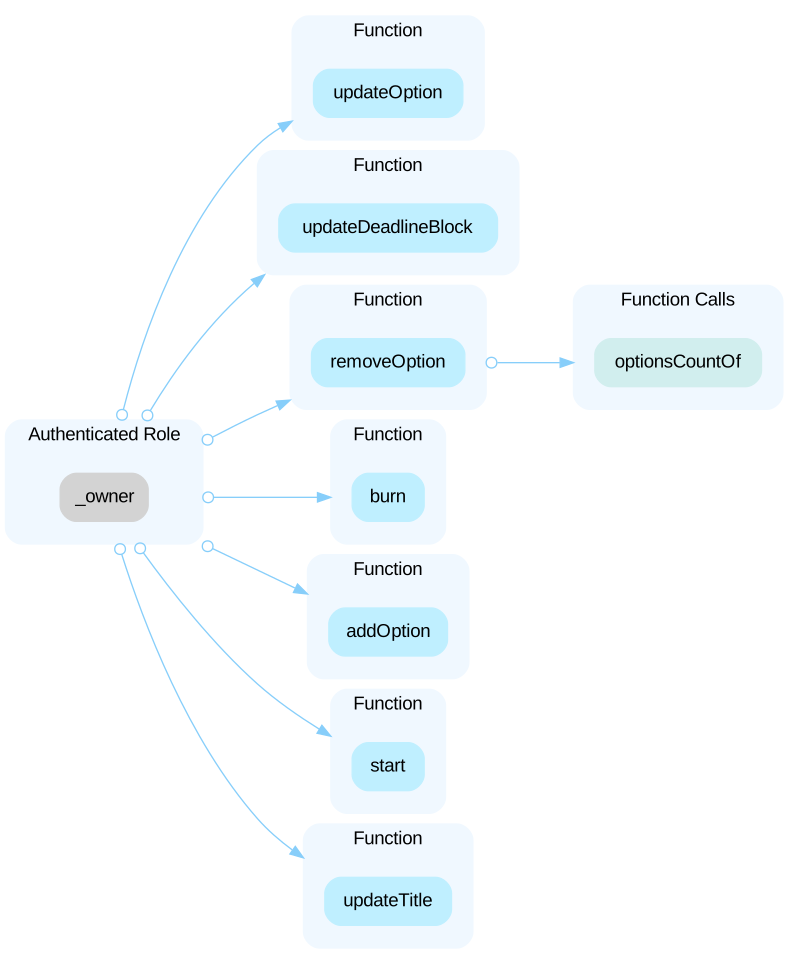 In the contract `BXP20SystemRewardToken` the role `SYSTEM_CONTRACT_ADDRESS` has authority over the functions shown in the diagram below. Any compromise to the `SYSTEM_CONTRACT_ADDRESS` account may allow the hacker to take advantage of this authority and mint any amount of tokens to any address within the contracts that inherit from this base; that is the `DelegatorHub` and `ValidatorHub` contracts 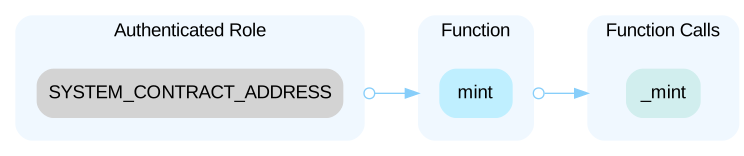 In the contract `BXP20Asset`, which inherits from the contract `BlackList`, any compromise to the `ASSET_BLACKLIST_MANAGER_ROLE` account may allow the hacker to add addresses to the blacklist. The contract `BXP20Asset` also inherits from the contract `Manageable`; any compromise to the `ASSET_MANAGER_ROLE` account may allow the hacker to mint and burn any amount of tokens for any address. The role `VALIDATOR_MANAGER_ROLE` has control over several contracts. In the contract `CandidateHub`, any compromise to the `VALIDATOR_MANAGER_ROLE` account may allow a hacker to add candidates to the validator set, remove candidates maliciously and set `requiredAmount` to any amount. In the contract `SlashingHub`, compromise to this role allows a hacker to use the `slash()` function to penalize rewards for a validator address. In the contract `ValidatorHub`, this may also allow the hacker to use the function `kick()` to remove any validator from the list. In the contract `VoteHub`, any compromise to the `VOTE_MINT_ROLE` account may allow the hacker to mint any amount of `VoteHub` tokens to any account and any compromise to the `VOTE_BURN_ROLE` account may allow the hacker to burn any amount of `VoteHub` tokens. In addition, any compromise to the `VOTE_SPENDER_ROLE` may allow the hacker to spend all the `VoteHub` tokens belonging to any account.
Open the reportMediumNo Validation for String input in `approve()`BlackFort Group · CertiK · 13 Oct 2022Open
In the `approve()` function, an address has an associated string input `name` that the `account` address is associated to in the mapping `_accounts`. There is no validation check that that the mapping `_accounts` for entry `name` is already occupied. From context, it appears the `approve()` function assigns a contract `name` to in-house contracts addresses, to be used for validation checks in other contracts. If an externally owned address is approved through this function, the address can directly interact with the `transferTo()` address, which sends out native BXN tokens to specified addresses. Moreover, any updates to the address corresponding to a given `name` using the `approve()` function causes the previous address to immediately lose privileged access. Lastly, there is no check that the input `name` is a mapping that is used within other contracts. If the `name` is incorrectly input, then the corresponding checks using the `onlyContract` modifier will not allow a contract to interact.
Open the reportLowCheck Effect Interaction Pattern ViolatedBlackFort Group · CertiK · 13 Oct 2022Open
The order of external calls or transfers and storage manipulation must follow the check-effect-interaction pattern to keep contract logic safe from exploitation. ### External call(s) ```solidity=45 ValidatorHub.join{value:amount}(account); ``` ### State variables written after the call(s) ```solidity=46 _candidatesBonds[account] = _candidatesBonds[account].sub(amount); ``` --- ### External call(s) ```solidity=169 VoteHub.mint(owner, nodePrice.div(100)); ``` ### State variables written after the call(s) ```solidity=180 amount = amount.sub(nodePrice); ``` --- ### External call(s) ```solidity=244 delegate(address(0), tokenId); ``` * This function call executes the following external call(s). * In `NodeHub.delegate`, * `DelegatorHub.burnExtraFor(tokenId)` * In `NodeHub.delegate`, * `DelegatorHub.decreaseDelegatedAmountFor(currentValidator,tokenId)` * In `NodeHub.delegate`, * `DelegatorHub.increaseDelegatedAmountFor(validatorAddress,tokenId)` * This call sends Ether. ```solidity=247 _burnFrom(from, reward - burnedByFrom); ``` * This function call executes the following external call(s). * In `NodeHub._burnFrom`, * `_getSystemContractInstance().transferTo(owner,amount)` * This call sends Ether. ### State variables written after the call(s) ```solidity=253 super._beforeTokenTransfer(from, to, tokenId); ``` * This function call executes the following assignment(s). * In `BXP721Enumerable._addTokenToAllTokensEnumeration`, * `_allTokens.push(tokenId)` * In `BXP721Enumerable._removeTokenFromAllTokensEnumeration`, * `_allTokens[tokenIndex] = lastTokenId` * In `BXP721Enumerable._removeTokenFromAllTokensEnumeration`, * `_allTokens.pop()` ```solidity=253 super._beforeTokenTransfer(from, to, tokenId); ``` * This function call executes the following assignment(s). * In `BXP721Enumerable._addTokenToAllTokensEnumeration`, * `_allTokensIndex[tokenId] = _allTokens.length` * In `BXP721Enumerable._removeTokenFromAllTokensEnumeration`, * `_allTokensIndex[lastTokenId] = tokenIndex` * In `BXP721Enumerable._removeTokenFromAllTokensEnumeration`, * `delete _allTokensIndex[tokenId]` ```solidity=253 super._beforeTokenTransfer(from, to, tokenId); ``` * This function call executes the following assignment(s). * In `BXP721Enumerable._addTokenToOwnerEnumeration`, * `_ownedTokensIndex[tokenId] = length` * In `BXP721Enumerable._removeTokenFromOwnerEnumeration`, * `_ownedTokensIndex[lastTokenId] = tokenIndex` * In `BXP721Enumerable._removeTokenFromOwnerEnumeration`, * `delete _ownedTokensIndex[tokenId]` --- ### External call(s) ```solidity=54 (bool result,) = account.call{value:amount}(""); ``` ### State variables written after the call(s) ```solidity=56 _candidatesBonds[account] = _candidatesBonds[account].sub(amount); _candidates.remove(account); ``` --- ### External call(s) ```solidity=173 VoteHub.burn(msg.sender, amountOfVote.sub(fee)); VoteHub.transferFrom(msg.sender, ownerOf(tokenId), fee); VoteHub.burn(ownerOf(tokenId), fee); ``` ### State variables written after the call(s) ```solidity=177 _pollVoteAmount[tokenId][optionId] = _pollVoteAmount[tokenId][optionId].add(amountOfVote); _pollTotalVoteAmount[tokenId] = _pollTotalVoteAmount[tokenId].add(amountOfVote); ```
Open the reportLowLogic issue when adding users to candidatesBlackFort Group · CertiK · 13 Oct 2022Open
A user can send the `requiredAmount` of BXN to the contract `CandidateHub` to become a candidate. Since the function `receive()` only checks the identity of a validator, candidates can trigger this function more than once. Although the validation on sent value `amount` is to check the cumulative total amount sent from a user, `_candidatesBonds[account]` is actually equal to 0 when a user triggers the function for the first time, meaning that a user has to pay at least the `requiredAmount` of BXN the first time. After that, they can send any amount they want to increase their bonds while adding a user to a candidate would be performed multiple times with `false` returned each time. We speculate that this validation is supposed to allow the user to send tokens multiple times before becoming a candidate until the required number is reached at which point, they will be added to the candidates set. ```solidity=25 receive() external payable { address account = msg.sender; uint256 amount = msg.value; IValidatorHub ValidatorHub = IValidatorHub(_getAddressOf("VALIDATOR_HUB")); require(!ValidatorHub.isValidator(msg.sender), "CandidateHub: you're already validator"); require( _candidatesBonds[account].add(amount) >= requiredAmount, "CandidateHub: you don't have enough amount of tokens to become candidate" ); _candidates.add(account); _candidatesBonds[account] = _candidatesBonds[account].add(amount); } ```
Open the reportLowNon-adherence to `AccessControl` instructionsBlackFort Group · CertiK · 13 Oct 2022Open
The method for checking an address has a role is set up to use a string input in the function `hasRole()` within `SystemAccess`. This function calls into `AccessControlHub` which inherits from OpenZeppelin's `AccessControl` contract. The function `hasStringRole()` in `AccessControlHub` calls `hasRole()` from `AccessControl` by first taking the string input `role`, converting it to bytes, then applying `keccak256` hash to the outcome. This method is inefficient since this conversion must take place each time a privileged role is checked in a contract that inherits from `SystemAccess`. Worse, there could be unforeseen vulnerabilities as a result of bypassing the instructions for set up in `AccessControl`.
Open the reportLowUnderflow Vulnerability through use of signed intBlackFort Group · CertiK · 13 Oct 2022Open
The `balanceOf()` function is overridden from the base `BXP20` contract, where the balance is calculated by first adding the amount minted and amount recorded in `_balances` for an account as signed integers. This value is converted to an unsigned integer and the amount burned by the address is subtracted. If the contract logic allows for the absolute value of `_balances[account]` to be larger than the value of `mintedBy(account)` while `_balances[account]` is a negative value, this will lead to an underflow. Consider the following set up: Let `_balances[account]` = -2 and `mintedBy(account)` = 1. The sum of the two values is -1 and when that value is converted to an unsigned integer, it causes an underflow, reading the value as 2^256 - 1 instead. The account accomplishing this now has access to an amount larger than what they actually own.
Open the reportContracts
No deployed address is recorded for these audits.
The reports name a repository or files. Open a report to see its scope.
BXN: questions
Is BXN audited?
Trustblock holds 2 public audit reports for BXN, dated 13 Oct 2022 to 31 Oct 2024. The latest is by CertiK (“Blackfort Exchange Network - Audit 2”).
Who audited BXN?
CertiK wrote the 2 reports Trustblock holds for BXN.
Are there open findings in BXN’s audits?
7 findings are still open or acknowledged in the firms’ reports: 2 high, 1 medium, 4 low (6 open, 1 acknowledged). Of 8 critical findings: all marked fixed by the firms. Statuses are the security firms’ own.
Show this on your site
Is this your project? Show this record on your own website. The label states what the record holds, links to this page and updates by itself. It is free and needs no sign-in.
Content
Automatic: the three strongest facts of this project’s own record (its last audit and two more), highlighted. They update with the record. Picking a fact turns Automatic off.
Style
Format
<head><script src="https://widget.trustblock.run/project-widget.min.js" defer></script></head><body><divdata-tb-project-widgetdata-tb-project-slug="blackfort-exchange-network"></div></body>
Paste the code where the label should appear. It uses no API credit and updates by itself.
Something wrong on this page? A missing report, a wrong date, a finding that was fixed since. Tell us and we check it against its source.
Tell us