
Valinity security record
As of 3 Nov 2026, Valinity has 4 audit reports by 1 security firm on Trustblock; the latest is by CertiK, dated 23 Oct 2023. Those reports list no open critical findings.
Record last updated . It holds audits, findings and contracts up to Nov 2026, and incidents up to Oct 2026. Trustblock does not review code.
Audits4
Newest first
| Audit | Security firm | Date | Scope | Critical findings | Report |
|---|---|---|---|---|---|
| Valinity Contract Audit | Security firm: CertiK | Date: | Scope: Files named in the report | No open critical findings | Open · skynet.certik.com |
| Valinity Audit | Security firm: CertiK | Date: | Scope: Files named in the report | No open critical findings | Open · skynet.certik.com |
| Valinity Formal Verification | Security firm: CertiK | Date: | Scope: Files named in the report | No open critical findings | Open · skynet.certik.com |
| Valinity Application | Security firm: CertiK | Date: | Scope: Not recorded (see the report) | No open critical findings | Open · skynet.certik.com |
Findings29
Statuses are the security firm’s own, from each report.
| Severity | Open | Acknowledged | Fixed |
|---|---|---|---|
| Critical | 0 | 0 | 0 |
| High | 2 | 0 | 3 |
| Medium | 1 | 0 | 4 |
| Low | 9 | 0 | 10 |
HighCentralization Related RisksValinity Contract Audit · CertiK · 23 Oct 2023Open
In the contract `RegistrarMigrator` the role `_adminAgents` has authority over the functions shown in the diagram below. Any compromise to the `_adminAgents` account may allow the hacker to take advantage of this authority and start migrating tokens. 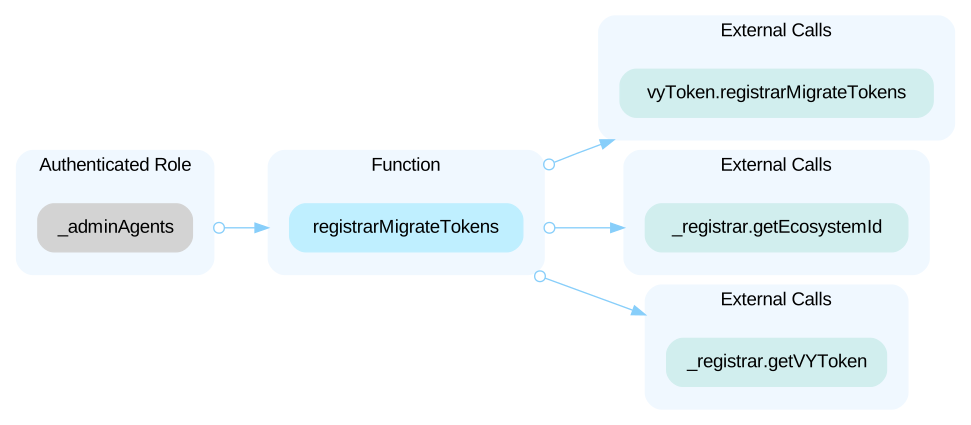 ----- In the contract `VETHReverseStakingTreasury` the role `_adminGovAgents` has authority over the function shown in the diagram below. Any compromise to the `_adminGovAgents` account may allow the hacker to take advantage of this authority and migrate tokens to another address. 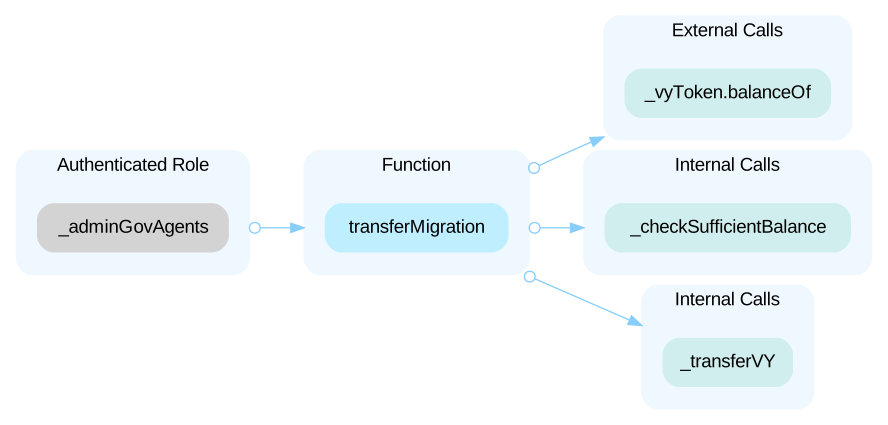 In the contract `VETHReverseStakingTreasury` the role `_backendAdminAgents` has authority over the functions shown in the diagram below. Any compromise to the `_backendAdminAgents` account may allow the hacker to take advantage of this authority and set the initial reverse stake term and the maximum reverse stakes for an address. 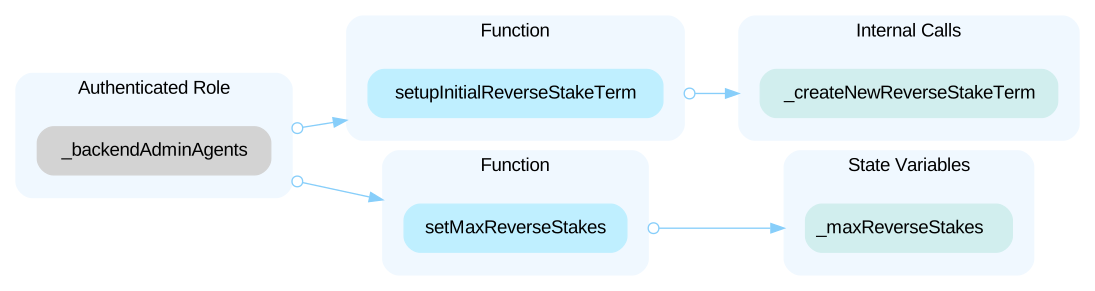 In the contract `VETHReverseStakingTreasury` the role `_backendAgents` has authority over the functions shown in the diagram below. Any compromise to the `_backendAgents` account may allow the hacker to take advantage of this authority and close offers, burn accrued VY tokens, and migrate reverse stakes. 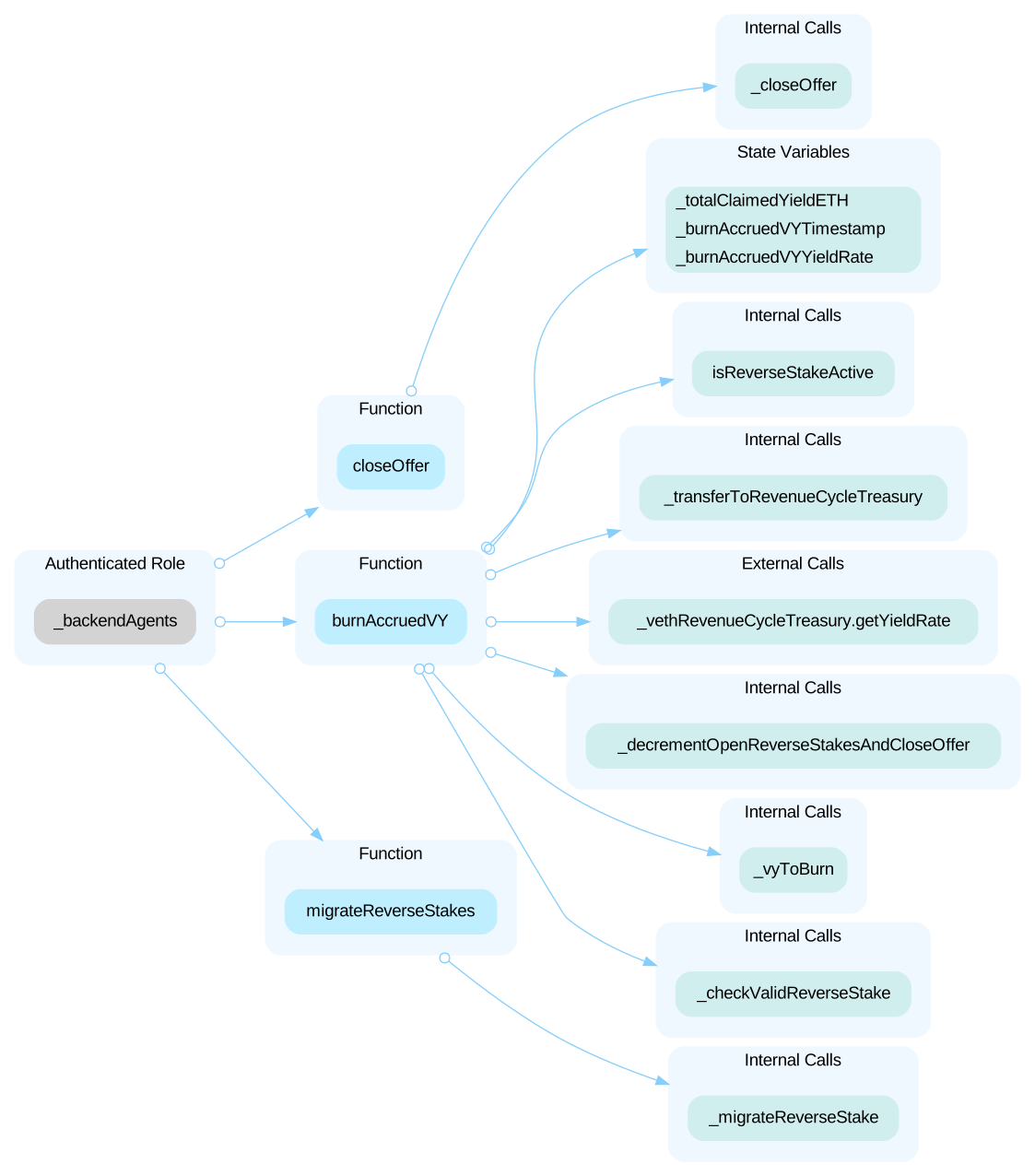 In the contract `VETHReverseStakingTreasury` the role `_governance` has authority over the functions shown in the diagram below. Any compromise to the `_governance` account may allow the hacker to take advantage of this authority and set the migration address and create a new reverse stake term. 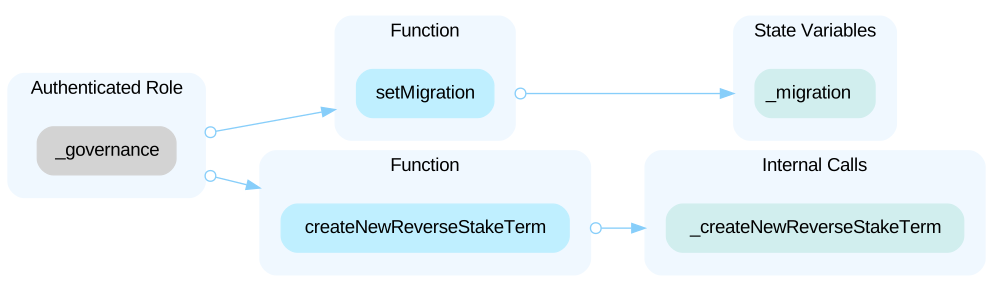 In the contract `VETHReverseStakingTreasury` the role `_registrar` has authority over the function shown in the diagram below. Any compromise to the `_registrar` account may allow the hacker to take advantage of this authority and update critical addresses. 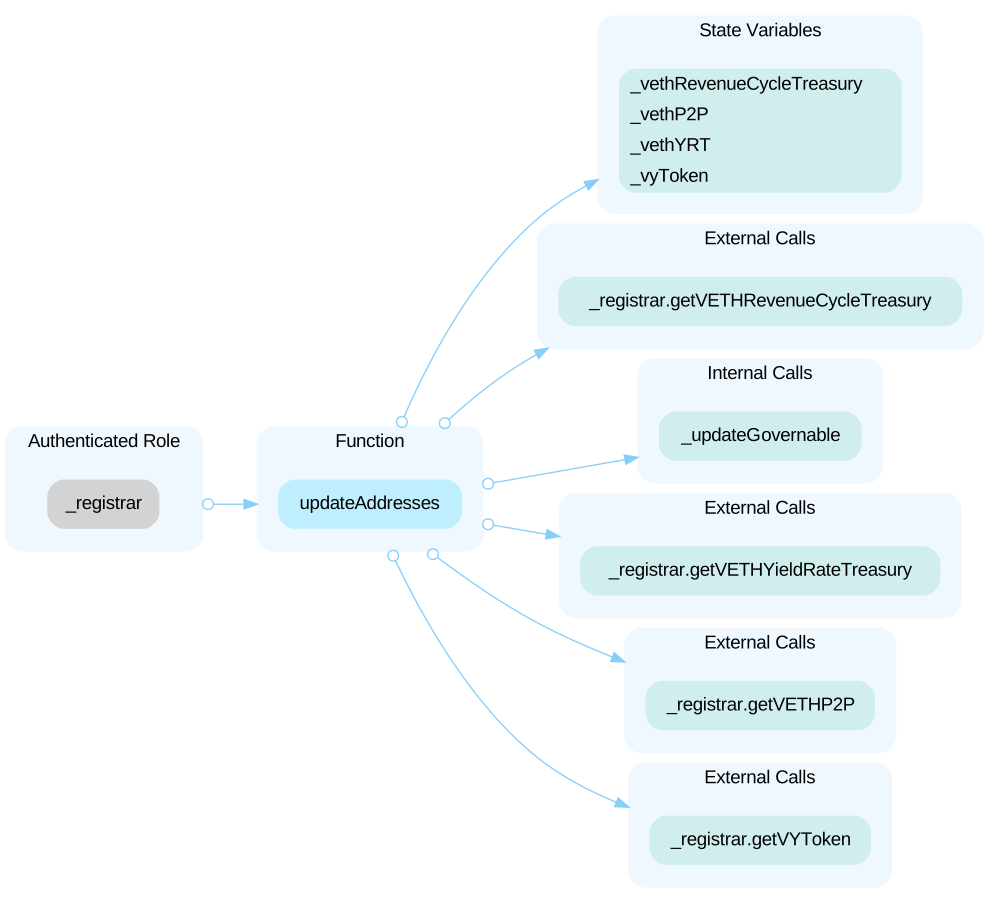 ----- In the contract `BackendAgent` the role `_backendAdminAgents` has authority over the functions shown in the diagram below. Any compromise to the `_backendAdminAgents` account may allow the hacker to take advantage of this authority and grant and revoke the `_backendAgents` role. 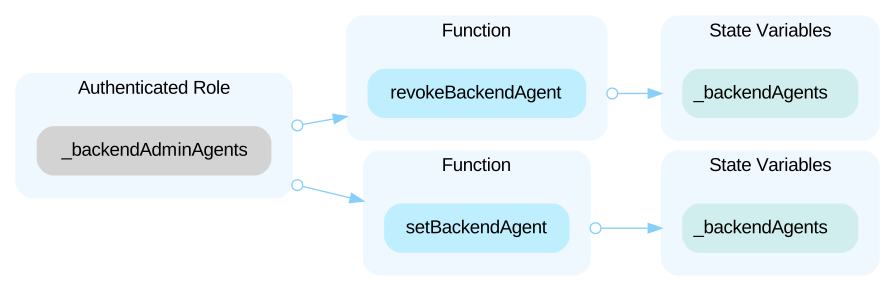 ----- In the contract `VETHP2P` the role `_backendAgents` has authority over the function shown in the diagram below. Any compromise to the `_backendAgents` account may allow the hacker to take advantage of this authority and close offers. 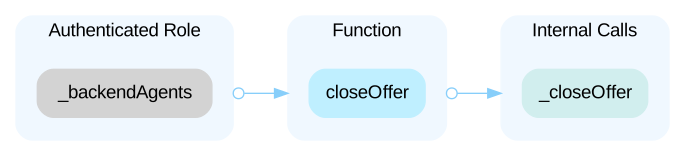 In the contract `VETHP2P` the role `_registrar` has authority over the functions shown in the diagram below. Any compromise to the `_registrar` account may allow the hacker to take advantage of this authority and update the `_vethRevenueCycleTreasury` and initiate the trading pairs. 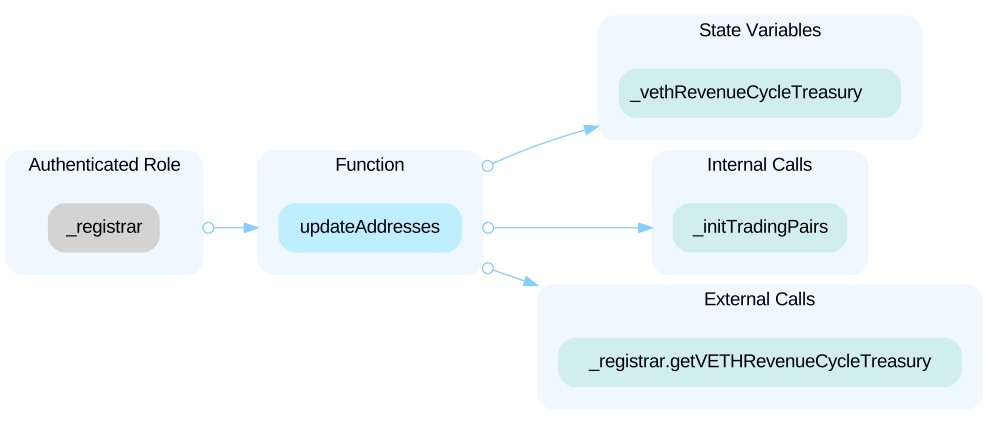 ----- In the contract `VETHRevenueCycleTreasury` the role `_adminGovAgents` has authority over the function shown in the diagram below. Any compromise to the `_adminGovAgents` account may allow the hacker to take advantage of this authority and migrate tokens to another address. 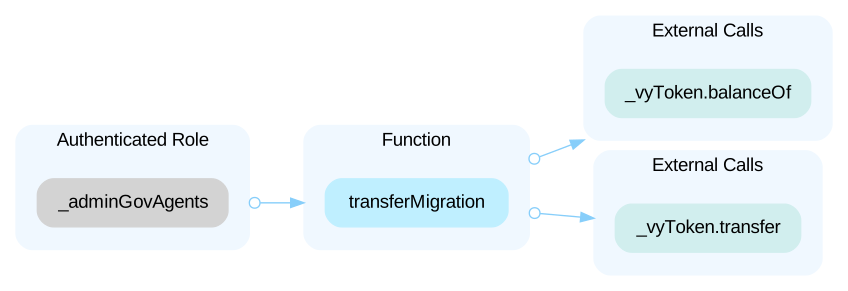 In the contract `VETHRevenueCycleTreasury` the role `_backendAgents` has authority over the functions shown in the diagram below. Any compromise to the `_backendAgents` account may allow the hacker to take advantage of this authority and create and close offers. , only 90 tokens actually arrived to the contract. However, a failure to discount such fees may allow the same user to withdraw 100 tokens from the contract, which causes the contract to lose 10 tokens in such a transaction. With the `VY Token`, if neither the sender nor the receiver is designated as an "agent", the token applies its fee. Within the `VETHP2P` contract, the `createOffer()` function triggers a token transfer, potentially leading to the contract receiving less tokens than expected. If these deductions persist, the contract may lack the necessary balance for functions such as `tradeOffer()`. Reference: https://thoreum-finance.medium.com/what-exploit-happened-today-for-gocerberus-and-garuda-also-for-lokum-ybear-piggy-caramelswap-3943ee23a39f ```solidity=126 _createOffer(tradingPair, quantity, price); ``` - Transferring tokens by `quantity`. - This function call executes the following operation. ```solidity=125 makerAsset.permit(_msgSender(), address(this), quantity, v, r, s); ``` ```solidity=145 if (tradingPair == TradingPairs.VY_ETH) { ERC20 token = _getSpendingTokenAndCheck(_tradingPairs[tradingPair].makerAssetAddress, quantity); token.transferFrom(_msgSender(), address(this), quantity); } ``` - The `quantity` appears to be used for bookkeeping purposes without compensating the potential transfer fees. The same issue also applies to `VETHRevenueCycleTreasury` and `VETHReverseStakingTreasury`.
Open the reportLowGovernance Manipulation - Denial of Service (DoS)Valinity Contract Audit · CertiK · 23 Oct 2023Open
A denial-of-service (DoS) attack overwhelms a system, rendering it inaccessible to intended users. In the context of smart contracts, DoS exploits vulnerabilities in the contract's logic or design, hindering its functions, potentially locking up funds or disrupting its normal operations. The `VETHGovernance` contract governs essential operations related to address updates and asset migration. An "_adminGovAgents" account can start a proposal, which is subsequently subjected to a voting process where token holders cast their votes. When a proposal expires and the half or more votes are 'yes', any of the "_adminGovAgents" can execute the proposal. A feature of the design is that the execution function can only execute the current proposal (for instance, when the proposal nonce is at 1). This leaves a vulnerability that makes it susceptible to DoS attacks. If an "_adminGovAgents" account is compromised, an attacker could exploit this by deliberately submitting a new proposal (with a higher nonce) before a previously approved proposal (with a lower nonce) gets executed. This vulnerability can lead to a denial of service attack on the governance system, effectively freezing any proposal that the attacker does not want to be executed. This malicious activity can cause delays in essential governance actions, creating system-wide inefficiencies, and undermining the credibility of the governance mechanism.
Open the reportLowMiscalculation of Max HoldingValinity Contract Audit · CertiK · 23 Oct 2023Open
The transaction may be charged fees, so the max holding of the receiver should be the sum of the held tokens and the amount received from the transfer. The fees should not be included in the max holding. ```solidity=121 uint256 fee = _calculateTransferFee(sender, recipient, amount); ``` - Receiving amount is adjusted. ```solidity=234 _balances[to] += amount; ``` - Balance is increased by the adjusted amount. --- ```solidity=352 require(_vyToken.balanceOf(address(this)) + stakedVY <= circulation, "Total staked VY cannot exceed circulation"); ``` - Max holding is checked. ```solidity=127 super.transferFrom(sender, recipient, amount - fee); // transfers amount - fee to recipient ``` - Receiving amount is adjusted. ```solidity=234 _balances[to] += amount; ``` - Balance is increased by the adjusted amount.
Open the reportLowNo Upper Limit for Fee RatesValinity Contract Audit · CertiK · 23 Oct 2023Open
The `VYToken` contract allows for the setting of the transfer fee rate without an upper limit. This design flaw enables setting the transfer fee to any arbitrary value, up to 100%, which exposes the token holders to severe financial risk and makes the token susceptible to becoming a honeypot. ```solidity=139 function setTransferFee(uint256 fee) external onlyAdminAgents { _transferFee = fee; } ```
Open the reportLowPotential Reentrancy RiskValinity Contract Audit · CertiK · 23 Oct 2023Open
A reentrancy attack can occur when the contract creates a function that makes an external call to another untrusted contract before resolving any effects. If the attacker can control the untrusted contract, they can make a recursive call back to the original function, repeating interactions that would have otherwise not run after the external call resolved the effects. In the `_tradeOffer()` function, once an offer's ETH quantity falls below the threshold defined by `MINIMUM_AUTOCLOSE_IN_ETH`, it should ideally no longer be available for trading. However, the possibility of reentrancy emerges due to the external calls made by the `_transfer()` function on lines 229 and 230. This call will trigger the `receive()` function within the caller's address, in which a malicious caller could make a recursive call back to `tradeOffer()` before the state change of contract has been finalized. This vulnerability might also result in events being emitted out of sequence, with subsequent trades broadcasting events prior to initial trades. ```solidity=191 function _tradeOffer(uint256 id, address seller, uint256 quantity) private returns (TradeOfferCalcInfo memory) { TradingPair memory tradingPair = _tradingPairs[_offers[seller][id].tradingPair]; uint256 maxInput = _offers[seller][id].quantity * _offers[seller][id].price / MULTIPLIER; require(quantity <= maxInput, "Not enough to sell"); /// @dev returns maker quantity fulfilled by this trade TradeOfferCalcInfo memory calc = _calcTradeOffer(tradingPair, quantity, _offers[seller][id].price); // Update offer quantity require(_offers[seller][id].quantity >= calc.amountOut, "Bad calculations"); _offers[seller][id].quantity -= calc.amountOut; // VY_ETH trade if (tradingPair.takerAssetAddress == address(0)) { ERC20 makerAsset = ERC20(tradingPair.makerAssetAddress); // Transfer taker ETH _transfer(seller, calc.makerReceives); _ethComptroller.route{ value: calc.makerFee }(); // Transfer maker VY makerAsset.transfer(_msgSender(), calc.takerReceives); makerAsset.transfer(tradingPair.makerTreasuryAddress, calc.takerFee); } else { // ETH_VY trade ERC20 takerAsset = _getSpendingTokenAndCheck(tradingPair.takerAssetAddress, quantity); /** * Transfer taker VY * * @dev the code below transfers makerReceives from taker to contract, then from contract to maker * instead of transferring makerReceives directly from taker to maker, is to avoid user transfer fee * being applied to (See ticket-296 for more info) */ takerAsset.transferFrom(_msgSender(), address(this), calc.makerReceives); takerAsset.transfer(seller, calc.makerReceives); takerAsset.transferFrom(_msgSender(), tradingPair.takerTreasuryAddress, calc.makerFee); // Transfer maker ETH _transfer(_msgSender(), calc.takerReceives); _ethComptroller.route{ value: calc.takerFee }(); } // ETH_VY market - selling amount in ETH < MINIMUM_AUTOCLOSE_IN_ETH bool makerCloseout = (tradingPair.makerAssetAddress == address(0) && _offers[seller][id].quantity < MINIMUM_AUTOCLOSE_IN_ETH); // VY_ETH market - converted selling amount in VY to ETH < MINIMUM_AUTOCLOSE_IN_ETH bool takerCloseout = (tradingPair.takerAssetAddress == address(0) && _offers[seller][id].quantity * _offers[seller][id].price / MULTIPLIER < MINIMUM_AUTOCLOSE_IN_ETH); if (makerCloseout || takerCloseout) { _closeOffer(id, seller); // Auto-close when selling amount in ETH < MINIMUM_AUTOCLOSE_IN_ETH } emit TradeOffer(id, _msgSender(), calc.amountOut, quantity, _offers[seller][id].quantity, block.timestamp); return calc; } ```
Open the reportLowThird-Party DependenciesValinity Contract Audit · CertiK · 23 Oct 2023Open
In the current contract logic, when doing the `VY_ETH` trade, the `primaryStakeholder` address (defined in `Router.sol`) need to receive native tokens as fees. If this address is malicious contract or have incorrectly implemented the payment receive feature, it can cause the contracts "VETHP2P" ,"VETHReverseStakingTreasury", and "VETHRevenueCycleTreasury" to malfunction (e.g. TradeOffer transaction may revert). The implementation of all the "primaryStakeholder" instances is out of the scope of the audit.
Open the reportLowDelay between offer creation and executionValinity Formal Verification · CertiK · 15 Dec 2022Open
The floor price is supposed to increase or stay the same after the `tradeOffer()` function call. However, some time can elapse between the creation of an offer and the invocation of `tradeOffer`, which allowes for a scenario where the execution of `tradeOffer()` would bring down the floor price. Let's assume that `createOffer()` was called when the floor price was `x` with `price = 2*x`. Then the floor price increased and went above `2*x`. At this point, when the floor price is greater than `2*x`, if the function `tradeOffer()` is called, it would bring down the value of the floor price. Therefore, it is not possible to formally verify that the floor price is nondecreasing, except by making an assumption that the price at the time of the trade is still above the floor.
Open the reportLowInsecure bucket configurationValinity Application · CertiK · 28 Oct 2022Open
During testing the testers found many bucket configuration issues with the `My Freedom Coin` project. The following problems exist. - Bucket Access Logging Disabled - Bucket Allowing Clear Text (HTTP) Communication - Bucket without Default Encryption Enabled - Bucket without MFA Delete - Bucket without Versioning
Open the reportShow 2 more
LowRoot Account without Hardware MFAValinity Application · CertiK · 28 Oct 2022Open
A hardware MFA device generates a six-digit numeric code based upon a time-synchronized one-time password algorithm. The user must type a valid code from the device when prompted during the sign-in process. Each MFA device assigned to a user must be unique; a user cannot type a code from another user's device to be authenticated.
Open the reportLowSensitive Information Disclosed in MemoryValinity Application · CertiK · 28 Oct 2022Open
The mnemonics and password for wallets as well as other sensitive information are still available in memory even after the user logs out of the application. This allows for an attacker with physical access to the user's system to access the memory and steal the session token. The clear text-sensitive information and PII in the memory should be reset after it is used or after the user logs out of the application.
Open the reportContracts
No deployed address is recorded for these audits.
The reports name a repository or files. Open a report to see its scope.
Show this on your site
Is this your project? Show this record on your own website. The label states what the record holds, links to this page and updates by itself. It is free and needs no sign-in.
Content
Automatic: the three strongest facts of this project’s own record (its last audit and two more), highlighted. They update with the record. Picking a fact turns Automatic off.
Style
Format
<head><script src="https://widget.trustblock.run/project-widget.min.js" defer></script></head><body><divdata-tb-project-widgetdata-tb-project-slug="valinity"></div></body>
Paste the code where the label should appear. It uses no API credit and updates by itself.
Something wrong on this page? A missing report, a wrong date, a finding that was fixed since. Tell us and we check it against its source.
Tell us